The best single origin coffee beans in India come from named estates in four regions — and the right bag depends less on the region than on how you brew and whether you drink it black. Short answer: Blue Tokai Attikan Estate is the best single origin to buy first (₹651 for 250 g on Amazon, bright and cocoa-finished, works in every brewer) — and at ₹39.06 a cup it is also the cheapest cup here; Savorworks Riverdale is the best-value bag here at ₹40.50 a cup; Araku Grand Reserve is the premium pick at ₹940, the brightest cup and the strongest published rating in this guide (4.8★ from 52 reviews on its own store). We checked every price below on 14 November 2026 — on each roaster’s own store, and on Amazon for Attikan, Araku and Third Wave — and worked out the per-100 g and per-cup cost of each bag — because 250 g pouches hide the real price. For the story behind the brand behind three of these bags, read the Blue Tokai coffee story — how a bedroom roaster in Delhi became India’s biggest specialty coffee brand.
One honest note: two estates we set out to include are not buyable today — Blue Tokai no longer sells Thogarihunkal Estate, Third Wave no longer sells Baarbara Estate, and KC Roasters has no working store at all (its site is a placeholder with no shop). We replaced them with verified in-stock alternatives and named the swaps in the “What we left out” section, rather than quoting prices we could not verify.
Last updated: 15 November 2026.
How to choose the best single origin coffee beans in India
Single origin is a traceability claim, not a quality badge: it means the beans come from one place — one estate, one region — so you can taste that place. The one constraint that splits this category for an Indian buyer is how you brew, and how much milk you add. That decides the bag before price or region does:
- You brew black — pour-over, Aeropress, French press: buy for brightness and character. Attikan (green apple, strawberry) or Araku Grand Reserve (tropical fruit, citrus, floral) will show you the most.
- You brew with a lot of hot milk — South Indian filter, moka pot, milky French press: buy for body and chocolate. Sandalwood Estate (dark chocolate, prune) or Riverdale (low acid, high body) hold up under milk; bright bags go thin.
- You brew espresso: buy medium-dark and full-bodied. Riverdale is built for it; Attikan’s dark-medium roast also works.
- You are buying your first single origin: buy the gentlest medium roast. Third Wave’s Chikmagalur Region bag is the easiest entry point here.
Decision checklist — run through it before you order: (1) Budget per cup: compare the per-cup figures in the table below, not the pack price — a 250 g pouch hides the real cost. (2) Brewer: check the bag offers your grind (all six offer whole bean; five offer South Indian filter grind). (3) Milk habit: milky = chocolate-led and medium-dark; black = bright and medium. (4) Whole bean or ground: whole bean if you own a grinder; ground if you do not — finish a ground bag within 2–3 weeks. (5) Roast level: medium keeps origin character; dark-medium adds body and forgives milk. (6) Roast date: buy bags with a printed roast date and use them within a month. (7) Pack size: 250 g is ~16 cups; 500 g and 1 kg bags cost less per 100 g on three of these six.
At a glance: the six bags, ranked
| # | Bag | Region | Roast | 250 g price | Per 100 g | Per cup (15 g) | Best for | Buy |
|---|---|---|---|---|---|---|---|---|
| 1 | Blue Tokai Attikan Estate — Best single origin | Biligiriranga Hills | Dark Medium | ₹651 | ₹260 | ₹39.06 | First single origin; every brewer | Buy on Amazon Buy at Blue Tokai |
| 2 | Savorworks Riverdale Estate — Best value | Chikmagalur | Medium-Dark | ₹675 | ₹270 | ₹40.50 | Best 1 kg value; espresso & moka pot | Store closed (Nov 2026) — not buyable online right now |
| 3 | Araku Grand Reserve — Premium pick | Araku Valley | Medium | ₹940 | ₹376 | ₹56.40 | Bright black coffee; organic | Buy at Araku Buy on Amazon |
| 4 | Blue Tokai Sandalwood Estate — Best for milk | Coorg | Medium Dark | ₹750 | ₹300 | ₹45 | Milky filter kaapi & moka pot | Buy at Blue Tokai |
| 5 | Third Wave Chikmagalur Region — Easiest first buy | Chikmagalur region | Medium | ₹699 | ₹280 | ₹41.94 | First pour-over; gentle & sweet | Buy on Amazon Buy at Third Wave |
| 6 | Blue Tokai Kalledevarapura, Pulp Sun Dried — Most balanced | Chikmagalur | Medium | ₹800 | ₹320 | ₹48 | Balanced daily cup; low bitterness | Buy at Blue Tokai |
Prices first checked 14 November 2026 on each roaster’s own store; Attikan, Araku Grand Reserve and Third Wave Chikmagalur were also checked on Amazon the same day. Brand-store prices, and the per-100 g and per-cup costs worked from them, update automatically from our price tracker; the Amazon prices quoted are as checked on 14 November 2026. Per-cup cost uses a 15 g dose. Two bags carry a verified rating — Araku (4.8★ from 52 reviews on its own store) and Third Wave (3.7★ from 71 ratings on Amazon); the other four product pages show no rating, so none is quoted for them.
The six bags, pick by pick
1. Blue Tokai Attikan Estate — Best Single Origin
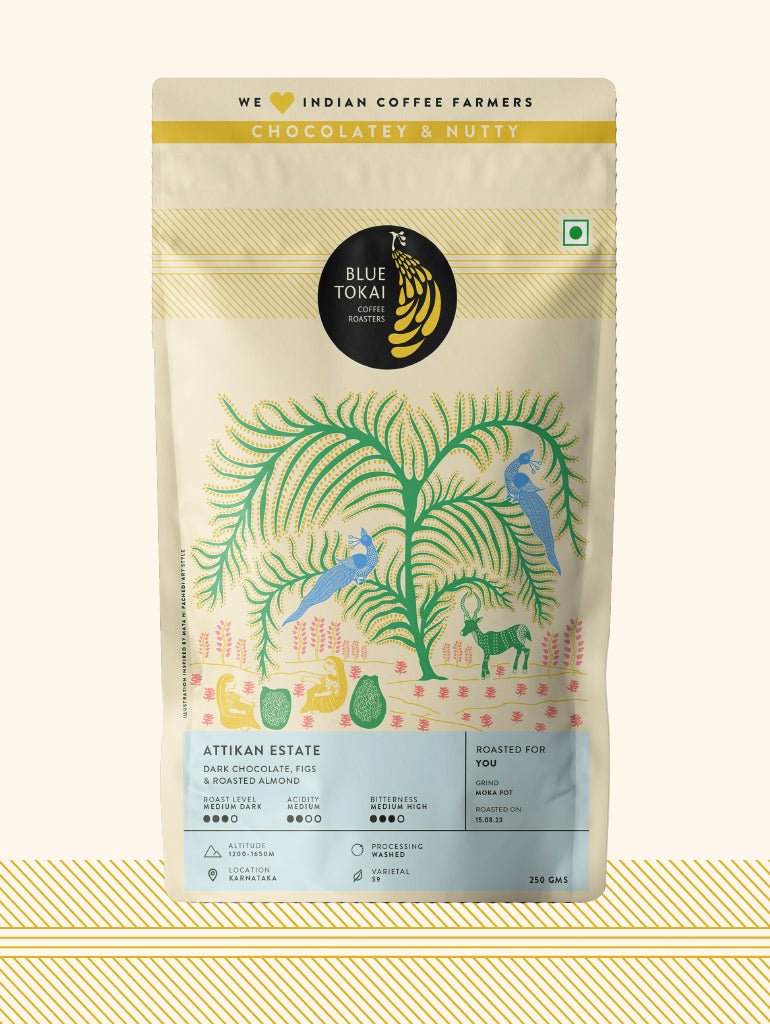
The Blue Tokai Attikan Estate.
The most convincing “this tastes like coffee, only better” bag here — bright fruit over a cocoa base, with enough body for milk.
The essentials
- 100% Arabica (S795 & Catimor), washed
- Dark medium roast
- Biligiriranga Hills, Karnataka, 1,220–1,320 metres
- Notes: green apple, strawberry, cocoa nibs
- Grinds for whole bean, espresso, French press, pour-over, South Indian filter, moka pot, Aeropress and cold brew — the widest grind menu of any pick
- Bag printed with a “ROASTED ON” field
- Per-100 g ₹260 at the Amazon price; per cup ₹39.06 at a 15 g dose — the cheapest cup here
What stands out
- The single-origin other Indian roasters get compared against
- At ₹651 on Amazon it is currently the cheapest bag in this guide, while offering far more traceability
Keep in mind
- The bright acidity can taste sharp under a lot of milk — if your kaapi is mostly milk, Sandalwood holds up better
- Many listings call Attikan a Chikmagalur coffee, but Blue Tokai’s own page places it in the Biligiriranga Hills
- No rating is published on the product page
₹700 for 250 g
₹700 on Blue Tokai (500 g ₹1,300; 1 kg ₹2,380), checked 14 November 2026.
Best for: A first single origin, and any brewer — the one bag to buy if you only buy one.
2. Savorworks Riverdale Estate — Best Value
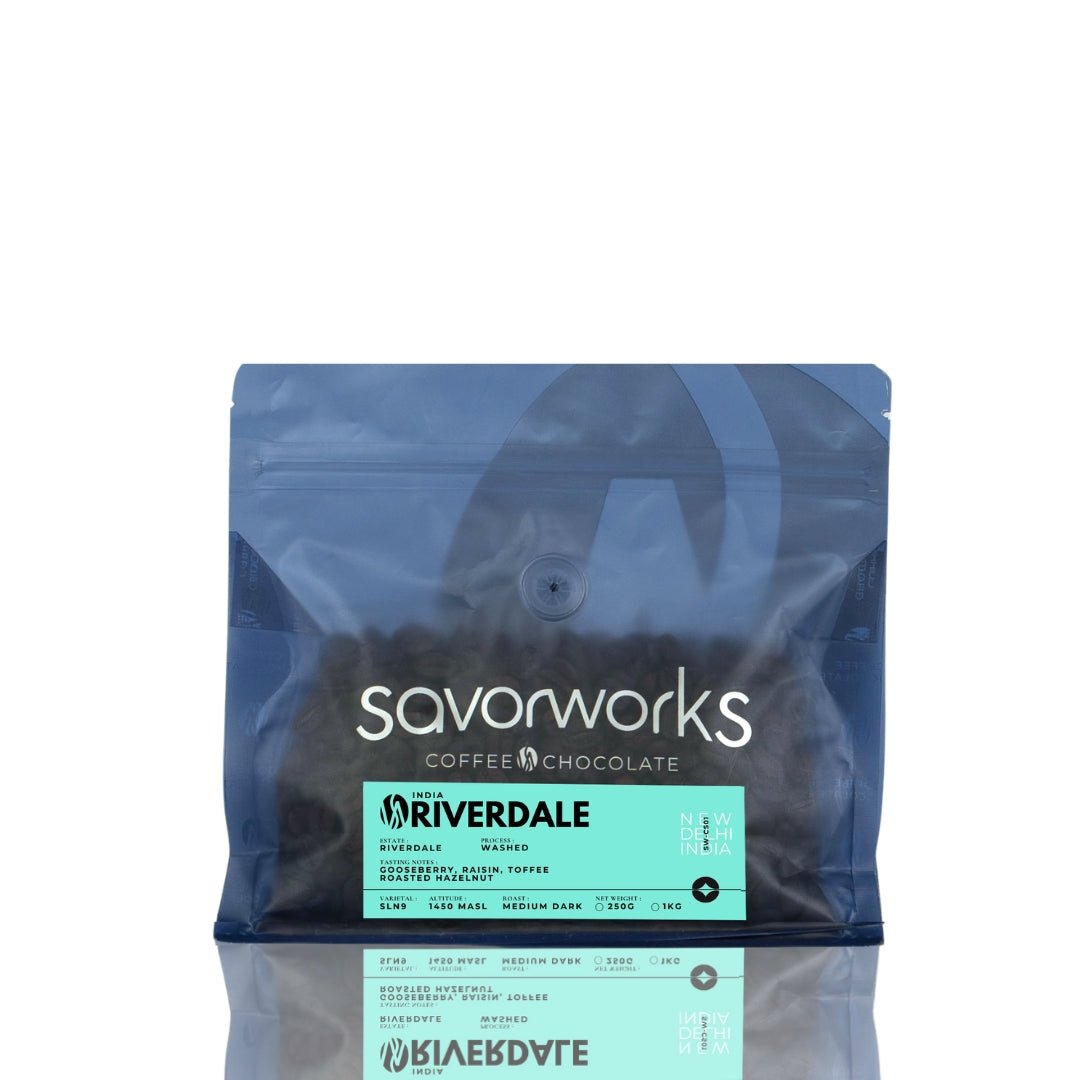
The Savorworks Riverdale Estate.
The only bag here pitched squarely at espresso and moka pot drinkers — low acid, high body — and the value pick, not the compromise pick.
The essentials
- SLN-9 varietal, washed
- Medium-dark roast (“roasted to the higher side of medium”)
- Riverdale Estate, Chikmagalur, 1,450 metres
- Notes: gooseberry, raisin, toffee, roasted hazelnut
- Low acidity, high body, long aftertaste
- New 2026 harvest
- Grinds for whole bean, espresso, pour-over, French press, moka pot, cold brew, Channi, South Indian filter and Turkish
- Per-100 g ₹270; per cup ₹40.50
- 1 kg ₹2,250 — ₹225 per 100 g, undercutting every other bag here
- Free shipping across India
Keep in mind
- The page never states whether the beans are Arabica or Robusta, and it names no region beyond the estate itself (Chikmagalur comes from a second published source) — neither changes the cup, but if full labelling matters to you, Attikan names everything, and on Amazon it currently costs less per bag
- No rating is published on the page
₹675
Store closed (Nov 2026) — not buyable online right now
Best for: Espresso and moka pot drinkers, and anyone who wants the best-value daily single-origin cup — especially in the 1 kg bag.
3. Araku Grand Reserve — Premium Pick

The Araku Grand Reserve.
The brightest, most distinctive Indian cup in the guide — a clean, tea-like fruitiness no Karnataka estate matches.
The essentials
- 100% Arabica, certified organic, Fair Trade, regenerative agriculture
- Medium roast
- Grand Cru plots of Araku Valley, Andhra Pradesh, 3,307–3,908 feet
- Natural & washed process
- Farmers: Badnaini Subadramma and Sombabu
- Notes: tropical fruits, dates, citrus, floral
- Grinds from whole beans to very fine
- Per-100 g ₹376; per cup ₹56.40 — the priciest cup here
- Rated 4.8★ from 52 reviews on Araku’s own store — the strongest published rating in this guide
What stands out
- The organic and Fair Trade certification is real (tribal farmer cooperative), not a label bought for the bag
Keep in mind
- The 500 g and 1 kg packs offer no per-100 g saving — only the 4% Subscribe & Save helps (₹902.40)
- A bright medium roast can taste thin if you brew it like a dark roast — the mildest store review is a 4-star note from an Aeropress brewer who did not like the hot brew
- Milk hides exactly the notes you paid for
₹940 for 250 g at Araku and on Amazon · checked 14 Nov 2026
500 g ₹1,880; 1 kg ₹3,760, checked 14 November 2026.
Best for: Black coffee drinkers — pour-over or Aeropress — who want the most distinctive Indian cup and value organic certification.
4. Blue Tokai Sandalwood Estate — Best for Milk
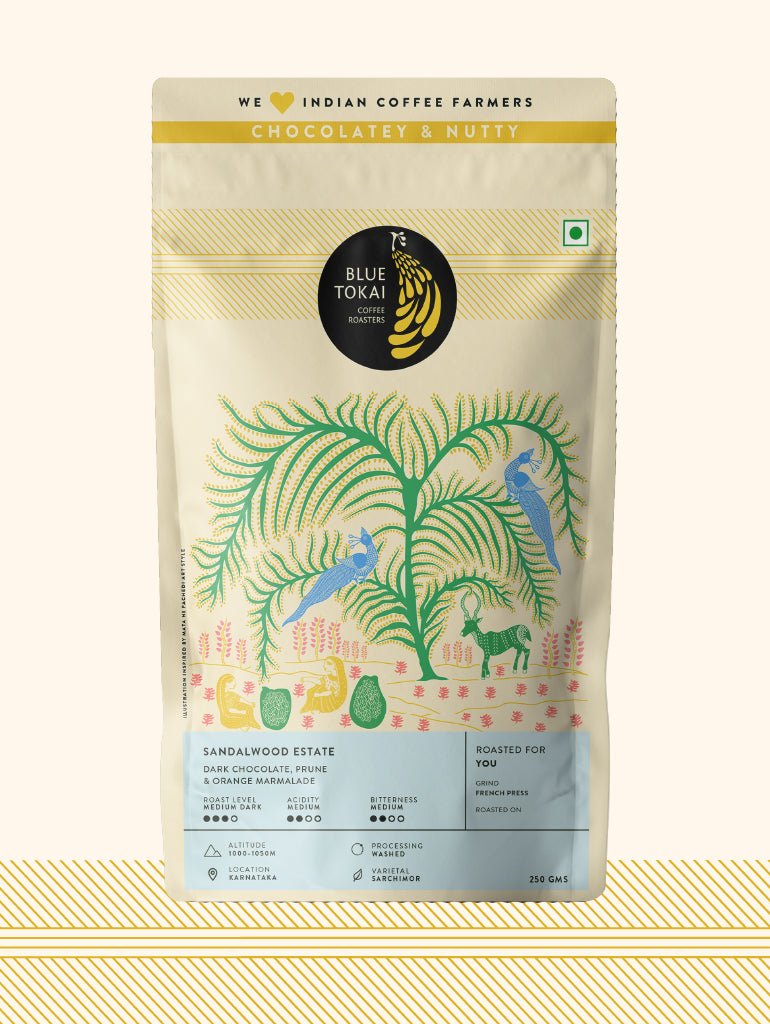
The Blue Tokai Sandalwood Estate.
The Coorg answer to Attikan — rounder, lower-acid, chocolate-led — and the bag in this guide most likely to survive a generous pour of hot milk without disappearing.
The essentials
- 100% Arabica (Sarchimor), washed
- Medium-dark roast
- Sandalwood Estate, Coorg (Kodagu), Karnataka, 1,000–1,050 metres — established 1878, ~180 acres
- Notes: dark chocolate, prune, orange marmalade
- Thirteen grind options including South Indian filter, Turkish and Channi
- Per-100 g ₹300; per cup ₹45
- 500 g ₹1,395, checked 14 Nov 2026
What stands out
- It replaces Thogarihunkal Estate, which Blue Tokai no longer sells — same roaster, same district, buyable today
Keep in mind
- It costs more than Attikan’s Amazon price for a less exciting black cup — if you drink your coffee black, the brighter bag is the better buy
- No rating is published on the product page
₹750
Best for: Milky South Indian filter kaapi, moka pot with milk, and French press with a splash of milk.
5. Third Wave Chikmagalur Region — Easiest First Buy

The Third Wave Chikmagalur Region.
The gentlest entry point in the guide — a sweet, medium-bodied, forgiving medium roast that flatters a first pour-over and does not punish a slightly coarse grind.
The essentials
- 100% Arabica, washed
- Medium roast
- Chikmagalur region, Karnataka — hand-picked and sun-dried
- Plants grow alongside pepper, cacao and cardamom
- Notes: stone fruit and raisins, with sweet honey and a juicy peach note
- Grinds: whole bean, coarse, medium and fine
- “Freshly roasted in-house” and “sealed for freshness”
- Per-100 g ₹280; per cup ₹41.94 at the Amazon price
- Rated 3.7★ from 71 ratings on Amazon
- Free delivery on orders over ₹400
Keep in mind
- It names a region, not an estate — no estate name and no altitude appear on the page, so it is the least traceable pick here
- The 500 g pack costs exactly the same per 100 g as the 250 g, so size up only for freshness reasons, not savings
- No reviews section exists on the page
₹700 for 250 g
₹700 on Third Wave’s own store (500 g ₹1,400), checked 14 November 2026. At ₹699 on Amazon it sits just above Attikan’s ₹651 while being the easier cup to get right.
Best for: A first single origin, and pour-over or French press drinkers who want a sweet, easy cup.
6. Blue Tokai Kalledevarapura, Pulp Sun Dried — Most Balanced

The Blue Tokai Kalledevarapura, Pulp Sun Dried.
The quietest bag in the guide, and deliberately so — a balanced, low-bitterness Chikmagalur that tastes the same in a French press on Monday and a pour-over on Sunday.
The essentials
- 100% Arabica (S795), pulp sun dried
- Medium roast
- Kalledevarapura Estate, Chikmagalur, 1,280–1,340 metres
- Notes: brown sugar, roasted almond, raisin
- Medium acidity, low bitterness
- This year’s harvest, with a recommended resting period of 11 days after roasting
- The pulp-sun-dried process gives it a rounder sweetness than the washed bags around it
- Per-100 g ₹320; per cup ₹48 — the second-priciest cup here
Keep in mind
- The 11-day rest is a real condition: brewed too fresh, a pulp-sun-dried coffee can taste flat and gassy, so do not open this bag the day it arrives
- It is also the second-priciest bag here, for the least showy cup
- No rating is published on the page
- KC Roasters sells the same estate, but has no buyable store today, so this Blue Tokai version is the verified way to buy it
₹800
Best for: A balanced daily cup for drinkers who value consistency over fireworks — and who will wait 11 days after the roast date.
What single origin actually means
“Single origin” means the coffee comes from one place — one country, one region, one farm, or one lot on one farm. It is a statement about traceability, not a quality badge, and it is not a regulated term: any roaster can print it on a bag. The serious ones tell you the region or the farm, the altitude, the varietal and the process. That is the test to apply to every bag above: Attikan, Sandalwood and Kalledevarapura pass it fully (estate, altitude, varietal); Araku passes it with a named valley and named farmers; Riverdale passes it halfway (estate and altitude, but no bean type); Third Wave’s Chikmagalur Region passes it only at region level.
A blend does the opposite job: it mixes origins on purpose so the cup tastes the same bag after bag, all year. Neither is better. If you want one coffee on autopilot every morning, or you mostly drink espresso with milk, a blend is often the better buy — the milk hides the delicate notes you paid a premium for. Save the single origins for the brew you actually sit down with, ideally black. For the cheaper daily options, see our instant coffee guide and filter coffee powder guide, and our decaf guide for the same question without the caffeine.
The roast-date rule
Freshness matters more than the label. Coffee peaks roughly 4–14 days after roasting, once it has degassed enough to extract evenly but before it begins to stale — and the roast date matters more than the origin or the roast level. Apply it like this: (1) Buy bags with a printed roast date. Blue Tokai prints a “ROASTED ON” field on its bags; Araku carries a “FRESH ROAST” badge; Third Wave roasts in-house and seals for freshness. (2) Rest fresh beans — Kalledevarapura’s roaster recommends 11 days; as a rule, give any fresh bag 4–7 days. (3) Use a 250 g bag within a month of roasting (~16 cups at a 15 g dose) and a ground bag within 2–3 weeks. (4) Buy whole bean if you own a grinder; it stales far slower than ground. (5) Store it sealed, away from light and heat — not in the fridge. A stale single origin tastes flat and papery, and no origin can rescue it.
What a month of single-origin coffee actually costs
Specialty beans look expensive per bag and cheap per cup. At a 15 g dose, one cup a day for a month (30 cups) costs ₹1,172–₹1,692 of beans across these six bags (at the prices checked on 14 November 2026) — against ₹6,000 for the same 30 cups at a café at ₹200 a cup. Even the priciest bag here, Araku at ₹56.40 a cup, costs less than a third of a café cup. The chart below shows the per-cup cost of each bag, checked 14 November 2026:
Per-cup cost at a 15 g dose, from prices checked on each roaster’s own store and on Amazon on 14 November 2026. The gap between the cheapest and priciest cup is ₹17.34 a day — ₹520 a month — so the choice here is about taste, not budget.
Bulk packs help on three of the six: Attikan’s 1 kg bag drops to ₹238 per 100 g (from ₹280 at the brand store for 250 g), Riverdale’s 1 kg to ₹225 (from ₹270), and Sandalwood’s 500 g to ₹279 (from ₹300). Araku and Third Wave charge the same per 100 g at 500 g as at 250 g, so size up only if you will finish the bag fresh. One caution: a 1 kg bag only saves money if you drink it within about a month of roasting — a stale kilo is worse value than a fresh 250 g bag.
Who should NOT buy single origin
Single origin is not for everyone, and the honest answer saves you money: skip it if you drink your coffee very milky and sweet every day — the origin character you paid for disappears under milk and sugar, and a good blend or a filter coffee powder will give you the same cup for a third of the price. Skip it if you want the exact same cup every morning — single origins shift a little from harvest to harvest, and that variability is the point. Skip it if you will not finish a bag within a month — stale specialty coffee tastes worse than fresh ordinary coffee. And wait if you do not own a grinder and will not buy ground coffee regularly — pre-ground single origin goes stale in 2–3 weeks, so the format only works if you brew often. Everyone else — black-coffee drinkers, pour-over and French press owners, the curious — this is the cheapest way to taste what Indian coffee actually is.
What we left out — and why
Three names did not make the guide, and the reasons are all verifiable: Blue Tokai Thogarihunkal Estate — its product page 404s and the store’s own search returns nothing buyable; only an “Our Farms” page names it. Replaced by Sandalwood Estate from the same roaster. Third Wave Baarbara Estate — same story: 404, zero search results, and the Single Origin collection now lists only region-named coffees. Replaced by the Chikmagalur Region bag. KC Roasters Kalledevarapura Estate — the roaster’s own site is a GoDaddy placeholder with no shop, its other domain does not resolve. The same estate is in the guide via Blue Tokai’s verified ₹800 listing instead. We also left out import-on-demand listings (Ubuy, Desertcart) that show foreign single origins at ₹2,000–₹5,000 a bag — not stocked in India, and not the point of an Indian-estate guide.
Frequently asked questions
What is single origin coffee?
Coffee from one place — one country, region, farm or lot — rather than a blend of beans from several origins. It is a traceability claim: you can taste that place in the cup. It is not a regulated term, so check that the bag names the estate or region, the altitude and the varietal.
Is single origin coffee better than a blend?
Neither is better — they do different jobs. Single origin shows you one place’s character and changes a little from harvest to harvest; a blend is built to taste the same bag after bag and to hold up in milk and espresso. Drink it black or by pour-over, pick single origin; espresso, milk drinks, or the same cup daily, pick a blend.
Which single origin coffee is best for beginners?
A medium-roast, sweet, forgiving bag: Third Wave’s Chikmagalur Region (stone fruit, raisins, ₹699 on Amazon) is the easiest entry point in this guide. Attikan at ₹651 on Amazon is the better buy if you want full estate traceability from the start.
Which Indian single origin is best for French press?
Any medium or medium-dark bag here works, but Riverdale (low acid, high body) and Sandalwood (chocolate-led, medium-dark) are the most forgiving in a French press. For pour-over, Attikan and Araku Grand Reserve show the most character.
Is single origin coffee more expensive?
Usually, yes — the lots are smaller and the sourcing takes more work. The per-100 g and per-cup cost of every bag here is in the table above — even the priciest cup is still under a third of a ₹200 café cup, and the cheapest bag here (Attikan) costs less per cup than most instant-coffee café drinks.
How do I know if single origin coffee is fresh?
Check the roast date on the bag — Blue Tokai prints a “ROASTED ON” field. Coffee peaks roughly 4–14 days after roasting. Rest fresh beans a few days (11 days for Kalledevarapura, per its roaster), use a 250 g bag within a month, and buy whole bean if you own a grinder.
Whole bean or ground — which should I buy?
Whole bean if you own a grinder: it stays fresh far longer. Ground if you do not — but order the grind for your brewer (all six bags offer whole bean; five offer a South Indian filter grind) and finish a ground bag within 2–3 weeks.