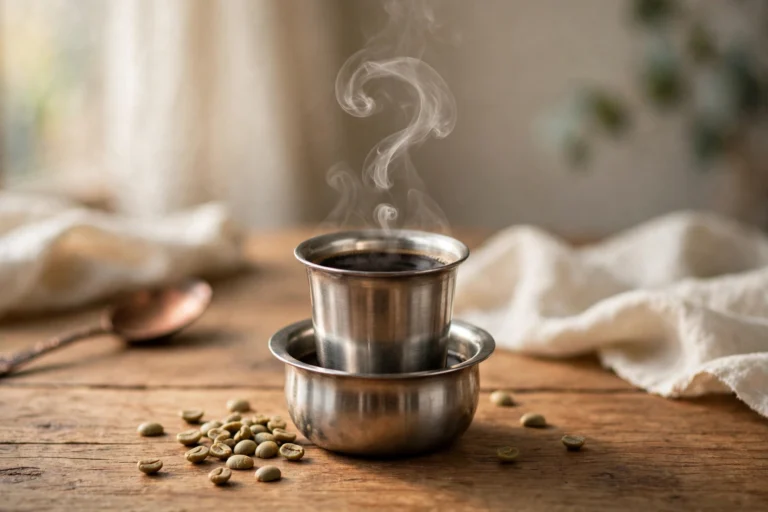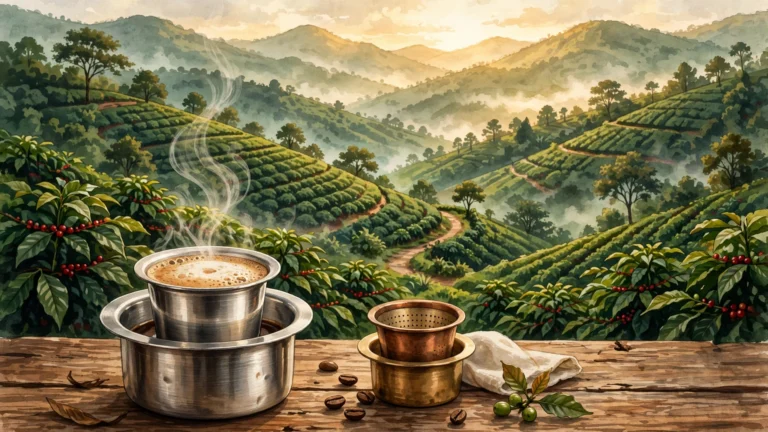
If you are comparing caffeine in filter coffee vs espresso, here is the short answer: a South Indian filter coffee has more caffeine per serving, but espresso is far stronger per millilitre. A dabara cup of filter coffee (about 150 ml) has roughly 90–120 mg of caffeine, while a single espresso shot (30 ml) has about 63 mg. Filter coffee wins on total caffeine; espresso wins on concentration, by about five times per ml.
That distinction clears up most of the confusion. Espresso tastes intense, so it feels like it must contain the most caffeine. A small, strong shot holds less total caffeine than a full cup. The three numbers to remember are an espresso shot, about 63 mg; a dabara cup of filter coffee, about 90–120 mg; and a mug of instant coffee, about 60–80 mg.
One honest caveat first: no lab-measured caffeine figure exists specifically for South Indian filter coffee. The 90–120 mg figure for a dabara cup is an estimate — consistent with the Indian Council of Medical Research (ICMR) range for brewed coffee and with published estimates for South Indian filter coffee, but never measured in a laboratory for this exact drink. Treat it as a good working range, not a precise measurement.
Caffeine in filter coffee vs espresso: the comparison in Indian servings
The table below uses the servings Indians actually drink — a dabara cup, a single espresso shot, a mug of instant — rather than the 8-ounce American servings in most international articles.
| Drink | Indian serving | Caffeine (mg) | Caffeine per 100 ml |
|---|---|---|---|
| Espresso (single shot) | 30 ml | ~63 mg | ~210 mg |
| South Indian filter coffee | 150 ml (dabara cup) | ~90–120 mg | ~60–80 mg |
| Instant coffee | 240 ml (mug) | ~60–80 mg | ~25–33 mg |
| Decaf coffee | 240 ml (mug) | ~2–5 mg | ~1–2 mg |
| Cold brew | 240 ml (glass) | ~100–200 mg | ~42–83 mg |
| Masala chai / black tea | 150 ml (cup) | ~30–50 mg | ~20–33 mg |
The table tells two stories. Per serving, filter coffee (90–120 mg) beats a single espresso shot (63 mg), and cold brew can beat both. Per 100 ml, the order flips: espresso, at about 210 mg per 100 ml, is roughly three times as concentrated as filter coffee and about eight times as concentrated as instant coffee. A double shot (60 ml, about 126 mg) would overtake a dabara cup — which is why “which has more caffeine?” has no single answer until you say how much of each you are drinking. The other drinks put coffee in perspective: instant has less caffeine than a dabara cup despite the bigger serving, because less coffee goes into each mug; masala chai (30–50 mg) has roughly a third to a half of a filter coffee’s caffeine; and decaf (2–5 mg) is not caffeine-free, but barely counts towards your daily total.
Per serving vs per ml: why espresso feels stronger but filter coffee has more
Espresso is made by forcing hot water through finely ground coffee under pressure, using little water and a short contact time. That produces a small, intensely flavoured shot with a very high concentration — about 210 mg of caffeine per 100 ml, according to United States Department of Agriculture (USDA) food-composition data. Filter coffee is made by slowly dripping hot water through grounds, using much more water: a larger, milder cup with a lower concentration (about 60–80 mg per 100 ml) but a higher total, because there is five times as much liquid in the cup. The same logic explains cold brew: it steeps a large dose of grounds in cold water for 12 hours or more, so a 240 ml glass can hold 100–200 mg, and its smooth, low-acid taste makes the caffeine easy to underestimate.
Why the number in your cup varies so much
Published studies show the real spread is wide. A 2024 study in the journal Nutrients by Wierzejska and Gielecińska, covering nearly 300 servings, found caffeine per serving ranging from about 20 mg to 300 mg. Three things decide where your cup lands.
First, the dose — how much coffee goes in. More grounds mean more caffeine, almost in direct proportion. As a rough guide, about 12 g of coffee yields roughly 70 mg in a 240 ml cup, 15 g yields about 90 mg, and 20 g yields about 120 mg. A generously loaded filter sits at the top of the range or above it; a light, milky cup sits at the bottom.
Second, the bean — robusta has roughly twice the caffeine of arabica. Robusta beans contain about 1.7–4% caffeine by weight, against about 0.8–1.4% for arabica. South Indian filter coffee is traditionally made from robusta-heavy blends, which is one reason a dabara cup punches above its size. Switch to a single-origin arabica and your cup’s caffeine can drop noticeably, even if nothing else changes.
Third, chicory — which has no caffeine at all. The classic South Indian blend is coffee mixed with chicory, commonly 80:20, with 70:30 and 60:40 blends also sold. Chicory adds body and a roasted, slightly bitter note, but zero caffeine. So an 80:20 blend delivers 20% less caffeine per spoon than pure coffee, and a 70:30 blend 30% less. The 90–120 mg dabara estimate already reflects a typical chicory blend; pure coffee would be higher, a heavy-chicory blend lower.
How much caffeine can you have in a day?
Two authorities give the two numbers that matter in India. The European Food Safety Authority (EFSA), in its 2015 safety opinion, and the United States Food and Drug Administration (FDA) both put the daily reference for healthy adults at 400 mg of caffeine a day, with a single dose of up to 200 mg raising no safety concern. The ICMR, in its 2024 dietary guidelines for Indians, sets a lower figure: 300 mg a day. For pregnancy, EFSA, the American College of Obstetricians and Gynecologists (ACOG), and the UK’s National Health Service (NHS) all advise staying at or below 200 mg a day.
These are population reference values — general guidance for healthy adults, not a personal prescription. Caffeine stays in the body for hours (its half-life is about five hours in a typical adult), so a late-afternoon cup is still partly with you at bedtime. This article is general information, not medical advice; anyone who is pregnant, has a health condition, or takes medication should ask a doctor what is right for them.
| Drink (Indian serving) | Cups to reach 300 mg (ICMR) | Cups to reach 400 mg (EFSA / FDA) | Cups to reach 200 mg (pregnancy) |
|---|---|---|---|
| Filter coffee, dabara cup (~90–120 mg) | 2–3 cups | 3–4 cups | 1–2 cups |
| Espresso, single shot (~63 mg) | 4–5 shots | 6 shots | 3 shots |
| Instant coffee, mug (~60–80 mg) | 3–4 mugs | 5–6 mugs | 2–3 mugs |
| Masala chai, cup (~30–50 mg) | 6–10 cups | 8–13 cups | 4–6 cups |
| Decaf coffee, mug (~2–5 mg) | 60+ mugs | 80+ mugs | 40+ mugs |
Two dabara cups in the morning (180–240 mg) plus one mug of instant coffee in the afternoon (60–80 mg) lands at roughly 240–320 mg — around the ICMR figure of 300 mg and under the EFSA/FDA figure of 400 mg. Add a third dabara cup and you are at roughly 330–440 mg, crossing the ICMR reference. The practical rule: two dabara cups a day fits inside both Indian and international guidance; three is where you should start counting. Two strong dabara cups drunk together (180–240 mg) can also reach the 200 mg single-dose figure in one sitting, which is why two back-to-back filter coffees can leave you jittery even when your day’s total is modest.
Myths vs facts
Myth: Espresso has the most caffeine of any coffee.
Fact: Espresso has the most caffeine per millilitre (about 210 mg per 100 ml), but not per serving. A single 30 ml shot has about 63 mg — less than a dabara cup (90–120 mg) and less than a large cold brew (100–200 mg).
Myth: Decaf coffee is caffeine-free.
Fact: Decaf still contains about 2–5 mg of caffeine per 240 ml mug, according to USDA data and peer-reviewed tables — roughly 95% less than regular coffee, but not zero.
Myth: Robusta and arabica have about the same caffeine.
Fact: Robusta has roughly double the caffeine of arabica — about 1.7–4% by weight against arabica’s 0.8–1.4%.
Myth: Instant coffee has almost no caffeine.
Fact: A mug of instant coffee has about 60–80 mg — close to a single espresso shot. Instant is weaker per cup because less coffee goes into each mug, not because it is caffeine-free. Two mugs (120–160 mg) contain more caffeine than one dabara cup.
Myth: A bigger cup always means more caffeine.
Fact: Usually, but not always. A 240 ml mug of instant coffee (60–80 mg) has less caffeine than a 150 ml dabara cup (90–120 mg), because the filter coffee is brewed from a bigger dose of stronger beans.
Frequently Asked Questions
How much caffeine is in filter coffee?
A dabara cup (about 150 ml) has roughly 90–120 mg. That is an estimate, not a lab measurement — no lab-measured figure exists specifically for South Indian filter coffee — but it matches the ICMR range for brewed coffee of 80–120 mg per 150 ml.
Does espresso have more caffeine than filter coffee?
Per serving, no: a single espresso shot (30 ml) has about 63 mg, while a dabara cup (150 ml) has about 90–120 mg. Per millilitre, yes, by a lot: espresso has about 210 mg per 100 ml against filter coffee’s 60–80 mg.
How much caffeine is in instant coffee?
About 60–80 mg per 240 ml mug, according to USDA data, or 50–65 mg per 150 ml cup according to the ICMR.
How many cups of coffee can I drink in a day?
For a healthy adult, the ICMR guidance for India is 300 mg of caffeine a day, while EFSA and the FDA use 400 mg a day. That is roughly 2–3 dabara cups of filter coffee (ICMR) or 3–4 cups (EFSA/FDA), and 3–4 mugs of instant coffee (ICMR) or 5–6 mugs (EFSA/FDA). During pregnancy, the advised limit is 200 mg a day — about 1–2 dabara cups.
Is 200 mg of caffeine a lot?
It is within daily guidance for a healthy adult: 200 mg is half the EFSA/FDA daily reference of 400 mg and two-thirds of the ICMR figure of 300 mg. As a single dose, EFSA considers up to 200 mg to raise no safety concern.
Does decaf coffee still have caffeine?
Yes, a small amount: about 2–5 mg per 240 ml mug. Decaffeination removes most of the caffeine but not all of it, so decaf is roughly 95% lower in caffeine than regular coffee rather than caffeine-free.
Which coffee has the most caffeine — cold brew, filter or espresso?
Per serving, cold brew usually has the most: 100–200 mg per 240 ml glass. Filter coffee is next at 90–120 mg per dabara cup, and a single espresso shot is last at about 63 mg. Per millilitre, the order reverses: espresso is by far the most concentrated.
How much caffeine is in tea vs coffee?
Coffee has roughly two to three times the caffeine of tea per cup. A cup of masala chai or black tea (150 ml) has about 30–50 mg, against 90–120 mg in a dabara cup of filter coffee and 60–80 mg in a mug of instant coffee.
Note: caffeine figures here are general information from published sources — EFSA 2015, the US FDA, ICMR 2024, USDA data, and the Nutrients 2024 study — not medical advice. If you are pregnant, have a health condition, or take medication, ask your doctor.
If you brew at home, our French press vs moka pot comparison looks at the same dose-and-method question from the brewing side. And if you are shopping for brewing gear, the latest offers on our deals page are updated through the week.