If you want the taste of coffee without the caffeine, India finally has a small but real decaf shortlist in 2026: Sleepy Owl Decaf sachets for everyday instant, Nescafe Gold Blend Decaf for the classic jar, Naivo Zero Buzz if you brew — including in a South Indian filter — TGL Co. Decaf if you like coffee strong and robusta-led, and Coffeeza Decaf capsules for Nespresso-compatible machines. Every pick was verified on a live Indian store page on 9 November 2026, at the price we actually saw. That matters, because most “best decaf coffee in India” lists pad themselves with import-on-demand listings at ₹2,000–₹5,000 a pack — we have named those in the “what we left out” section instead.
Quick verdict
Best overall: Sleepy Owl Decaf Instant Coffee (30 sachets) — 100% Arabica, single-serve, price tracked live.
Best budget: Nescafe Gold Blend Decaf (95 g) — the classic Gold taste without caffeine, lowest cost per cup here.
Best for filter-coffee lovers: Naivo Zero Buzz Decaf — freshly roasted ground decaf with a proper South Indian filter grind.
The best decaf coffees in India, pick by pick
Sleepy Owl Decaf Instant Coffee — Pack of 30 Sachets

The Sleepy Owl Decaf Instant Coffee — Pack of 30 Sachets.
The easiest recommendation on this list — 100% Arabica in single-serve sachets, with no jar going stale and no measuring.
The essentials
- Pack of 30 single-serve sachets
- Each sachet holds 1.5 g of instant coffee
- Made from 100% Arabica beans
- No measuring — tear, pour hot water or milk, stir
What stands out
- The easiest recommendation on this list
- A clean, medium-bodied instant — noticeably smoother than most Indian instant coffee, without the bitterness that makes people reach for sugar
- Because the caffeine is removed before processing, an evening cup does not come with the usual 10 pm regret
Keep in mind
- The smaller 10-sachet packs also appear on Zepto and Blinkit — stock varies by city
- Decaf is not caffeine-free — roughly 2–7 mg of caffeine per cup remains (see “How much caffeine is left in decaf?” below)
₹499Same price as when this guide was published (₹499, 9 Nov 2026).
Price: ₹499 for the pack of 30 sachets on Sleepy Owl’s own store. This product is tracked by our price system, so the figure above is live, not typed into this article. Smaller 10-sachet packs also appear on Zepto and Blinkit (₹149–₹169 when checked; stock varies by city).
At the tracked price it works out to under ₹20 a cup — fair for single-serve convenience, and the format is ideal if you travel or drink coffee at odd hours.
Nescafe Gold Blend Decaf — 95 g Jar

The Nescafe Gold Blend Decaf — 95 g Jar.
The decaf for people who already drink Nescafe Gold — the same ritual minus the caffeine.
The essentials
- 95 g glass jar
- A blend of Arabica and Robusta with golden-roasted Arabica
- Rated intensity 7
- Holds a 4.5★ average from 644 Amazon ratings
What stands out
- It dissolves into the familiar smooth Gold cup
- Per cup it is the cheapest route into decaf here — roughly ₹14 a cup at the checked price
- The classic Gold taste without caffeine
Keep in mind
- It is an imported line — stock comes and goes
- Third-party sellers sometimes list it far above the tracker average — buy it near ₹650, not at ₹1,000-plus
₹932
Price: ₹647 on Amazon.in, checked 9 November 2026. This jar’s price swings a lot — trackers show roughly ₹470–₹1,099 over the past year, averaging around ₹682, so anything under ₹700 is a good buy.
Naivo Zero Buzz Decaf — Roasted Beans & Ground Coffee
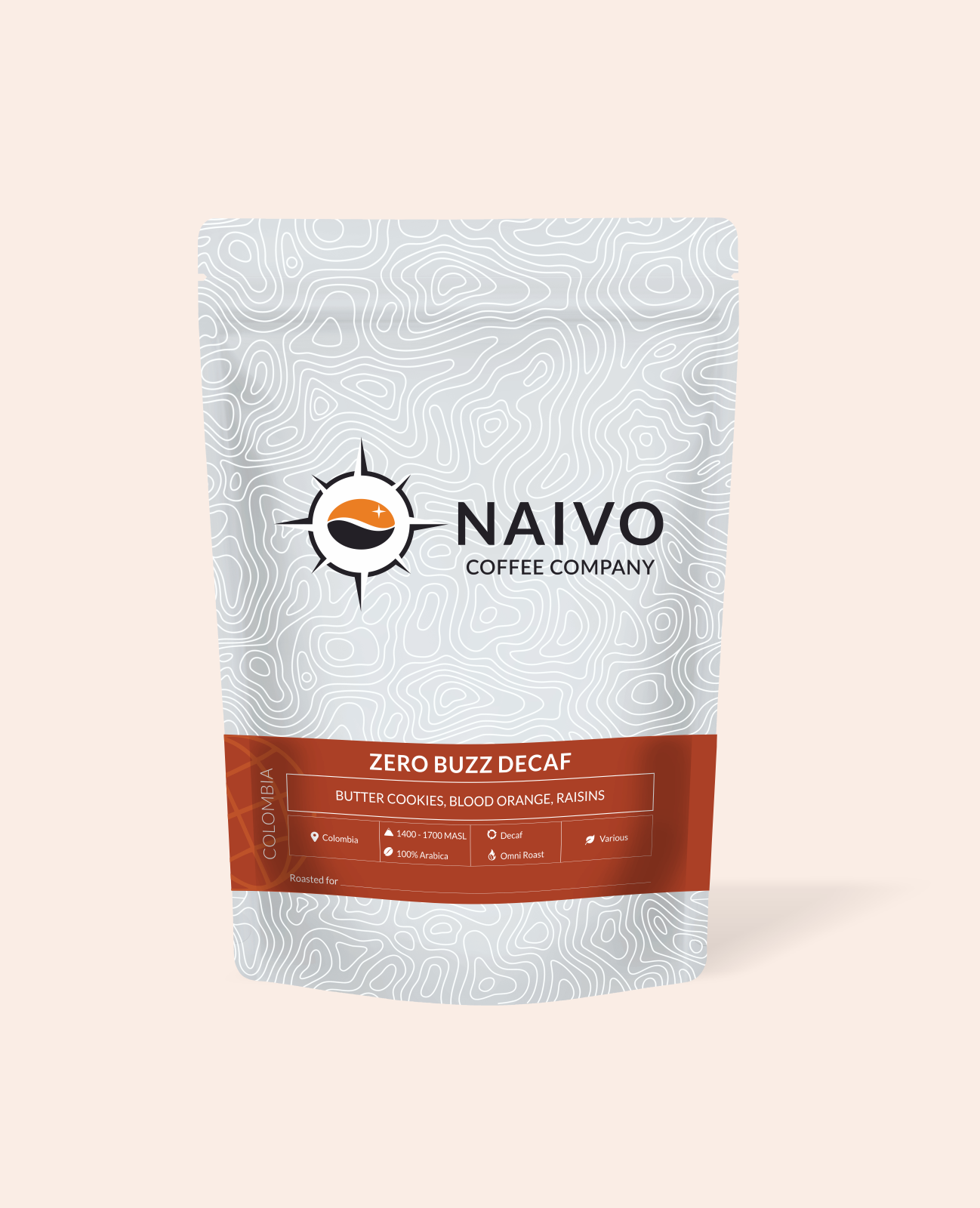
The Naivo Zero Buzz Decaf.
Almost every decaf sold in India is instant — Zero Buzz is the exception: a proper roasted coffee, and the one that earns our filter-coffee slot.
The essentials
- 100% Colombian Arabica grown at 1,400–1,700 metres
- Decaffeinated before roasting by CR3 Kaffeeveredelung in Germany
- Roasted fresh to order by Bengaluru-based Naivo
- 100 g and 250 g bags, whole bean or ground
- The grind menu includes a dedicated South Indian grind — alongside espresso, moka pot, French press, V60 and cold brew
- Listed tasting notes — blood orange, butter cookies, raisins
What stands out
- A proper roasted coffee, not an instant — the exception in Indian decaf
- In a steel filter with frothed milk on top, it makes a convincing decaf filter kaapi — something no instant here can honestly claim
- A soft, sweet, low-acidity cup
Keep in mind
- Choose whole bean if you own a grinder
- Use it within a few weeks of roasting — it is roasted fresh to order
From ₹620 at Naivo · checked 9 Nov 2026
Price: From ₹620 on Naivo’s own store, checked 9 November 2026 (100 g and 250 g bags, whole bean or ground).
TGL Co. Decaf Instant Coffee — 100% Robusta, 100 g

The TGL Co. Decaf Instant Coffee — 100 g.
Most decaf goes mild — TGL Co. went the other way: 100% decaffeinated Robusta from Coorg, bold, earthy and full-bodied.
The essentials
- 100% decaffeinated Robusta from Coorg
- Spray-dried instant
- 100 g
- Listed 24-month shelf life
What stands out
- Bold, earthy and full-bodied — closer to the strong coffee South Indian drinkers actually like
- It stands up to milk and a little sugar without disappearing
- The one built for you if every decaf you have tried tasted like a compromise
Keep in mind
- It is the priciest instant here per gram
- Too intense if you prefer delicate coffee
- We have also seen it cheaper on bigbasket — worth a quick comparison before you order
₹999
Price: ₹999 on TGL Co.’s own store, checked 9 November 2026 (we have also seen it at ₹799 on bigbasket, so it is worth a quick comparison before you order).
Coffeeza Decaf Aluminium Capsules — Box of 10
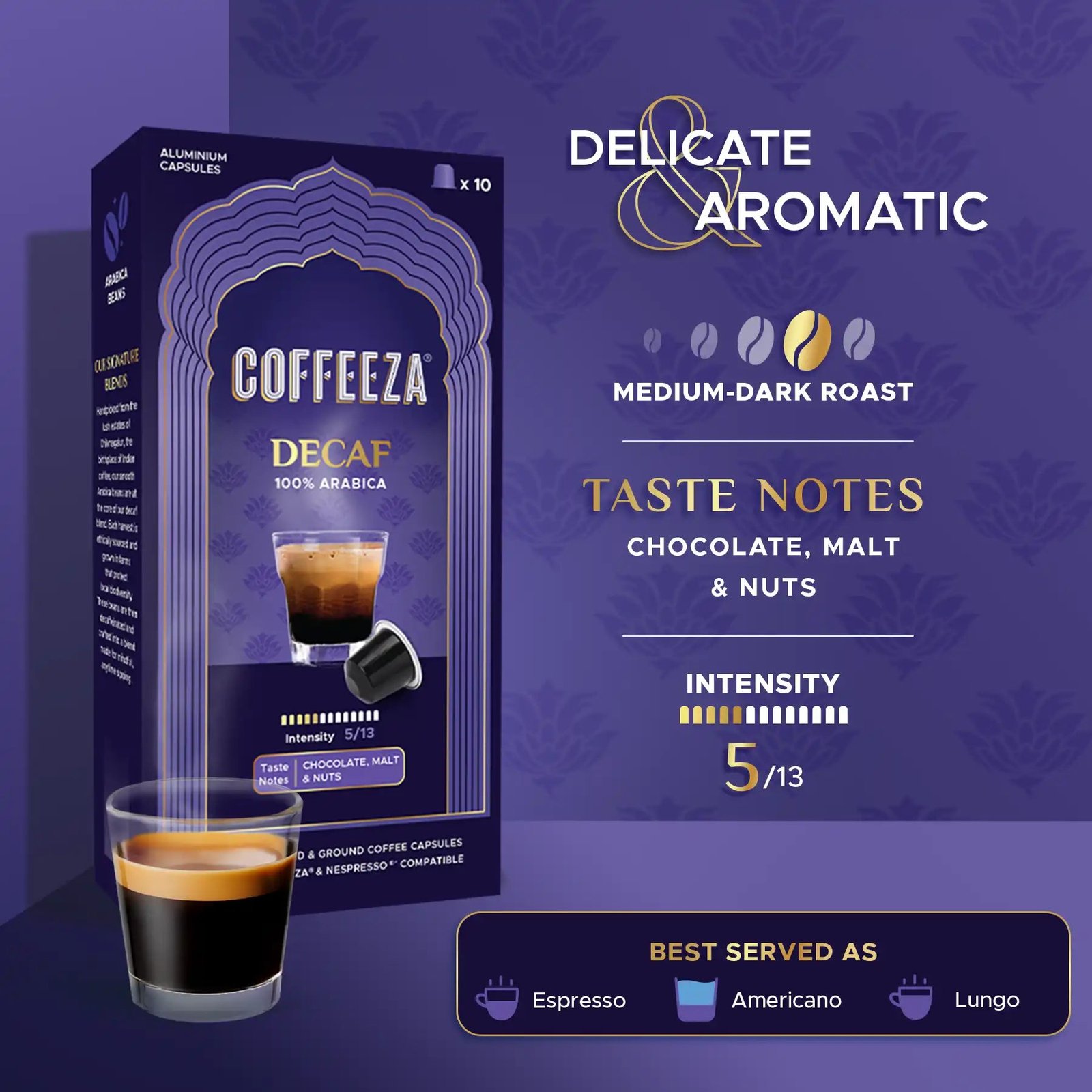
The Coffeeza Decaf Aluminium Capsules — Box of 10.
Capsule-machine owners are usually forgotten by decaf roundups — Coffeeza, an Indian brand, makes a dedicated Decaf in its Nespresso-compatible aluminium range.
The essentials
- Box of 10 aluminium capsules — larger boxes of 30, 60 and 100 bring the per-capsule cost down
- Nespresso-compatible
- Medium-dark 100% Arabica
- Listed notes of chocolate, malt and nuts
- A gentle intensity of 5 out of 13
What stands out
- A dedicated Decaf in a Nespresso-compatible aluminium range, from an Indian brand
- Suited to an evening espresso or lungo rather than a punchy morning shot
- Fairly priced next to imported decaf pods, and it ships within India
Keep in mind
- At about ₹64 a capsule it costs more per cup than instant, as all capsules do
- You do need a Nespresso-compatible machine — without one, the picks above are better value
₹639
Price: ₹639 on Coffeeza’s own store, checked 9 November 2026 (MRP ₹850; larger boxes of 30, 60 and 100 capsules bring the per-capsule cost down).
All five picks, side by side
| Product | Type | Pack | Price we verified | Best for |
|---|---|---|---|---|
| Sleepy Owl Decaf | Instant sachets, 100% Arabica | 30 × 1.5 g | Live tracked price (see pick above) | Everyday decaf, travel, office |
| Nescafe Gold Blend Decaf | Instant jar, Arabica + Robusta | 95 g | ₹647 on Amazon.in | Budget; fans of Nescafe Gold |
| Naivo Zero Buzz Decaf | Roasted whole bean / ground | 100 g / 250 g | From ₹620 on Naivo | Filter coffee, moka pot, French press |
| TGL Co. Decaf | Instant, 100% Robusta | 100 g | ₹999 on TGL Co. | Strong, milk-based cups |
| Coffeeza Decaf | Nespresso-compatible capsules | 10 capsules | ₹639 on Coffeeza | Capsule machine owners |
Prices for untracked products checked on 9 November 2026 and liable to change; the Sleepy Owl price is tracked live by our price system.
How decaf coffee is made
Decaffeination always happens while the beans are still green — before roasting — because caffeine is far easier to draw out of an unroasted bean. Three families of methods do almost all the work. The Swiss Water Process uses no solvents: beans are soaked in a caffeine-free “green coffee extract” already saturated with coffee’s flavour compounds, so only caffeine migrates out, and carbon filters strip it from the liquid for the next batch. The CO2 process uses carbon dioxide compressed into a supercritical state — part liquid, part gas — which selectively dissolves caffeine while leaving most flavour behind; it is gentle but expensive, so it tends to appear in premium lines. Solvent methods rinse steamed beans with ethyl acetate (often derived from sugarcane, hence the “sugarcane process”) or methylene chloride, which bind to caffeine; the beans are steamed afterwards and any residue is regulated to trace levels far below safety limits. Good decaf from any method keeps most of the original flavour — the flat, papery decaf of old restaurants is a freshness problem more than a process problem.
How much caffeine is left in decaf?
Decaf is not caffeine-free, and honest labels never claim it is. Major markets require at least 97% of the original caffeine to be removed, and most modern processes remove 99% or more. In the cup, that leaves around 2–7 mg of caffeine in a decaf, versus roughly 80–100 mg in a regular coffee — low enough that most people can drink it in the evening without disturbing sleep. If you are avoiding caffeine completely on medical advice, though, “almost none” is not “none”, and a herbal drink is the safer swap.
What we left out — and why
Search for decaf beans in India and you will be offered Starbucks, Lifeboost, Koffee Kult and similar names at ₹2,000–₹5,400 a bag. Those are import-on-demand listings (Ubuy, Desertcart and the like): not stocked in India, shipped from abroad, at three to five times the home-market price. We left every one out of the picks. We also checked the big Indian names — Blue Tokai, Tata Coffee and Rage Coffee do not sell a decaf in their current ranges. Two stocked imports are worth knowing about: Davidoff Decaf Elegant (100 g, seen at ₹879 on bigbasket) and Moccona Classic Decaffeinated (100 g, seen around ₹1,399 on Amazon.in). Both are good coffees; both simply cost more per cup than our picks.
Frequently asked questions
Is decaf coffee completely caffeine-free?
No. At least 97% of the caffeine is removed, which leaves roughly 2–7 mg per cup, compared with 80–100 mg in regular coffee. For almost everyone that trace amount has no noticeable stimulating effect, but decaf is not literally zero-caffeine.
Which decaf is best for South Indian filter coffee?
Naivo Zero Buzz Decaf, ordered in the brand’s South Indian grind. It is a real roasted coffee rather than an instant, so it brews properly in a steel filter and takes frothed milk the way filter kaapi should. Use about 10% more coffee than your usual dose, as decaf brews slightly milder.
Is decaf coffee safe during pregnancy?
This is general information, not medical advice. Decaf contains only a trace of caffeine (about 2–7 mg a cup), and many people choose it in pregnancy specifically to keep caffeine low. But how much caffeine is right for you is a personal medical question — please check with your doctor before making decaf, or any coffee, a daily habit during pregnancy.
Does decaf taste like regular coffee?
Close, with modern methods. Swiss Water, CO2 and sugarcane-process decafs keep most flavour compounds, so a fresh decaf tastes like a slightly milder version of the same coffee. Stale decaf tastes flat — buy brands that roast or pack recently, and finish opened packs within a few weeks.
Can I drink decaf coffee at night?
For most people, yes — that is the main reason decaf exists. With only a few milligrams of caffeine per cup, an after-dinner decaf is very unlikely to affect sleep the way regular coffee would. If you are extremely caffeine-sensitive, keep it to the early evening and see how you respond.
Why is decaf so hard to find in India?
Demand is still small, decaffeination adds a processing step (mostly done abroad, in facilities in Germany, Canada and Mexico), and Indian roasters have historically focused on regular coffee. The set is growing, though: an Indian roaster with a filter grind, an Indian capsule brand, and two Indian instant brands all sell decaf today — every pick in this guide is proof.