If you have ever wondered why coffee machine is expensive in India — why one machine costs a few thousand rupees and another more than a scooter EMI — the short answer is that you are not comparing like with like. A steel filter that costs a few hundred rupees is a container with holes. An espresso machine is a small pressure vessel, a boiler, a pump and a grinder that must work together at 90-plus degrees and 9 bars of pressure, every morning, for years, without leaking or scalding anyone. This guide explains, honestly, where the money goes — and where it does not.
Last updated: 13 November 2026. Prices checked on Amazon.in (via price tracker), Flipkart and official brand stores; prices change frequently — the price at checkout is what counts.
AT A GLANCE — Seven things decide the price: pump, boiler, grinder, materials, automation, import duties and service. The cheapest honest start is a ₹233 steel filter; the cheapest real espresso is ₹6,990; one-touch milk drinks start at ₹19,999; bean-to-cup starts at about ₹50,000. A machine that lands in India pays 20% customs duty plus 18% GST on the duty-inclusive value — and the concessional duty rate rose from 7.5% to 10% in February 2026. Spend the most on what touches the coffee: beans first, grinder second, machine last.
Why Coffee Machine Is Expensive: The Short Answer
Seven things decide the price: the pump, the heating system, the grinder, the materials, the automation, Indian taxes and import costs, and the service network behind it. A cheap brewer skips most of these; an expensive machine pays for all of them. The rest of this guide takes each one apart, then shows the real price ladder in India today — from a ₹233 steel filter to a ₹76,599 bean-to-cup machine — so you can judge what is worth paying for.
Decide in 60 Seconds: What You Drink Decides What You Pay
Every other decision in this guide follows from one constraint: what you actually drink. Filter-kaapi households waste money on a pump machine; cappuccino households waste mornings on a manual steam wand. Match your drink first, then your budget:
| If you mostly drink… | And your budget is… | Buy | Why |
|---|---|---|---|
| Filter kaapi | Under ₹500 | CENTURA steel filter — ₹233 | Gravity brewing; nothing to break |
| Filter kaapi or moka, 2 cups | ₹1,500–₹2,000 | InstaCuppa French Press — ₹1,599 / Classic moka — ₹1,999 | Full-immersion or stovetop pressure; the beans do the work |
| Drip for the family | ~₹1,500 | Morphy Richards Europa — ₹1,482 | Set-and-forget, 6 cups, warming plate |
| Espresso, first machine | ₹7,000–₹10,000 | IBELL BaristaMax300 — ₹6,990 / AGARO Imperial — ₹8,808 / Regalia Neo — ₹9,499 | Real pressure plus a steam wand; the cheapest honest espresso |
| Cappuccinos, one-touch | ~₹20,000 | Wonderchef Regenta 20-bar — ₹19,999 | Built-in milk container; no manual steaming |
| Bean-to-cup, black coffee | ₹50,000–₹65,000 | Philips 3200 EP3221/40 — ₹61,990 | Cheapest bean-to-cup we could verify; ceramic grinder |
| Bean-to-cup, widest menu | ~₹77,000 | Budan X7 — ₹76,599 | 16+ one-touch drinks, touchscreen |
The rest of this guide is the evidence behind that table: what each cost driver buys, the verified prices, what a year of ownership costs, and when to buy.
1. The Pump: Pressure Costs Money
Espresso is brewed by forcing near-boiling water through finely ground coffee at about 9 bars of pressure — roughly nine times atmospheric pressure. Doing that safely, day after day, needs a pump, a pressure valve, seals and fittings rated for that pressure and temperature.
Cheap machines use a small vibration pump and a pressurised basket that fakes crema. Mid-range machines use a stronger pump and a proper portafilter. Premium machines use larger, quieter pumps with better pressure stability, so the shot tastes the same on cup one and cup fifty. The pump alone does not explain a ₹50,000 price tag — but it is the first reason a ₹1,500 drip machine and a ₹9,500 espresso machine are different appliances.
One marketing trap: headline bar numbers. Machines advertise 15, 19 or 20 bars, but espresso brews at around 9 bars; the extra headroom is the pump’s maximum, not the brewing pressure. A 20-bar badge is not automatically better than a 15-bar one — judge the machine on the coffee it makes, not the biggest number on the box.
2. The Boiler: Stable Heat Is Expensive Engineering
Good espresso needs water at a stable 90–96°C — simple to say, hard to hold while cold water flows in and steam goes out. Cheap machines use a small thermoblock, a heated block that flashes water to temperature but swings several degrees between shots. Better machines use a proper boiler, sometimes brass or stainless, with a PID controller that holds temperature within a degree or two.
The difference shows up in the cup: temperature swings make the same beans taste sour one day and bitter the next. A boiler plus PID plus sensors and safety cut-outs is a large share of what separates a ₹5,000 machine from a ₹15,000 one, and a ₹15,000 one from a ₹50,000 one — and why bean-to-cup machines cost so much: they heat water for coffee and steam for milk, often from the same system, without making you wait.
3. The Grinder: The Most Underrated Cost
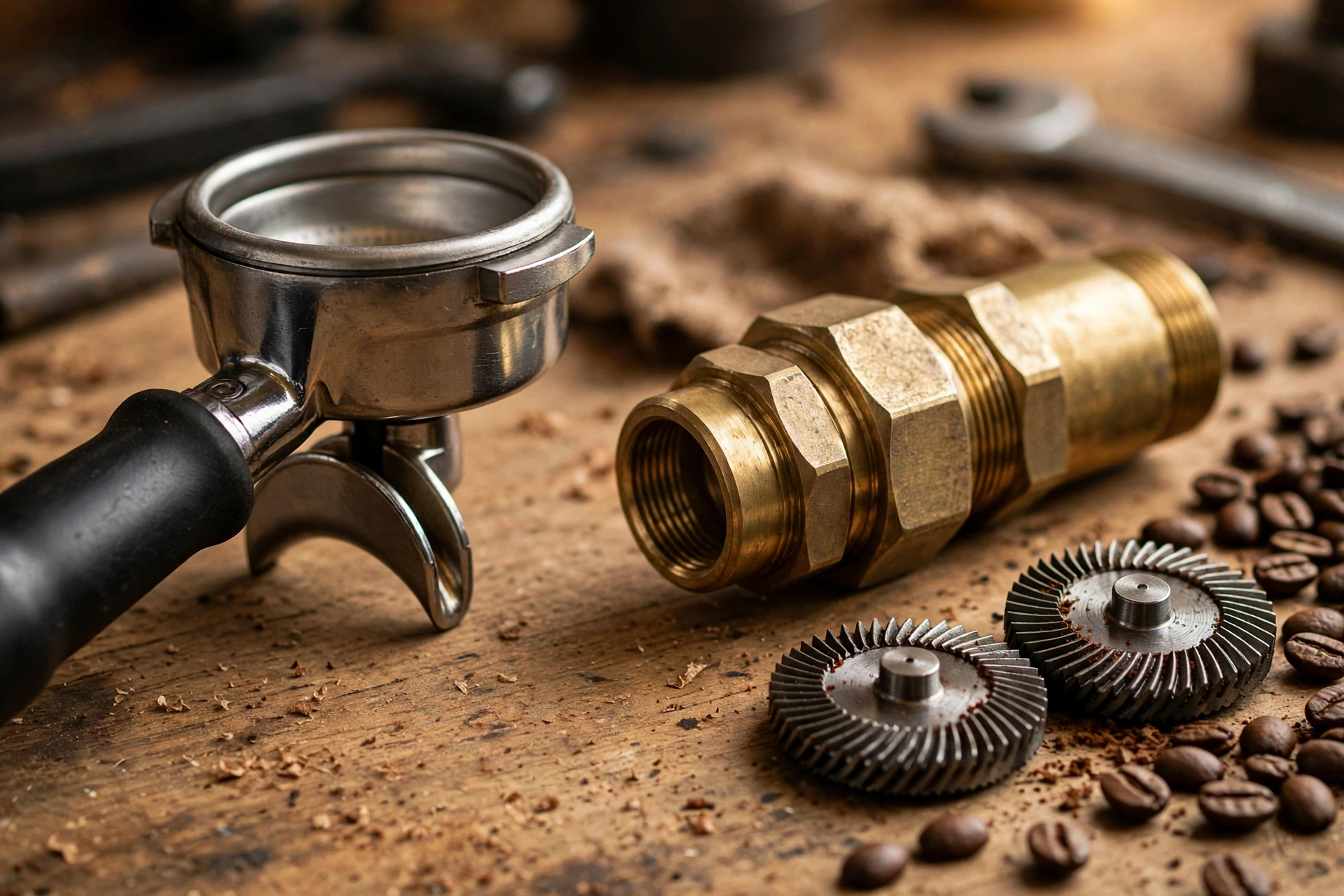
Many serious coffee drinkers will say the grinder matters most, not the machine. Espresso needs a fine, even grind; uneven grounds over-extract the dust and under-extract the boulders, and no machine can fix that. A decent conical burr grinder alone costs ₹1,000–₹3,000 — see our Best Coffee Grinder Under ₹3000 in India guide — and a good one costs more. Today, for example, the AGARO Elite manual grinder costs ₹1,299 on the brand store.
Bean-to-cup machines build that grinder in: hardened steel or ceramic burrs, a motor, grind settings, a hopper and a dosing system, all squeezed into the same box. That is why a bean-to-cup machine starts at roughly ₹50,000 today — a grinder and an espresso machine in one body, with one warranty, as our Best Coffee Machine with Grinder India guide shows. If you already own a good burr grinder, a machine without one plus your existing grinder will usually beat a bean-to-cup machine on coffee quality for less money.
4. Materials: Steel, Brass and Plastic Are Not the Same Price
Pick up a ₹233 steel filter and a ₹9,499 espresso machine and the weight tells the story. Cheap machines are mostly plastic: light, cheap to mould, fine for a drip maker that never sees pressure, but it flexes, stains and ages. Mid-range and premium machines use stainless housings, brass or stainless boilers, chrome-plated brass portafilters and metal steam wands — costlier to buy, machine and ship, and longer-lasting, which is part of the point.
Indian conditions make this matter more: hard water scales up boilers, humidity corrodes cheap chrome, and a machine that lives on an Indian countertop for five years needs materials that survive both. Plastic is not automatically bad — some excellent brewers are plastic — but when a machine holds pressure and heat, metal is a cost, not a decoration.
5. Automation: One Button Is a Lot of Engineering
A moka pot asks you to do everything: grind, fill, watch the heat, pour. A bean-to-cup machine asks you to press one button. Between those two sits an enormous amount of engineering: sensors for the bean hopper, water tank and drip tray; motors that dose and tamp; milk systems that froth to the right temperature and clean themselves; displays, drink memories and self-cleaning cycles.
Every automated step removes a chore and adds a part that can fail — which is why the warranty and service network matter as much as the feature list. For a household drinking four cappuccinos a morning, automation is genuinely valuable; for one black coffee a day, it is wasted money.
6. Import Duties, GST and the India Markup
Most espresso machines sold in India are imported, and imports carry costs a locally made steel filter never sees. Customs tariff data for coffee/tea makers (HS code 85167100) lists a 20% basic customs duty, plus a 10% Social Welfare Surcharge on that duty, with 18% IGST charged on the duty-inclusive value — before freight, distributor and dealer margins and the cost of running an Indian warranty and service network. And the duty layer moved in 2026: a concessional rate that many imported machines entered under rose from 7.5% to 10% when exemptions lapsed on 2 February 2026, with coffee chains expecting 3–4% cost inflation — and because a higher duty lifts the GST taxable value too, the rise costs more than the duty alone. Add a rupee at about ₹90 to the dollar, and a machine that leaves a European factory at one price lands in an Indian warehouse at a materially higher one, before the retailer adds a margin.
This is also why some famous international models are missing or oddly priced in India: with no official distributor, you get import listings with converted prices, no Indian warranty and no local service — sometimes at ₹1 lakh or more for a machine that costs half that abroad. Our Coffee Machine Price in India (2026) guide names these absentees plainly: a machine you cannot buy with a warranty is not a deal, however good the headline price looks.
7. Brand, R&D and Service: The Invisible Part of the Price
The last slice is the least visible and the easiest to dismiss as “brand tax” — but it is not all marketing. A company that has spent decades refining boilers, grinders and milk systems charges for that engineering. More importantly, an established brand runs service centres, stocks spare parts and honours warranties. At ₹50,000 and above, that network is worth real money: a machine with no service backup is a gamble.
None of this means every expensive machine is worth it — brands do charge a premium for a name. The honest test is always the same: compare the street price (not the MRP) against machines with similar pumps, boilers and grinders, and check warranty terms before the badge.
The Price Ladder in India Today
Here is what the seven cost drivers add up to, with prices verified today, 13 November 2026. The jump from each row to the next buys a specific thing — not just a fancier box. Two honesty notes: the two Amazon prices below are our price tracker’s same-day verified figures, not live listing reads; and the Philips 3200 EP3221/40 is not the LatteGo model — it has a Classic Milk Frother, and it is not listed on Croma today.
| Brewer / machine | What the money buys | Price today (13 Nov 2026) | Verdict |
|---|---|---|---|
| CENTURA steel filter, 100ml | Gravity brewing, no moving parts | ₹228 (Flipkart) | Cheapest honest start |
| InstaCuppa French Press, 600ml | Full-immersion brewing, steel mesh | ₹1,599 (brand store) | Best cheap brewer for two |
| InstaCuppa Classic moka pot, 300ml | Stovetop pressure brewing | ₹1,999 (brand store) | Strongest cup under ₹2,000 |
| Morphy Richards Europa drip, 6-cup | Automatic drip, warming plate | ₹1,799 (Flipkart) | Cheapest automatic brewing |
| InstaCuppa Electric moka pot, 300ml | Push-button moka, no stove needed | ₹3,599 (brand store) | Easiest strong coffee, no stove |
| IBELL BaristaMax300, 20-bar | Real espresso plus a steam wand | ₹6,990 (Amazon.in, tracker-verified today) | Cheapest real espresso |
| Wonderchef Regalia Neo, 20-bar | Espresso plus frother, double thermoblock | ₹9,499 (brand store) | Best-value pump machine |
| AGARO Imperial, 15-bar | Espresso plus adjustable milk wand | ₹8,808 (Amazon.in, tracker-verified today) | Most controllable budget pump |
| Wonderchef Regenta Automatic, 20-bar | One-touch automatic espresso drinks | ₹19,999 (brand store) | Cheapest one-touch automatic |
| Philips 3200 EP3221/40 | Bean-to-cup, Classic Milk Frother | ₹61,990 (Aalapelectronics) | Cheapest bean-to-cup we could verify |
| Budan X7 | Bean-to-cup, 16+ one-touch drinks | ₹76,599 (Something’s Brewing) | Widest one-touch menu |
Check the latest offer and conditions for the IBELL BaristaMax300, Wonderchef Regalia Neo and AGARO Imperial on our deals page.
CENTURA Steel Filter, 100ml — ₹233

Price: ₹228 on Flipkart (MRP ₹599) — checked 13 November 2026, in stock, 4★ from 598 ratings on the listing. It was ₹195 on 30 October 2026: up ₹38 in two weeks. The lowest we have tracked is ₹195 (24 October 2026).When this guide was published (30 Oct 2026): ₹195 at Flipkart.
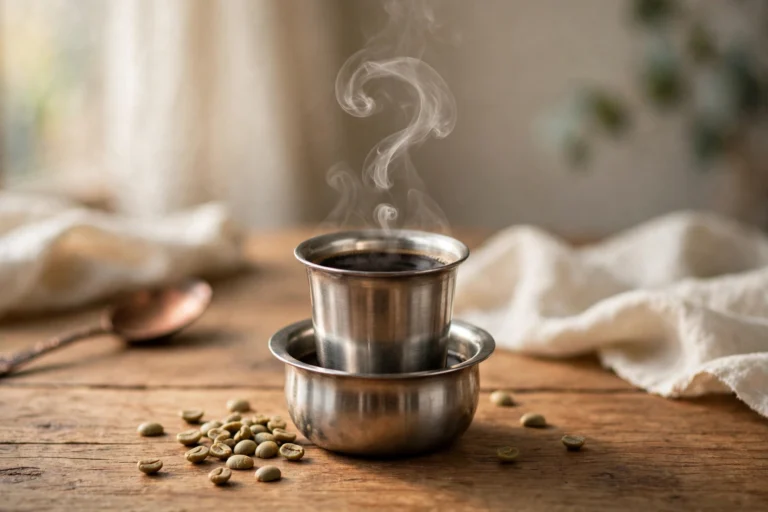
Key details: 100ml capacity, 2 cups, stainless steel, gravity drip (South Indian filter), no power needed, no moving parts.
Why it wins: it is the cheapest honest start in Indian coffee — a steel container that makes real filter kaapi for the price of one café cup, with nothing to break.
Watch out for: 100ml makes two small tumblers only, not two mugs; and CENTURA is a Flipkart marketplace brand with no service network, so judge it on the steel and the price, not on a warranty.
Best for: filter-kaapi drinkers who want the cheapest start and brew one or two tumblers at a time.
When to buy: at ₹233 it is mid-range — it was ₹195 on 24 October, so wait for a dip toward ₹195 if you are not in a hurry.
InstaCuppa French Press, 600ml — ₹1,599
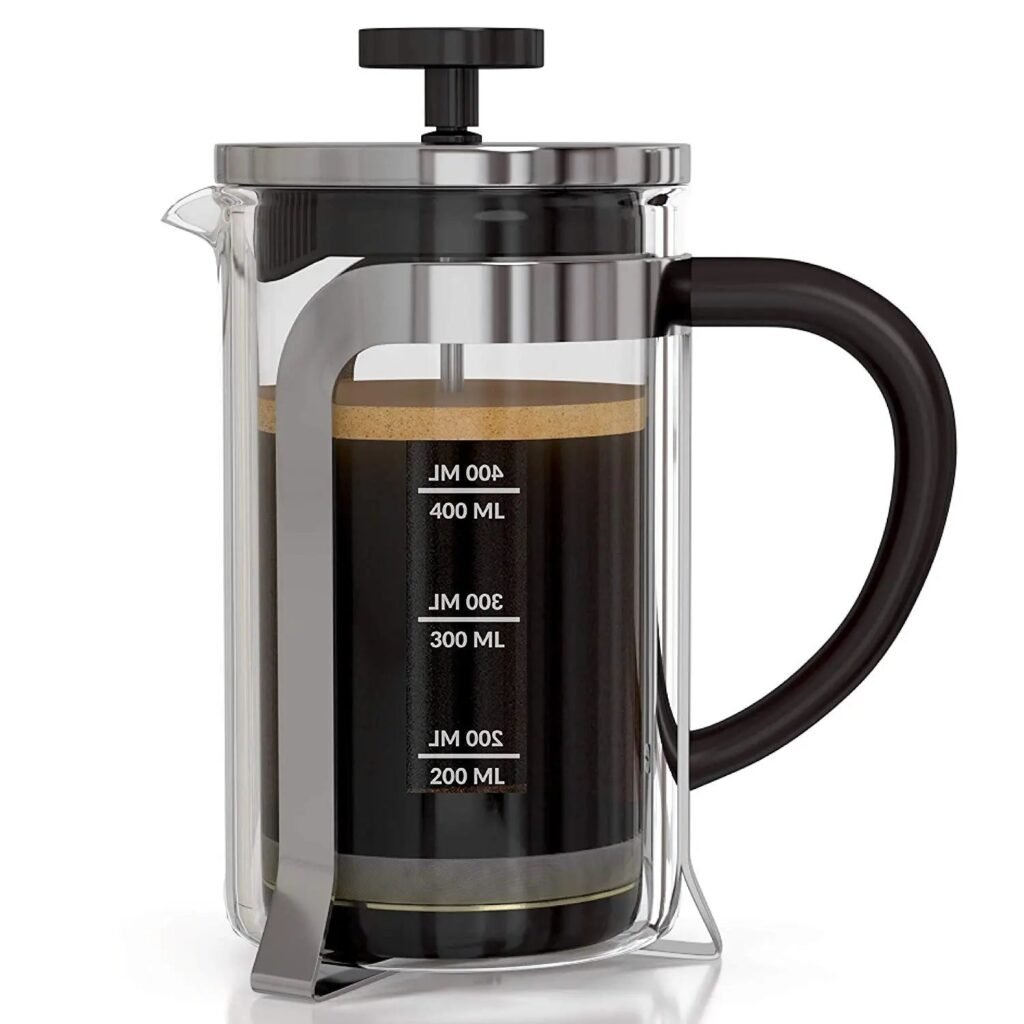
Price: ₹1,599 on the InstaCuppa store — checked 13 November 2026, all colours (Clear, Black, Copper) in stock at 600ml. It was ₹1,499 on 30 October 2026: up ₹100 in two weeks. The lowest we have tracked is ₹1,299 (8 October 2026), and it dipped to ₹1,399 intraday today.When this guide was published (30 Oct 2026): ₹1,499 at InstaCuppa.
Key details: 600ml, heat-resistant glass, steel mesh 4-part filter, 2 spare filters, scoop and cleaning brush in the box, 395g, 1-year warranty.
Why it wins: full-immersion brewing is the simplest way to a full-flavoured cup, and 600ml serves two properly — with spare filters in the box, the running cost is nil.
Watch out for: the beaker is glass, so it can break; fine sediment gets through the mesh into the cup; and check you are buying the 600ml, not the 350ml — the smaller size costs less and brews less.
Best for: two-cup households that want full-immersion brewing without power or pressure.
When to buy: today ₹1,599 is the top of its range — wait for a dip toward ₹1,399, which it touched intraday today.
InstaCuppa Classic Moka Pot, 300ml — ₹1,999
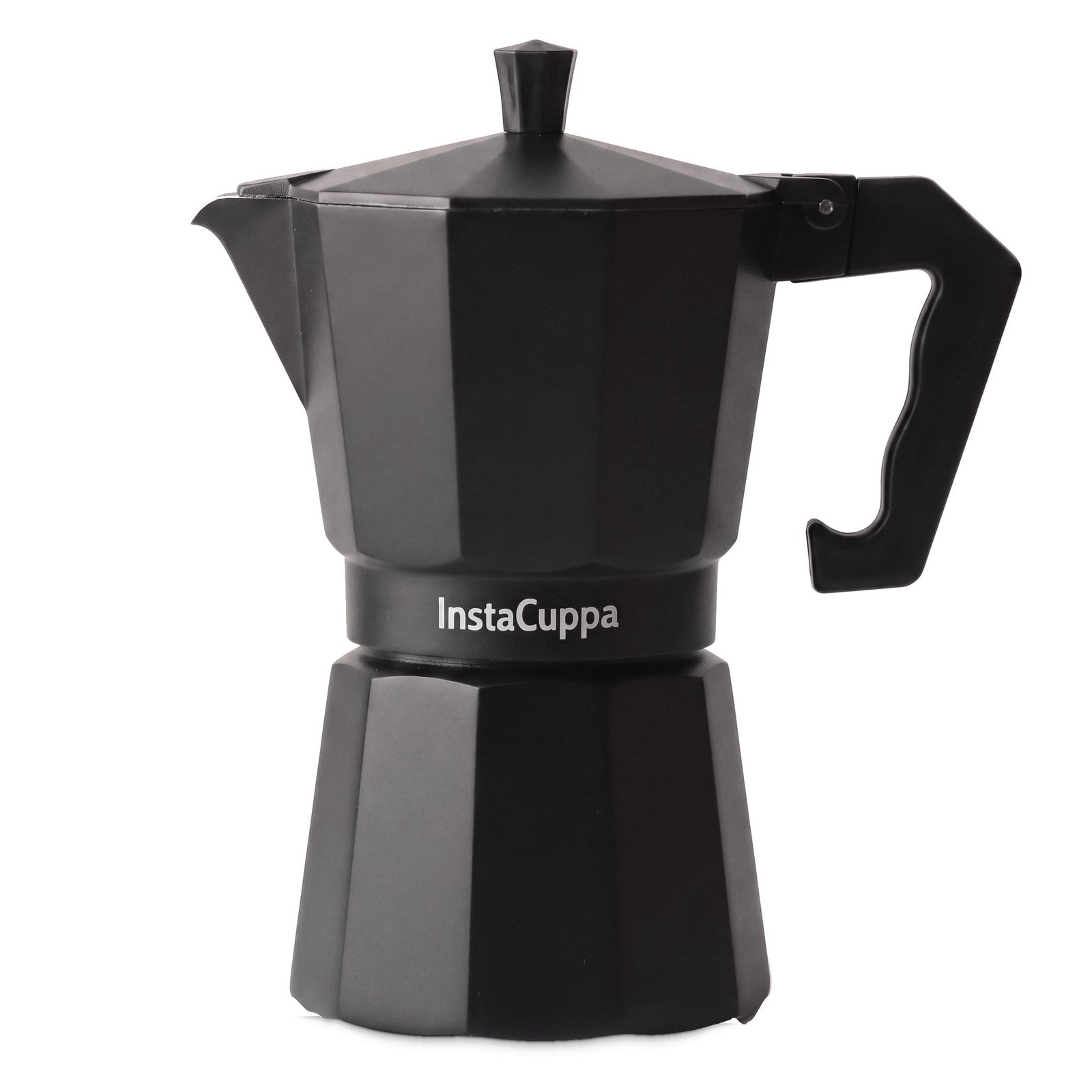
Price: ₹1,999 on the InstaCuppa store (MRP ₹2,499) — checked 13 November 2026, all colours (Black, Silver, Red) in stock. It was ₹1,799 on 30 October 2026: up ₹200 in two weeks. The lowest we have tracked is ₹1,799 (15 October 2026).When this guide was published (30 Oct 2026): ₹1,799 at InstaCuppa.
Key details: 300ml / 6 moka cups, food-grade aluminium, brass safety valve, 440g, gas stove (induction only if the cooktop detects the 8cm base), 1-year warranty.
Why it wins: stovetop pressure gives the strongest cup under ₹2,000 — the cheapest route to espresso-like intensity without a pump.
Watch out for: aluminium means no induction unless your cooktop detects the 8cm base; and 300ml is six small moka cups, not six mugs — it serves two generously, not six.
Best for: stovetop coffee lovers who want the strongest cup under ₹2,000 and enjoy the ritual.
When to buy: today ₹1,999 is the top of its range — wait for ₹1,799, its price a month ago.
Morphy Richards Europa Drip, 6-Cup — ₹1,482

Price: ₹1,799 on Flipkart (MRP ₹3,095) — checked 13 November 2026, in stock, 4.1★ from 2,019 ratings on the listing. It was ₹1,799 on 30 October 2026: down ₹317 in two weeks. The lowest we have tracked is ₹1,482 (4 November 2026) — today is that low.Same price as when this guide was published (₹1,799, 30 Oct 2026).
Key details: 600W, 600ml carafe, 6 cups, anti-drip, warming plate, 2-year warranty.
Why it wins: it is the cheapest automatic brewing in the ladder — fill it, switch it on, and six cups brew themselves while the plate keeps them warm.
Watch out for: drip only, so no pressure, no espresso and no crema; and the carafe is glass, not steel, so it needs a careful hand.
Best for: families that want set-and-forget drip for six cups at a time.
When to buy: at ₹1,482 it is at its recent low — buy now if you need a drip maker.
InstaCuppa Electric Moka Pot, 300ml — ₹3,599

Price: ₹3,599 on the InstaCuppa store — checked 13 November 2026, Black and Silver both in stock; the same ₹3,599 on Amazon.in per a price-tracker check today (MRP ₹5,999). It was ₹3,199 on 30 October 2026: up ₹400 in two weeks. The lowest we have tracked is ₹3,199 (17 October 2026).When this guide was published (30 Oct 2026): ₹3,199 at InstaCuppa.
Key details: 300ml / 6 cups, food-grade aluminium, 110°C brew, 3–4 minutes, 125°C auto cut-off plus keep-warm, 1.1kg, 1-year warranty.
Why it wins: the same strong moka cup as the stovetop pot, at the push of a button — no stove, no watching the heat, and it switches itself off.
Watch out for: it needs a power socket by the counter; the body is aluminium; and 300ml is six small cups, not six mugs.
Best for: anyone who wants moka without a stove — office desks and induction kitchens included.
When to buy: today ₹3,599 is the top of its range — wait for ₹3,199, its price a month ago.
Buy at InstaCuppa Buy on Amazon
IBELL BaristaMax300, 20-Bar — ₹6,990
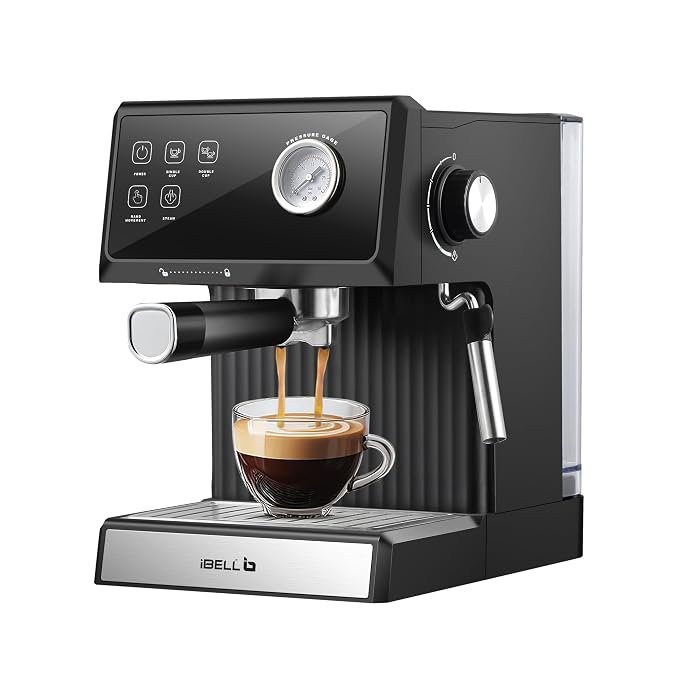
Price: ₹6,990 on Amazon.in (MRP ₹13,700) — our price tracker’s same-day verified figure, 13 November 2026. Unchanged from 30 October 2026. The lowest we have tracked is ₹6,790 (17 October 2026).
Key details: 20-bar pump, 1200W, 1.8L tank, touch controls, steam wand, 2-year warranty (1+1 on registration).
Why it wins: it is the cheapest real espresso in the ladder — a 20-bar pump and a steam wand for under ₹7,000, where the next rung up costs ₹2,000 more.
Watch out for: a vibration pump with a pressurised basket, so the crema is helped along rather than earned; and touch controls rather than a dial, which some buyers find fiddly.
Best for: first-time espresso buyers on the tightest budget who want real pressure and a steam wand.
When to buy: near its low — it was ₹6,790 on 17 October, so ₹6,790 is the wait-for level if you are not in a hurry.
Wonderchef Regalia Neo, 20-Bar — ₹9,499

Price: ₹9,499 on the Wonderchef store (MRP ₹23,000) — checked 13 November 2026, in stock. It was ₹8,999 on 30 October 2026: up ₹500 in two weeks. The lowest we have tracked is ₹8,999 (17 October 2026).When this guide was published (30 Oct 2026): ₹8,999 at Wonderchef.
Key details: 20-bar pump, 1200W, 1.5L tank, metal portafilter, double thermoblock, built-in frother, LCD panel, 2-year warranty.
Why it wins: double thermoblock plus a metal portafilter plus a frother, at the lowest price for that spec set — the best-value pump machine in the ladder.
Watch out for: a double thermoblock is not a boiler, so temperature swings more between shots than on a boiler machine; and the 1.5L tank needs refilling often in a heavy-drinking household.
Best for: daily espresso and cappuccino drinkers who want a frother at the lowest honest price.
When to buy: today ₹9,499 is ₹500 above its recent low of ₹8,999 — wait for ₹8,999 if you can.
AGARO Imperial, 15-Bar — ₹8,808
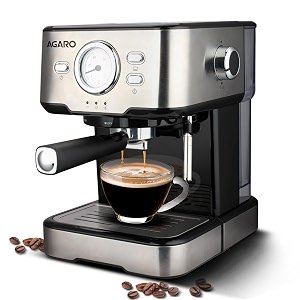
Price: ₹8,808 on Amazon.in (MRP ₹16,990) — our price tracker’s same-day verified figure, 13 November 2026. It was ₹9,560 on 30 October 2026: down ₹752 in two weeks. The AGARO store also sells it, at ₹9,999. The lowest ever recorded is ₹6,999 (July 2022).
Key details: 15-bar pump, 1100W, 1.5L tank, analogue dial thermometer, 2 thermostats, stainless steel body, adjustable milk frothing wand.
Why it wins: the analogue thermometer dial is genuinely useful at this price — you can see the temperature instead of guessing it — and the adjustable wand gives you more control over milk than any rival under ₹9,000.
Watch out for: the milk wand is manual, so you froth the milk yourself and it takes practice; and the dial is analogue, not a digital temperature readout.
Best for: buyers who want temperature feedback and a controllable wand on their first pump machine.
When to buy: at ₹8,808 it is near the low end of its usual ₹8,000–9,500 band — a fair price today; the ₹6,999 all-time low is a sale-season hope, not a plan.
Wonderchef Regenta Automatic, 20-Bar — ₹19,999

Price: ₹19,999 on the Wonderchef store (MRP ₹33,000) — checked 13 November 2026, in stock. Unchanged from 30 October 2026, and flat at ₹19,999 in our tracking.Same price as when this guide was published (₹19,999, 30 Oct 2026).
Key details: 20-bar pump, 1200W, 1.8L tank, automatic frothing with a built-in milk container, 2 thermostats, temperature dial, 2-year warranty.
Why it wins: it is the cheapest one-touch automatic in the ladder — the built-in milk container means cappuccinos at the press of a button, with no manual steaming to learn.
Watch out for: the built-in milk container needs cleaning after milk drinks, or it sours; and do not confuse it with the cheaper Regenta 19-bar (₹8,499, manual steamer, 1.5L tank) — a different machine with a similar name.
Best for: households that want one-touch milk drinks without learning to steam milk.
When to buy: flat at ₹19,999 with no dip pattern in our tracking — buy when you need it.
Philips 3200 Series EP3221/40 — ₹61,990

Price: ₹61,990 at Aalapelectronics (MRP ₹69,990) — checked 13 November 2026, in stock. The old ₹49,994 figure was a stale Smartprix listing; the verified price today is ₹61,990. Two corrections to the old article: this model has a Classic Milk Frother (a manual steam wand), not the one-touch LatteGo system — LatteGo is the EP3241/54 variant — and it is not listed on Croma today (the ₹64,999 Philips on Croma is the 2200 Series, a different machine).
Key details: 15-bar pump, 1500W, ceramic grinder with 12 settings, 1.8L tank, 275g bean hopper, AquaClean filter, 4 drinks, touch display, 2-year warranty.
Why it wins: it is the cheapest bean-to-cup machine we could verify in India today, with a ceramic grinder and an AquaClean filter that stretches descaling to 5,000 cups.
Watch out for: the frother is manual, not one-touch — you steam the milk yourself; it makes 4 drinks only; and at 7.5kg it needs a permanent counter spot.
Best for: black-coffee households that want bean-to-cup at the lowest verified price and do not mind steaming milk by hand.
When to buy: tracked only since 11 November at a flat ₹61,990 — no dip history yet, so check the live price before paying.
Budan X7 — ₹76,599

Price: ₹76,599 at Something’s Brewing (MRP ₹1,09,999) — checked 13 November 2026, in stock. Unchanged from 30 October 2026. Budan has no standalone store of its own — Something’s Brewing is the brand’s official sales and service partner, so this is effectively the brand store.Same price as when this guide was published (₹76,599, 30 Oct 2026).
Key details: 19-bar pump, built-in conical burr grinder, 250g hopper, 1.7L tank, 16+ one-touch drinks, touchscreen, automatic cleaning programme, 1-year warranty.
Why it wins: the widest one-touch menu in the ladder — 16+ drinks from a touchscreen — from an Indian brand, at a price the international brands cannot match for the same menu.
Watch out for: the owner-evidence base is thin (no aggregated rating exists anywhere we could verify); the hopper runs dry at awkward moments; the milk steel needs hand washing; and the footprint is a permanent counter commitment.
Best for: touchscreen-and-menu buyers who want the widest one-touch choice from an Indian brand.
When to buy: flat at ₹76,599 since tracking began — no dip history yet.
The pattern is the point. Under ₹3,000, you are buying a brewer — it makes coffee, and you do the work. Between ₹3,000 and ₹15,000, you are buying pressure and temperature control: real espresso, with effort. Above that, you are increasingly buying convenience, consistency and service; above ₹50,000, a grinder, a boiler and a milk system in one box, plus the warranty to back all three.
What a Year of Coffee Actually Costs
The machine is only the first payment. For a two-cup-a-day household, the beans cost more than a budget machine within a year — so the running cost, not the sticker price, decides whether an expensive machine is worth it. Working, checked 13 November 2026:
| Drink (at home) | Beans | Milk | Descaler / filters | Home cost per cup |
|---|---|---|---|---|
| Filter kaapi (12g coffee) | ₹29 (250g at ₹599 = ~20 cups) | ₹3 | ~₹0 | ~₹32 |
| Cappuccino (15g coffee) | ₹36 (250g at ₹599 = ~17 cups) | ₹3 | ₹1 | ~₹40 |
Beans are Sleepy Owl Original whole beans, 250g at ₹599, verified 13 November 2026. Milk is ~60ml of toned milk per cup. A café cappuccino in India retails at roughly ₹80–150 (Kaapi Machines price guide) — so a home cappuccino at ~₹40 saves ₹40–110 a cup. Against a ₹10,798 setup (Regalia Neo ₹9,499 + AGARO Elite grinder ₹1,299), that pays back in ~270 cups at café ₹80 (about 4½ months at two cups a day) or ~98 cups at café ₹150 (about 7 weeks). And the beans alone run to about ₹1,200 a month — ₹14,400 a year — before descaler and filters. A machine you cannot afford to feed is a decoration.
What You Do Not Need to Pay For
Not every rupee of a high price is justified. Three things are routinely overpaid for in India.
MRP theatre. Many listings show a huge struck-through MRP — we have seen ₹1,22,999 on a machine selling for far less — to make a normal street price look like a big discount. Judge every machine on its street price, never on the MRP.
Bar-pressure marketing. As noted above, espresso brews at about 9 bars. A 20-bar badge over a 15-bar badge is not a quality signal on its own.
Features you will not use. Iced-coffee modes, 24 drink recipes, app control and touchscreens are nice, but if you drink two espressos a day, they add cost without adding coffee. Pay for the drinks you actually make.
When a Cheap Brewer Beats an Expensive Machine
Here is the honest counterweight: for many Indian drinkers, the best coffee comes from the cheapest gear. A South Indian filter, a moka pot or a French press makes superb coffee with fresh beans and a little practice — and our Moka Pot vs South Indian Filter comparison shows how to choose between them. The expensive machine wins on espresso, milk drinks and convenience; it does not win on filter kaapi, and it does not make stale beans taste fresh.

The rule of thumb at Kaapi Craft: spend the most on what touches the coffee — fresh beans first, then a good grinder, then the brewer. A ₹233 filter with ₹599 beans will beat a ₹50,000 machine with month-old beans almost every time. The machine is the last upgrade, not the first.
Who Should Not Buy an Expensive Machine
An expensive machine is the wrong buy for more households than the right one. Skip it — or wait — if any of these is you:
You drink filter kaapi or moka happily. No pump machine makes better filter kaapi than a ₹233 steel filter. Spend the money on beans instead.
You drink one black coffee a day. One-touch milk systems, 24 drink recipes and a built-in grinder earn nothing on one cup. A ₹1,999 moka pot and a ₹1,299 grinder cover you.
You will not descale or clean it. Hard water scales a boiler within months in most Indian cities. A machine you will not maintain dies early and expensively — a brewer with no boiler cannot.
Your pick has no Indian service network. At ₹15,000 and above, an import listing with no local service is a risk, not a bargain — however good the headline price looks.
Your pick is at its recent high. The Regalia Neo is ₹9,499 today against a ₹8,999 low a month ago; the Electric moka is ₹3,599 against ₹3,199. If you can wait, wait for the low.
Buying Guide: How to Decide What to Spend
Five questions, answered honestly, will place you on the ladder above:
1. What do you actually drink? Filter kaapi or moka pot coffee → stay under ₹3,000 and spend the rest on beans. Espresso and cappuccino daily → budget at least ₹8,000–₹15,000.
2. How many cups a day? One or two → any machine copes. Four or more, or a family → check tank size, and consider bean-to-cup only if the convenience genuinely saves you time every day.
3. Do you already own a grinder? Yes → buy a machine without one and keep your grinder. No, and you want espresso → a bean-to-cup machine starts making sense, but only from about ₹50,000.
4. Who services it? At ₹15,000 and above, prefer a machine with an Indian warranty and a service network. An import listing with no local service is a risk, not a bargain.
5. What is your real budget, including beans? Keep aside roughly ₹1,200 a month for fresh beans (a 250g bag at ₹599 lasts a two-cup-a-day household about two weeks), plus descaler and filters for pump machines. A machine you cannot afford to feed is a decoration.
If you are still deciding between machine types, our Best Espresso Machine Under ₹15000 in India guide compares the mid-range in detail, and the Best Moka Pot in India guide covers the best cheap route to strong coffee.
Verdict
So why coffee machine is expensive in India? Because a real espresso machine is a pressure vessel, a boiler, a pump and often a grinder, built from metal, shipped across the world, taxed at the border and backed by a service network — while a steel filter is a container with holes. Both make coffee; only one makes espresso at the touch of a button, and that gap is what the price buys.
Our advice: if you love filter kaapi or moka pot coffee, stay cheap and buy better beans. If you drink espresso or milk coffee daily, spend ₹8,000–₹15,000 on a pump machine with an Indian warranty and a separate burr grinder. Only step up to a ₹50,000-plus bean-to-cup machine when one-button convenience will genuinely change your mornings — that is what you are really paying for.
Frequently Asked Questions
Why are espresso machines so expensive compared to coffee makers?
A drip maker just heats water and lets gravity do the work. An espresso machine forces water through coffee at about 9 bars at a stable 90–96°C, which needs a pump, a boiler or thermoblock, pressure valves, safety systems and metal construction. That engineering, plus import duties and service costs in India, is the price gap.
Is a ₹50,000 coffee machine worth it?
Only if you use what it does: a bean-to-cup machine at that price buys a built-in burr grinder, one-touch milk drinks and consistency with no skill required. If you drink one black coffee a day, it is not worth it — a ₹1,299 grinder and a ₹9,499 pump machine will make better coffee for a fifth of the price. If your household runs on four cappuccinos a morning, the convenience can be worth it.
Why are coffee machines costlier in India than abroad?
Three reasons: import duties and GST on imported machines, distributor and dealer margins in a smaller market, and the cost of an Indian warranty and service network. The duty layer moved in 2026 — a concessional rate rose from 7.5% to 10% when exemptions lapsed on 2 February 2026, with chains expecting 3–4% cost inflation — and a rupee at about ₹90 to the dollar adds more. Models with no official Indian distributor only appear as import listings at converted prices with no local service — not a genuine saving.
Does a higher bar rating mean better coffee?
No. Espresso brews at around 9 bars whatever the box says — 15, 19 or 20 bars is the pump’s maximum, not the brewing pressure. Temperature stability, grind quality and fresh beans matter far more than the bar number.
Can a cheap machine make good espresso?
Yes, with limits. Entry-level pump machines around ₹5,000–₹9,000 make real espresso with crema, especially with a good burr grinder and fresh beans. What you give up is temperature stability, build quality, milk-steaming power and longevity — not the ability to make a good shot.
Why is a South Indian filter or moka pot so cheap?
Because there is almost nothing to pay for: no pump, no boiler, no electronics, no grinder. A steel filter is a container with a perforated plate; a moka pot is three chambers heated by your stove. The coffee still tastes superb because the method is simple and the beans do the work — which is why cheap brewers are the smartest first purchase.
How much should I pay for a coffee machine in India?
It depends on what you drink. Under ₹3,000 buys an excellent brewer — filter, moka pot or French press. ₹7,000–₹15,000 buys the first real espresso machine with a steam wand. ₹19,999 buys the cheapest one-touch automatic. Bean-to-cup starts at about ₹50,000 — the De’Longhi Magnifica S was ₹49,999 on 11 November 2026, and the cheapest bean-to-cup we could verify today is the Philips 3200 EP3221/40 at ₹61,990. Above ₹77,000 you are paying for menu width and touchscreens, not better coffee.
Why are brands like Jura, La Marzocco and Smeg so expensive?
Four things stack up: low production volumes (a few thousand units a year, not millions), hand assembly and expensive materials (brass, copper, stainless), decades of R&D in boilers and grinders, and a service network with spare parts. A premium badge also carries a premium — but on the best machines the engineering is real, and the service network is what you are actually buying at the top end.
Do I need a separate grinder for a budget espresso machine?
Yes, for espresso. A budget pump machine has no grinder, and pre-ground coffee goes stale within days — espresso needs a fine, even grind made fresh. A ₹1,299 manual burr grinder plus an ₹8,808–₹9,499 pump machine will make better espresso than any cheap machine with a built-in grinder, because built-in grinders only appear on bean-to-cup machines starting at about ₹50,000.
Why are built-in (bean-to-cup) machines so expensive?
Because they are two machines in one box: a burr grinder (burrs, motor, grind settings, hopper, dosing) plus an espresso machine (pump, boiler or thermoblock, milk system), with the automation to run both at one button-press and one warranty covering all of it. That is why they start at about ₹50,000, while a separate grinder and pump machine together cost under ₹11,000.
Prices checked on 13 November 2026 on Amazon.in (via price tracker), Flipkart and official brand stores. Prices change frequently — the price at checkout is what counts.
About the author
Kaapi Craft Editorial — Coffee-gear recommendations at Kaapi Craft are researched by our editorial team. We compare specifications from manufacturer product pages, verify street prices across Amazon.in, Flipkart and official brand stores in India, and check warranty terms before recommending anything. Prices are re-checked before major sales. Our picks are never paid placements.