Blue Tokai Coffee Roasters is India’s best-known specialty coffee brand — and its story starts not in a boardroom but in a spare bedroom in Delhi, with a 500-gram roaster and about ₹10 lakh of savings. Husband and wife Matt Chitharanjan and Namrata Asthana began roasting in 2012 and launched the brand in 2013, because India grew some of the world’s finest coffee yet sold almost none of it at home. Today Blue Tokai runs around 240 cafés across India, works directly with more than 80 estates, and reported about ₹325 crore in revenue in FY25. This is the blue tokai coffee story: how a home roaster became a national brand, what it actually sells, what its beans cost today, and which bag to buy first.
Last verified: 25 November 2026.
AT A GLANCE — Blue Tokai was founded by Matt Chitharanjan and Namrata Asthana, who started roasting in a Delhi bedroom in 2012 and launched the brand in 2013; Shivam Shahi joined as the third co-founder in 2016. It buys directly from 80+ Indian estates, roasts in-house, and sells beans, cold brew and café drinks — at flat MRP prices, with no deep-discount sale calendar. Its three best-known estate beans cost ₹700–₹800 for 250 g (checked 25 November 2026), or about ₹42–₹48 a cup at home. First buy: Attikan Estate for espresso and moka pot. Skip it if your coffee is instant-only — at roughly nine times the per-cup cost of instant, Blue Tokai is a flavour upgrade, not a caffeine bargain.
The Blue Tokai coffee story in 60 seconds
Matt Chitharanjan moved to India from the United States in 2011, after more than a decade there studying finance and economics and working in consulting. His partner Namrata Asthana had studied in the US too and worked in communications at PepsiCo India. Living first in Chennai, they found it nearly impossible to buy freshly roasted coffee — even though India grew excellent beans. The good stuff was exported; what stayed behind was instant or generic ground coffee.
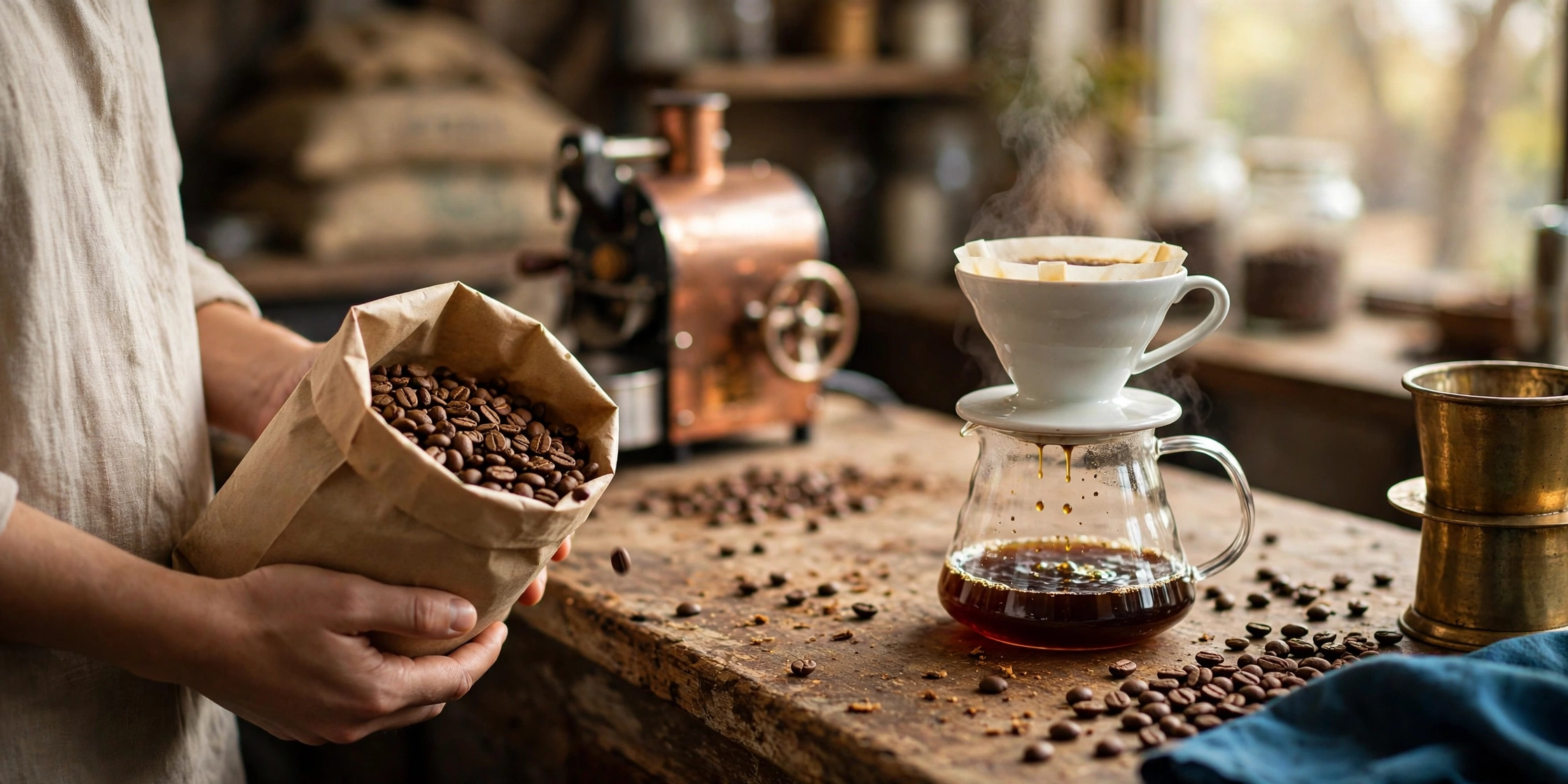
In 2012 the couple moved to Delhi, built a website, found a packaging company and began sourcing Arabica directly from Indian farmers. They installed a small Taiwanese tabletop roaster — a 500-gram machine — in a spare bedroom of Namrata’s parents’ house, and started roasting, packing and selling beans themselves. The brand launched in 2013 under the name Blue Tokai Coffee Roasters. One detail the sources disagree on, honestly recorded: Wikipedia lists the founding as 2012, while nearly every press profile dates the launch to 2013. Both are true in their own way — 2012 is when the roasting started, 2013 is when it became a brand.
Shivam Shahi joined in 2016, after discovering Blue Tokai online and applying through a cold LinkedIn message. He had lived in Canada, where specialty coffee had shown him customers would pay for quality, and he took over café and retail operations as the third co-founder and COO. The company sold beans only, through its website, until the café business took off around 2020.
The idea that built it
Blue Tokai’s founding idea was simple, and it is still the whole business: India grows great coffee and exports it, so Indians drink instant. The founders’ bet was that a middle ground existed — freshly roasted, single-estate Indian coffee, with the farm named on the bag. As Shivam Shahi put it in a Business Today interview, “India was growing good, specialty coffee, but most of it was getting exported. Domestic consumption was minimal.” The brand’s own claim, in the co-founder’s words, is that it was the first to start specialty coffee in India.
The name fits the idea. “Tokai” comes from an old Malabari word for a peacock’s tail — the founders wanted the name to carry the beauty and complexity they saw in a good cup. The peacock motif still runs through the brand’s packaging and café art.
From a bedroom roaster to 240 cafés: the timeline
| Year | What happened | Why it mattered |
|---|---|---|
| 2011 | Matt moves from the US to Chennai; the couple can’t find freshly roasted coffee | The problem is spotted: great Indian beans, no Indian market for them |
| 2012 | Move to Delhi; roasting begins on a 500-gram roaster in a spare bedroom, ~₹10 lakh invested | The bootstrapped start — no outside funding for the first two years |
| 2013 | Blue Tokai Coffee Roasters launches as a brand, selling beans online | India’s first specialty-coffee brand for home brewers is born |
| 2015 | First roastery-cum-café opens in Champa Gali, Delhi | Customers can finally taste the coffee before buying the beans |
| 2016 | Mumbai’s first café-cum-roastery opens at Mahalaxmi; Shivam Shahi joins as third co-founder | The brand goes beyond Delhi; café operations get a dedicated leader |
| 2017 | Café inside Bahrisons Booksellers, Delhi (later Chandigarh too) | Coffee meets bookshops — the brand’s neighbourhood-café identity takes shape |
| 2020 | Beans-only era ends; cafés become the growth engine | The pandemic-era home-brewing surge pushes the brand into the mainstream |
| 2024 | $35 million Series C led by Verlinvest; Suchali’s Artisan Bakehouse acquired | Funding for 350+ cafés; an in-house bakery joins the cafés |
| 2025–26 | About ₹325 crore revenue in FY25; ~240 cafés; Temasek and ChrysCapital reported competing to invest ₹1,000–1,200 crore | From bedroom roaster to a multi-thousand-crore valuation story |
Timeline sources: Wikipedia (Blue Tokai), Economic Times, Inc42, YourStory and Hindu BusinessLine — linked in Sources below. Where sources disagree on the founding year, the article says so rather than picking one.
What Blue Tokai actually sells in India today
Four things, in order of what matters to a home brewer. First, beans: single-estate Arabica from Indian farms — Attikan, Sandalwood, Kalledevarapura, Ratnagiri, Harley Estate and others — plus house blends such as Silver Oak and Vienna Roast, sold whole bean or ground for your brewer, in 250 g, 500 g and 1 kg bags. Second, ready-to-drink coffee: cold brew bags and canned Classic Bold cold brew. Third, cafés: around 240 across India, serving espresso drinks and food — the bakery side grew in-house after the Suchali’s acquisition in 2024. Fourth, subscriptions and B2B: regular bean deliveries for home drinkers, and beans for offices and other cafés.
What it does not do is also worth knowing. Blue Tokai runs no deep-discount sale calendar, and it does not publish a café menu price list online — check prices in the café itself. Its prices are flat MRP: the three estate beans below cost exactly the same today as they did on our last check on 14 November 2026. Free standard shipping applies on prepaid orders above ₹350. The parent company is Muhavra Enterprises Pvt Ltd.
For the numbers-minded: revenue of about ₹325 crore in FY25, up 50% year on year, with the loss narrowing to about ₹50 crore (Economic Times; Inc42 cites ₹341 crore, unaudited). The company has raised $60 million to date including a $35 million Series C in August 2024, and the Economic Times reported in September 2026 that Temasek and ChrysCapital were competing to invest ₹1,000–1,200 crore at a ₹3,550–3,700 crore valuation.
What to buy first: three estate beans, checked today
Every price below was checked on Blue Tokai’s own store on 25 November 2026. Blue Tokai has no affiliate programme and its products are not in our price tracker, so these are dated brand-store prices — the only store that sells them at these prices. Per-cup maths uses a 15 g dose: a 250 g bag brews about 16–17 cups. Each bean’s title links to its own Product File on this site, with the full price story and specifications.
| Bean | 250 g (25 Nov 2026) | 500 g | 1 kg | Per cup (15 g) | Best for |
|---|---|---|---|---|---|
| Attikan Estate | ₹700 | ₹1,300 | ₹2,380 | ~₹42 | Espresso, moka pot |
| Sandalwood Estate | ₹750 | ₹1,395 | ₹2,550 | ~₹45 | Espresso, moka pot, French press |
| Kalledevarapura Pulp Sun Dried | ₹800 | ₹1,488 | ₹2,720 | ~₹48 | Espresso, pour over, AeroPress |
1. Blue Tokai Attikan Estate — the first bag to buy
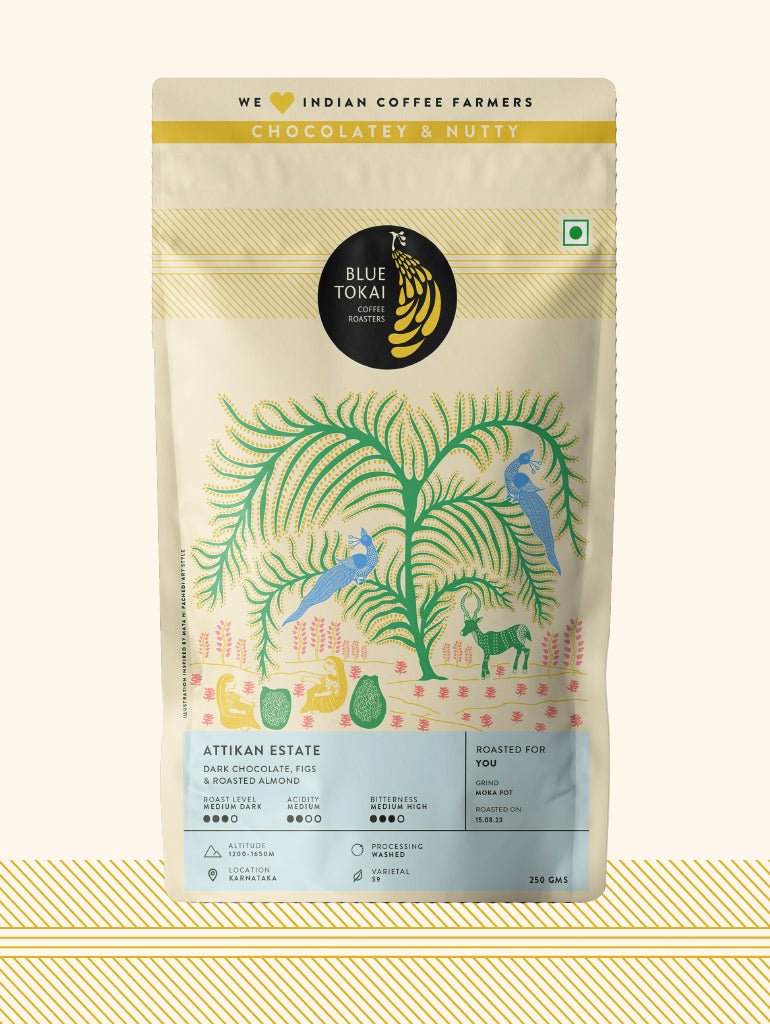
Price: ₹700 for 250 g at Blue Tokai (500 g ₹1,300; 1 kg ₹2,380) · checked 25 November 2026. Per cup ~₹42 at a 15 g dose.
Attikan is Blue Tokai’s most popular estate coffee, and the right first buy. The beans come from the Biligiriranga Hills in Karnataka — among India’s highest coffee-growing regions at 1,650 metres — and it is the darkest of the brand’s standard medium roasts, which is why the brand itself recommends it for espresso lovers. The live product page describes it as “sweet with nutty overtones and balanced acidity”, and it also works for moka pot, South Indian filter and AeroPress. If you own one brewer and want one bag, buy this one. Recommended resting period after roast: 10 days — don’t brew it the day it arrives.
2. Blue Tokai Sandalwood Estate — the milk-coffee pick
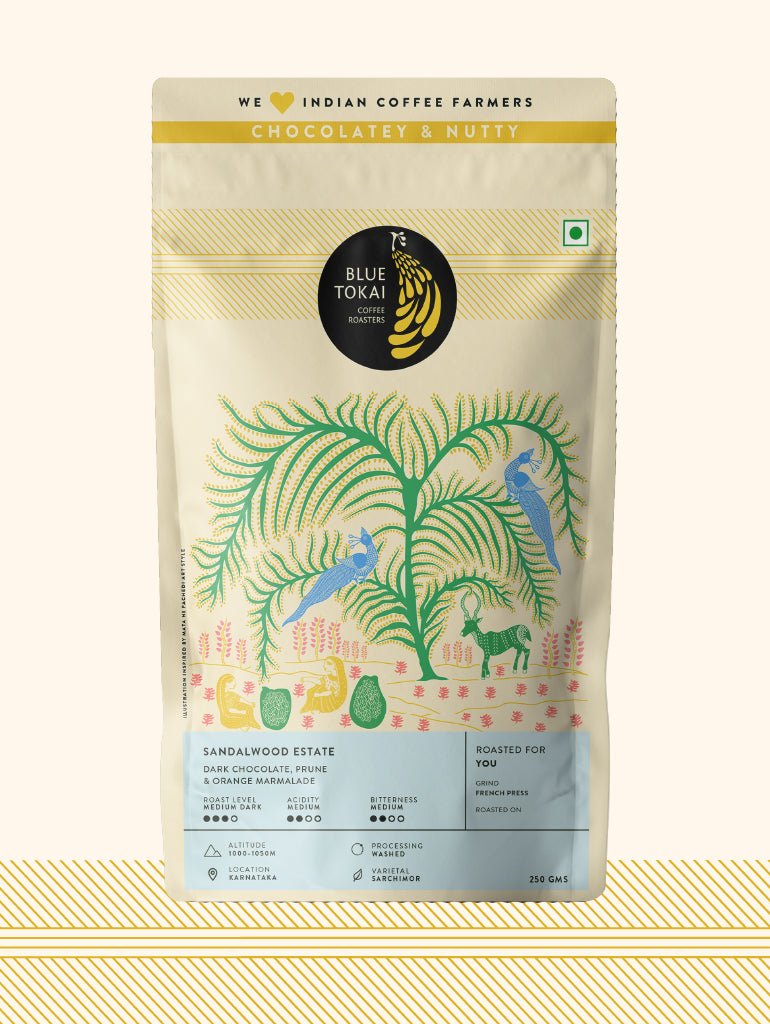
Price: ₹750 for 250 g at Blue Tokai (500 g ₹1,395; 1 kg ₹2,550) · checked 25 November 2026. Per cup ~₹45 at a 15 g dose.
Sandalwood is the chocolatey one. Grown in Coorg from the Sarchimor variety, it brews cups with notes of dark chocolate, sweet prune and zesty orange marmalade, with a heavy body and a smooth, syrupy mouthfeel. The brand recommends it for espresso, moka pot or French press — and that heavy body is exactly what survives milk, so if your coffee is mostly milk, this is the better pick of the three. Recommended resting period: 11 days. See how it compares with the other five estate bags in our Best Single Origin Coffee Beans in India (2026) guide, where it was our pick for milk.
3. Blue Tokai Kalledevarapura Estate, Pulp Sun Dried — the most balanced cup

Price: ₹800 for 250 g at Blue Tokai (500 g ₹1,488; 1 kg ₹2,720) · checked 25 November 2026. Per cup ~₹48 at a 15 g dose.
Kalledevarapura is the connoisseur’s pick of the three — and the priciest cup here. This year’s harvest is a medium-bodied, pulp sun-dried coffee from Chikmagalur with notes of brown sugar, roasted almond and raisin, and it suits espresso, pour over, moka pot and AeroPress alike. Buy it if you already brew with a pour over or AeroPress and want to taste what processing does to a cup; if you only drink milky coffee, the cheaper Attikan or Sandalwood will serve you better. Recommended resting period: 11 days.
One practical note for all three: buy whole bean and grind fresh if you can — a 250 g bag lasts about two weeks at two cups a day, which is roughly the window these beans stay at their best. Our best coffee grinder under ₹3,000 guide covers the cheapest way to start. If you buy pre-ground, pick the grind for your brewer on the product page — the store offers everything from Turkish to cold brew.
Blue Tokai vs Third Wave and Starbucks
The comparison most readers actually make is with two rivals: Third Wave Coffee Roasters, the other Indian specialty chain, and Starbucks, the global chain. The honest answer is that they solve different problems. Blue Tokai’s edge is Indian single-estate traceability for home brewers — the farm is named on the bag, the roast date is printed, and the same beans you drink in the café are the ones you can buy for home. Third Wave is the closer rival: also Indian, also specialty, also café-first, with a similar premium position — the choice between them usually comes down to which café is nearer and whose house blend you prefer. Starbucks is a different category: global consistency, dessert-like drinks and a loyalty ecosystem, at a premium that buys convenience rather than origin transparency. One independent taste comparison found Blue Tokai’s pour over beat Starbucks’ Pike Place on freshness and nuance — but Starbucks wins if you travel and want the same drink in every city.
Who should buy it — and who should skip it
Buy it if: you brew at home with a French press, moka pot, pour over, AeroPress or espresso machine; you want to taste the difference between estates; you are moving from instant to real beans and want a guided first bag (Attikan). Skip it if: your coffee is instant-only and you are happy with it — a home-brewed Blue Tokai cup costs about ₹42–48 against roughly ₹5 for a cup of instant (Bru Instant works out near ₹4.73 a cup at 2 g a serving), so you would be paying nine times more for flavour, not for caffeine. Skip it too if you want deep discounts: Blue Tokai’s prices are flat MRP and barely move — the three beans above cost exactly what they cost eleven days ago. And skip the cafés if you are price-sensitive about eating out: the food menu is café-priced, and the brand does not publish its menu prices online.
Watch out before you order
- Rest the beans. Blue Tokai lists a recommended resting period of 10–11 days after roast for these three estates. Freshly roasted beans need that time to settle; brewing on arrival day wastes the best of the bag.
- Whole bean beats pre-ground. Pre-ground coffee stales in days. If you buy ground, order the grind for your exact brewer and finish the bag within two weeks.
- No discounts to wait for. Prices are flat MRP with no sale calendar — ₹700/₹750/₹800 today, the same as on 14 November. Buy when you need beans, not when a sale starts. Shipping is free above ₹350 on prepaid orders, so a single 250 g bag already ships free.
- Café prices are not published online. The cafés don’t list menu prices on the website, so check in-store before ordering for a group.
- Grind choice matters more than the estate. The wrong grind ruins a good bean faster than a cheaper bean does — pick the grind on the product page, or grind fresh at home.
Frequently Asked Questions
Who founded Blue Tokai Coffee?
Blue Tokai was founded by husband and wife Matt Chitharanjan and Namrata Asthana, who started roasting in Delhi in 2012 and launched the brand in 2013. Shivam Shahi joined in 2016 as the third co-founder and COO, after discovering the brand online.
When was Blue Tokai founded?
The roasting started in 2012, when Matt and Namrata moved to Delhi and set up a 500-gram roaster in a spare bedroom; the Blue Tokai brand launched in 2013. Wikipedia lists the founding as 2012, while most press profiles date it to 2013 — both refer to the same start, a year apart.
What does “Blue Tokai” mean?
“Tokai” comes from an old Malabari word for a peacock’s tail. The founders chose it to evoke the beauty and complexity they wanted in every cup — and the peacock motif still runs through the brand’s packaging and café art.
Is Blue Tokai an Indian brand?
Yes. Blue Tokai Coffee Roasters is an Indian company headquartered in Gurugram, Haryana, owned by Muhavra Enterprises Pvt Ltd. It sources from Indian estates, roasts in India and sells through Indian cafés and its own Indian online store.
Is Blue Tokai coffee good?
For freshly roasted single-estate beans, yes — it is India’s best-known specialty brand for a reason, and its Attikan Estate is a reliable first buy for espresso and moka pot. But “good” depends on your habit: if you drink instant coffee with milk, Blue Tokai costs about nine times more per cup, so the upgrade is flavour, not value.
Is Blue Tokai better than Starbucks?
For freshness and origin transparency, yes — Blue Tokai names the estate on the bag and roasts in-house, while Starbucks sells global consistency. For convenience while travelling, Starbucks wins: the same drink in every city. For home brewing, Blue Tokai is the stronger choice; for a café routine on the move, Starbucks is the easier one.
Which Blue Tokai coffee should I buy first?
Attikan Estate, 250 g, ₹700. It is the brand’s most popular estate coffee, the darkest of its standard medium roasts, and the one the brand itself recommends for espresso lovers — it also works for moka pot, South Indian filter and AeroPress. If your coffee is mostly milk, buy Sandalwood Estate (₹750) instead; its heavy, chocolatey body holds up better in milk.
What does Blue Tokai coffee cost in India?
Its three best-known estate beans cost ₹700–₹800 for 250 g on the brand’s own store (checked 25 November 2026): Attikan ₹700, Sandalwood ₹750, Kalledevarapura ₹800. At a 15 g dose that works out to about ₹42–₹48 a cup. Prices are flat MRP — they barely move, so there is no sale to wait for. Free standard shipping applies on prepaid orders above ₹350.
Prices in this article were checked on 25 November 2026 on Blue Tokai’s official store (bluetokaicoffee.com). Prices and availability change — the price at checkout is what counts. Per-cup costs use a 15 g dose per cup. Blue Tokai has no affiliate programme; links to its store are direct, not affiliate links.
Sources
- Wikipedia — Blue Tokai (founding, history, estates, outlets)
- Economic Times — Blue Tokai: India’s small home roaster that brewed a multi-thousand-crore café business (founding, revenue, outlets, valuation)
- ETRetail — Blue Tokai: Transforming India’s Coffee Culture into a Multi-Thousand-Crore Venture
- Inc42 — Inside Blue Tokai’s 4-Point Playbook To Hit INR 1,000 Cr Revenue By FY27 (name meaning, funding, revenue)
- Business Today — “We’re just at the start of India’s coffee story”: Blue Tokai Co-founder and COO Shivam Shahi
- YourStory — From coffee in cans to foraying into Japan: how coffee startup Blue Tokai is ramping up its game
- The Hindu BusinessLine — Speciality coffee Blue Tokai raises $35 million in funding round led by Verlinvest
- Startuppedia — Meet the Husband-Wife Duo Behind Blue Tokai’s Rise
- Blue Tokai — Attikan Estate product page (price ₹700, tasting notes, resting period)
- Blue Tokai — Sandalwood Estate product page (price ₹750, tasting notes, resting period)
- Blue Tokai — Kalledevarapura Estate Pulp Sun Dried product page (price ₹800, tasting notes, resting period)
- Financial Express — From farm to cup: meet the couple who founded Blue Tokai