Is decaf coffee caffeine free? No. A typical cup of decaf coffee still has 2 to 15 milligrams of caffeine, according to the US Food and Drug Administration (FDA) — against 70 to 140 milligrams in a regular cup. Decaffeination removes at least 97% of the caffeine, but no process removes all of it. Decaf is low-caffeine coffee, not caffeine-free coffee, and the difference matters if you are drinking it specifically to avoid caffeine.
AT A GLANCE — Decaf is not caffeine-free: the FDA puts a typical 240 ml cup at 2–15 mg of caffeine, against 70–140 mg for regular coffee. At least 97% of the caffeine is removed. A 2006 University of Florida study measured 8.6–13.9 mg in 16-ounce brewed decaf from coffee chains. None of the five decaf coffees sold in India states a caffeine figure in milligrams — and two call themselves “caffeine-free”. Decaf barely counts towards the FDA’s 400 mg daily reference for healthy adults; in pregnancy the limit is 200 mg a day.
Is decaf coffee caffeine free? The numbers
The FDA’s page “Spilling the Beans: How Much Caffeine is Too Much?” states it plainly: “Decaffeinated coffees and teas have less caffeine than their regular counterparts, but still contain some caffeine. For example, decaf coffee typically has 2 to 15 milligrams in an 8-fluid-ounce cup.” An 8-fluid-ounce cup is about 240 ml — roughly a mug of instant coffee, or a large dabara tumbler and a half.
The range is wide because the number genuinely varies. Three things move it: the bean (robusta starts with about twice the caffeine of arabica), the dose (how much coffee goes into the cup), and the brew (espresso extracts differently from a slow filter drip). That is why sources quote different figures — 2 to 5 mg here, 3 to 15 mg there — and none of them is wrong.
The best-measured numbers come from a 2006 University of Florida study, published in the Journal of Analytical Toxicology, which lab-tested 16-ounce decaffeinated drip coffees from nine chains and coffee houses. “Every serving but one — instant decaffeinated Folgers Coffee Crystals — contained caffeine, ranging from 8.6 milligrams to 13.9 milligrams.” Their decaf espresso tests found: “The espresso drinks contained 3 milligrams to 15.8 milligrams of caffeine per shot, while the brewed coffees had caffeine concentrations ranging from 12 milligrams to 13.4 milligrams per 16-ounce serving.”
| Drink | Serving | Caffeine | Source |
|---|---|---|---|
| Decaf coffee, brewed | 240 ml mug | 2–15 mg | FDA |
| Decaf coffee, brewed (café) | 473 ml (16 oz) | 8.6–13.9 mg | UF study, 2006 |
| Decaf espresso | 1 shot | 3–15.8 mg | UF study, 2006 |
| Decaf espresso | 60 ml | ~0.6 mg | USDA lab figure, via Healthline |
| Decaf instant | 240 ml mug | ~2–4 mg | Healthline; one instant tested at zero detectable caffeine (UF study) |
| Regular brewed coffee | 240 ml mug | 70–140 mg | Healthline |
| Black tea | 240 ml cup | ~40–50 mg | TalkAboutCoffee |
Two rows look contradictory — the UF study’s 3–15.8 mg per decaf espresso shot against the USDA lab figure of about 0.6 mg. Both are real measurements of different things: the USDA figure is a standardised lab brew, while the UF team measured drinks actually served in a café, where dose and extraction vary. Treat the USDA figure as the floor and the UF figures as what a café cup can hold. The honest range is the FDA’s 2–15 mg. In Indian servings, a 150 ml dabara cup of brewed decaf scales to roughly 1–9 mg from the FDA range — an arithmetic estimate, not a lab measurement.
Why decaf still has caffeine: the 97% rule
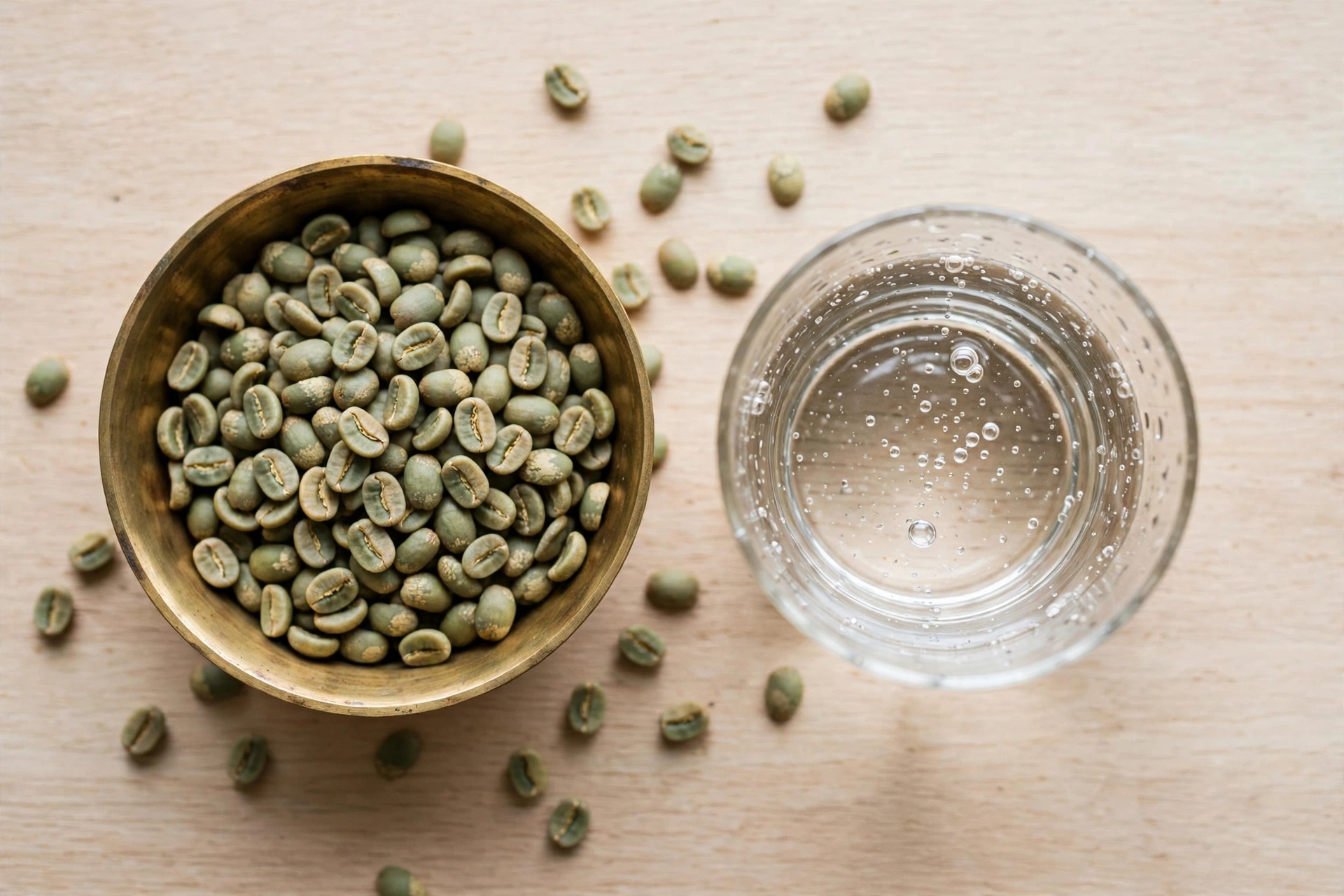
Decaffeination happens to green, unroasted beans, before roasting. The caffeine is dissolved out; the flavour compounds are, as far as possible, left in. But no method can take out every last caffeine molecule without also stripping the flavour that makes coffee taste like coffee. Swiss Water, the company behind the best-known solvent-free process, puts it this way: “Due to the nature of decaf processing — any method of decaf processing — it’s just not possible to get every single molecule of caffeine out of a coffee bean (unless you remove the flavors that make coffee taste like coffee).”
The legal line is drawn at 97%. Under US Department of Agriculture rules, coffee sold as decaf must not exceed 0.10% caffeine on a dry basis in the packet — at least 97% of the caffeine removed. Swiss Water guarantees that any green coffee leaving its process is “99.9% caffeine free”, a guarantee on the unroasted bean. Coffeeza, the Indian capsule brand, quotes a wider range on its own blog, saying its methods “remove 94–98% of caffeine”. So this article uses the FDA’s 2–15 mg range rather than any one brand’s claim.
How decaf coffee is made: the four methods
Four commercial methods take the caffeine out. All four are approved for food use; they differ in what dissolves the caffeine, and in what is left behind.
| Method | How it works | Solvent? | What to know |
|---|---|---|---|
| Swiss Water Process | Beans are soaked in caffeine-free green coffee extract; caffeine migrates out and is trapped by carbon filters | No | Claims 99.9% removal from green coffee |
| Carbon dioxide (CO2) | Pressurised CO2 selectively dissolves caffeine; flavour compounds largely stay | No | Used for larger lots and premium lines |
| Ethyl acetate (“sugarcane process”) | A solvent — often derived from sugarcane — washes the caffeine out; beans are steamed afterwards | Yes | Residues regulated to trace levels |
| Methylene chloride | A chemical solvent extracts the caffeine; beans are steamed afterwards | Yes | FDA limits residue to 0.001%, under 10 parts per million |
The solvent question worries readers most. The FDA’s limit, via Health.com: “The United States Food and Drug Administration (FDA) requires that levels of chemical solvent residue in decaf coffee must not exceed 0.001%, less than 10 parts per million.” Residues are also largely driven off by roasting, which happens after decaffeination. If you would rather avoid solvents entirely, look for “Swiss Water” or “CO2” on the label — but as the next section shows, most Indian listings do not name their method at all. Which method tastes best is debated: on Quora, readers split between CO2 and Swiss Water, and the bean and roast matter at least as much as the method.
What India’s decaf coffees actually say about caffeine — our tally
We read the live listings of the five decaf coffees actually stocked in India — the same five in our best decaf coffee in India guide — and recorded exactly what each one says about caffeine. Prices were checked live on the brand stores on 22 November 2026, except where noted.
| Product | Price (checked) | What the listing says about caffeine | Mg figure? | Removal %? | Process named? | Cost per cup* |
|---|---|---|---|---|---|---|
| Sleepy Owl Decaf Instant — 30 sachets | ₹499 (22 Nov) | “without the buzz” | No | No | No | ₹16.6 |
| Nescafé Gold Blend Decaf — 95 g jar | ₹647 (9 Nov, Amazon.in) | Not re-read today | — | — | — | ~₹13.8 |
| Naivo Zero Buzz Decaf — 250 g | ₹620 (9 Nov) | “free from caffeine yet full of character” | No | No | Yes — DCM (dichloromethane), by CR3 Germany | ~₹37 |
| TGL Co. Decaf Instant — 100 g | ₹999 (22 Nov) | “completely caffeine-free” — the title adds “(No Caffeine)” | No | No | No | ~₹20 |
| Coffeeza Decaf Capsules — box of 10 | ₹639 (22 Nov) | “without the caffeine buzz” | No | No | No | ₹63.9 |
*Cost per cup worked out by us: instant at 2 g a cup (Sleepy Owl 30 sachets = 30 cups; Nescafé 95 g ≈ 47 cups; TGL 100 g = 50 cups); Naivo brewed at 15 g a cup (250 g ≈ 16 cups); Coffeeza one capsule = one cup.
The findings: none of the five listings states a caffeine figure in milligrams. Two of the five use “caffeine-free” wording — TGL says “completely caffeine-free” and Naivo says “free from caffeine” — even though decaf is never zero-caffeine. Only one names its process (Naivo, unusually open about using dichloromethane via the German decaffeinator CR3). None states a removal percentage. Cheapest cup: Nescafé Gold Decaf, about ₹14. Dearest: Coffeeza’s capsules, about ₹64. Read the wording as marketing, not measurement: “caffeine-free” on a pack means decaffeinated, not zero caffeine.
Is decaf coffee bad for you? Benefits and side effects, balanced
Decaf keeps most of what regular coffee has, minus most of the caffeine. Its composition is highly similar to regular coffee, according to a 2017 systematic review, and studies have linked decaf drinking with a lower risk of premature death, cardiovascular death and type 2 diabetes — associations from large observational studies, not proof. Decaf also keeps coffee’s antioxidants, including chlorogenic acid.
The caveats are real but narrow. Decaf is still acidic, though slightly less so than regular coffee, so it can worsen heartburn or acid reflux (GERD) in people prone to it. Decaf can raise cholesterol levels — coffee contains two natural compounds, kahweol and cafestol, that raise cholesterol, and they are present in decaf too. And the trace caffeine matters for a small group: the Johns Hopkins researcher Roland Griffiths, quoted in the University of Florida report, put it precisely: “Carefully controlled studies show that caffeine doses as low as about 10 milligrams can produce reliable subjective and behavioral effects in sensitive individuals.”
The balanced read: for most healthy adults, decaf is a low-risk way to keep the coffee ritual without the caffeine. It is not a health drink — but its risks are the same ones regular coffee carries, minus the caffeine-driven ones (jitters, anxiety, sleep disruption). If you have a health condition or take medication, ask your doctor.
Decaf coffee in pregnancy
The American College of Obstetricians and Gynecologists (ACOG) recommends that pregnant women consume no more than 200 mg of caffeine from all sources per day. A brewed cup of decaf has about 2.4 mg of caffeine, and a decaf espresso about 0.6 mg — USDA figures quoted by Healthline. At those levels, it would take dozens of cups of decaf to approach the 200 mg limit from decaf alone. Healthline also notes the honest gap: “There are no official guidelines on decaffeinated coffee and pregnancy.”
That is general information, not a personal recommendation. Caffeine crosses the placenta and is broken down more slowly during pregnancy — which is why the 200 mg limit exists. Some older studies raised questions about decaf and miscarriage, but their own authors said the results were most likely due to bias in the data, not the decaf. If you are pregnant, trying to become pregnant, or breastfeeding, the FDA’s advice is to talk to your healthcare provider. This article cannot answer that for you.
Can you drink decaf coffee at night?
Usually, yes — but count your cups. The University of Florida researchers’ warning is the one to remember: “If someone drinks five to 10 cups of decaffeinated coffee, the dose of caffeine could easily reach the level present in a cup or two of caffeinated coffee.” Five to ten cups of decaf is 10 to 150 mg by the FDA range. One or two cups in the evening is a few milligrams, about the same caffeine as a small piece of dark chocolate. Six cups across an afternoon is a different drink.
Two rules follow. If you are caffeine-sensitive, treat decaf as low-caffeine, not no-caffeine — doses as low as about 10 mg can produce effects in sensitive people. And if you must avoid caffeine entirely on a doctor’s advice, decaf is not the answer: the FDA says plainly, “If you react strongly to caffeine in a negative way, you may want to avoid these beverages altogether.” A herbal infusion, which never had caffeine, is the only zero-caffeine option.
Myths vs facts
Myth: Decaf coffee is caffeine-free.
Fact: No. The FDA puts a typical cup at 2–15 mg, and a 2006 lab study found 8.6–13.9 mg in 16-ounce brewed decaf from coffee chains. Decaf is about 97% caffeine-free, not 100%.
Myth: Decaf is loaded with chemicals and unsafe to drink.
Fact: Solvent residues are regulated — the FDA limits methylene chloride residue to under 10 parts per million — and two of the four methods (Swiss Water, CO2) use no chemical solvents at all. The bigger gap is transparency: only one of the five Indian decaf listings we checked names its method.
Myth: Decaf has no health benefits at all.
Fact: Decaf keeps most of coffee’s other compounds, including antioxidants, and large studies have linked decaf drinking with lower risks of premature death, cardiovascular death and type 2 diabetes. Associations, not proof — but “no benefits” is wrong too.
Myth: All decaf tastes the same — and worse than regular.
Fact: The bean and roast matter at least as much as the method, and drinkers debate CO2 against Swiss Water on taste. A good decaf from a good bean tastes like coffee, because it is coffee.
Myth: You can drink as much decaf as you like, even at night.
Fact: Five to ten cups of decaf can add up to the caffeine in one to two cups of regular coffee. One or two cups in the evening is a few milligrams; a whole afternoon of decaf is a real dose.
How to choose decaf coffee in India
Three checks before you buy. First, look for the method on the label — “Swiss Water” or “CO2” if you want no solvents; if the listing names no method at all, which is the case for four of the five Indian decafs we checked, you are buying on trust. Second, pick the format by cost: instant decaf runs about ₹14–20 a cup, fresh-roasted decaf about ₹37, and capsules about ₹64. Third, ignore the word “caffeine-free” on the pack; it means decaffeinated, and the real number is the FDA’s 2–15 mg a cup.
Our caffeine in filter coffee vs espresso guide has the numbers for regular coffee in Indian servings, and the latest offers on our deals page carry current prices on coffee gear and beans.
Frequently Asked Questions
Is decaf coffee really caffeine-free?
No. Decaf coffee typically has 2 to 15 milligrams of caffeine in an 8-ounce (240 ml) cup, according to the FDA. Decaffeination removes at least 97% of the caffeine, but no process removes all of it.
How much caffeine is in decaf coffee?
A typical cup has 2–15 mg (FDA). A 2006 University of Florida study measured 8.6–13.9 mg in 16-ounce brewed decaf from coffee chains, and 3–15.8 mg per decaf espresso shot. Instant decaf sits at the bottom, around 2–4 mg a mug. The exact figure depends on the bean, the dose and the brew.
Is decaf coffee safe during pregnancy?
There are no official guidelines specifically for decaf in pregnancy, but the caffeine is very low — about 2.4 mg per brewed cup — against the ACOG limit of 200 mg a day from all sources. Most likely safe in moderation, but this is general information only: if you are pregnant, ask your doctor.
Can I drink decaf coffee at night?
One or two cups, usually yes — only a few milligrams of caffeine. But five to ten cups of decaf can add up to the caffeine in one to two cups of regular coffee, so a whole afternoon of decaf can still disturb sleep, especially if you are caffeine-sensitive.
Does decaf coffee taste different from regular coffee?
Slightly — it depends on the bean, the roast and the method. Decaffeination can soften some flavour compounds, which is why cheap decaf tastes flat, but a good decaf from a good bean tastes like coffee. Drinkers debate CO2 against Swiss Water on taste, with no settled winner.
Is decaf coffee better than tea for cutting caffeine?
Decaf coffee (2–15 mg a cup) has less caffeine than black tea (about 40–50 mg a cup), so it cuts further. But if you need zero caffeine, neither works — only a drink that never had caffeine, like a herbal infusion, is genuinely caffeine-free.
Sources: US FDA, "Spilling the Beans: How Much Caffeine is Too Much?"; University of Florida / Journal of Analytical Toxicology 2006 study (via UF Health); Swiss Water Process; Healthline (USDA decaf rule, ACOG limit, USDA lab figures); Health.com (FDA solvent residue limit); GoodRx (decaf risks); TalkAboutCoffee (tea comparison). India tally: live brand-store listings checked 22 November 2026 (Sleepy Owl, TGL, Coffeeza) and 9 November 2026 (Nescafé Gold Decaf, Naivo). General information from published sources, not medical advice — if you are pregnant, have a health condition, or take medication, ask your doctor.