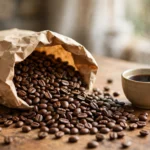
Does coffee expire? Not the way milk does. Dry coffee — beans, ground or instant — does not suddenly become unsafe on a printed date. It goes stale: aroma fades, sweetness flattens, the cup turns dull. Whole beans taste best within about 2–4 weeks of roasting, ground coffee within 1–2 weeks of opening, instant coffee for a year or more unopened. The printed date is a quality deadline, not a safety one — with one exception: damp or mouldy coffee should always be thrown away.
The short answer: coffee goes stale, it does not spoil
Roasted coffee is a dry, shelf-stable product, food-safe in storage while its moisture stays very low — a forgotten bag in the cupboard is a disappointment, not a health scare. The “best by” date is the manufacturer’s flavour promise: the US food safety authority defines it as the point up to which a product keeps its best flavour or quality, not a safety date.
Two clocks run on every pack: the freshness clock (how long it tastes as the roaster intended) and the usability clock (how long it stays drinkable). The table keeps them separate.
How long each type of coffee stays fresh
| Coffee type | At its best (peak flavour) | Still fine to drink, if kept dry |
|---|---|---|
| Whole beans, unopened | Within 2–4 weeks of the roast date | About 6–9 months sealed; follow the best-by date |
| Whole beans, opened | 1–3 weeks in an airtight container | A few months, flavour fading |
| Ground coffee, unopened | About 3–5 months | Up to the best-by date on the pack |
| Ground coffee, opened | 1–2 weeks | About a month, noticeably flat |
| Instant coffee, unopened | 1–2 years (the printed best-before window) | Well beyond, while the seal holds and it stays dry |
| Instant coffee, opened | About 2–3 months for best quality | 6 months or more, slowly flattening |
| Pods and capsules, sealed | About 6–12 months | Until the best-by date, if the seal is intact |
| Whole beans, frozen in airtight portions | 3–4 months | Use within 1–2 weeks once a portion is thawed |
These windows come from National Coffee Association storage guidance and Specialty Coffee Association freshness research, and assume proper storage.
Why coffee goes stale: gas out, oxygen in
Roasting fills each bean with carbon dioxide — roughly 1–2% of the bean’s weight. From the moment roasting ends, that gas slowly escapes: degassing. While it surrounds the beans, it helps keep oxygen out; once it is gone, oxygen moves in and oxidises the coffee’s delicate oils and aroma compounds. That is staling — not rotting, just a slow chemical fade.
The Specialty Coffee Association’s freshness handbook names oxygen, temperature and moisture as the main accelerators, and the National Coffee Association adds light — the four enemies: air, moisture, heat and light. Every storage rule below is a way of keeping those four away from your coffee. Grinding speeds it all up: ground coffee loses most of its trapped gas within hours to days.
Whole beans: the clock starts at the roast, not the shop shelf
The most useful date on a bag of beans is the roast date: freshness counts from roasting, not purchase. The Specialty Coffee Association treats whole beans as fresh within about three weeks of roasting; most roasters put the peak at roughly 2–4 weeks. Beans need a short rest first — a few days of degassing before they brew well, espresso wanting the longer end. Too fresh tastes gassy; too old tastes flat.
The catch for Indian buyers: most supermarket packs here print a packed-on (PKD) date and a “best before” window counted in months, not a roast date — and a pack can sit inside that window while being far past its flavour peak. Buy from a roaster who prints a roast date and you can count your 2–4 weeks. Otherwise buy smaller packs: the National Coffee Association advises buying only as much as you will drink in one to two weeks.
Ground coffee and filter powder: the fastest clock
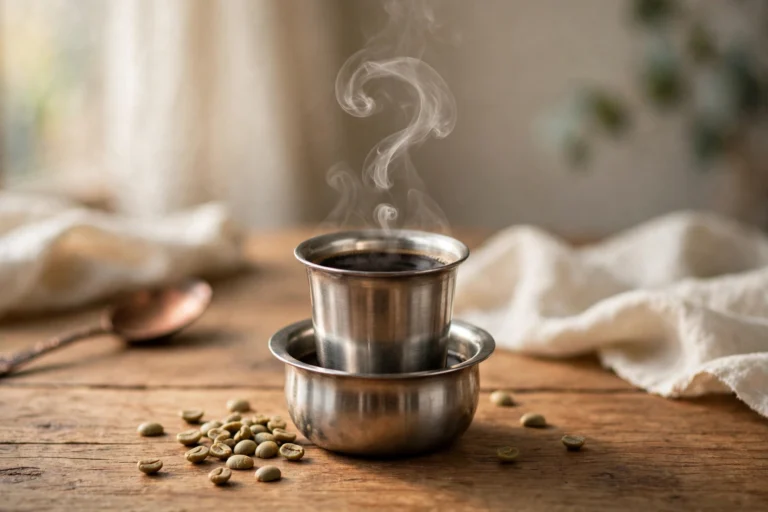
Ground coffee stales fastest of all: grinding breaks the bean open and lets gas and aroma escape almost immediately. Opened ground coffee is at its best for about 1–2 weeks; a sealed pack holds peak quality for roughly 3–5 months. This applies directly to South Indian filter coffee powder, ground fine and often blended with chicory — once the packet opens, decant it into an airtight tin the same day. Our guide to the best filter coffee powder in India compares the main options. Grind at home? Grind only what you need, right before brewing.
Instant coffee: the longest shelf life in the cupboard
Instant coffee is the survivor of the family: the granules are so dry that little can react with them. An unopened jar carries a best-before window of one to two years and stays usable well beyond it. Once opened, the US Department of Agriculture’s FoodKeeper guide suggests using it within about 2–3 months for best quality, though a tightly closed jar kept dry stays drinkable far longer, just gradually flatter. Its real enemy is moisture — a wet spoon or a steamy kitchen makes it clump and taste flat. Dry spoon, tight lid, away from the stove.
Coffee pods and capsules
Pods are engineered for shelf life: small sealed portions, often flushed with nitrogen to push oxygen out. Sealed pods typically hold quality for about 6–12 months, and packaging matters — in one storage comparison cited in the freshness literature, all-aluminium capsules showed hardly any change over a full year, while weaker barrier materials changed the most. The seal is everything: a pod with punctured or swollen foil has lost its protection.
Storage rules that actually work
- Airtight and opaque. Move opened coffee into a sealed, opaque container.
- Cool and dark. A closed cupboard away from the oven, stove and afternoon sun — heat speeds up every staling reaction.
- Dry — this matters most in India. Roasted coffee absorbs moisture from humid air, and humidity measurably speeds up aroma loss. During the monsoon, keep coffee in your driest cupboard, seal it right after your spoonful, and never leave the tin open on the counter.
- Skip the fridge. Many Indian homes keep coffee powder in the fridge, but refrigerated beans keep only about two weeks anyway, and the fridge adds exactly what coffee hates — moisture, plus strong food smells that coffee absorbs.
- Buy at your pace. Smaller packs finished in a week or two beat a large “value” pack that spends a month open.
Should you freeze coffee?
Yes — in the right way. Freezing strongly slows degassing and staling, which is why the Specialty Coffee Association treats it as legitimate and the National Coffee Association gives frozen beans about 3–4 months in a truly airtight container. The catch is condensation: a bag repeatedly taken in and out collects moisture and gets worse. So portion first — single-week amounts, each sealed airtight (tape over the bag’s one-way valve if freezing in the original bag), thaw one at a time in its sealed bag, never refreeze. For coffee you will finish within two weeks, the cupboard is simpler and just as good.
How to tell your coffee has gone stale
- The sniff test: fresh coffee smells rich the moment you open the pack; stale coffee smells faint, dusty or like cardboard.
- No bloom: fresh grounds swell and bubble under hot water; stale grounds sit flat.
- Flat cup: papery, one-dimensional flavour with the sweetness gone; older oils can add a slightly rancid edge.
SAFETY — Stale is fine; damp is not. If coffee has got wet, feels damp or sticky, shows any visible mould, or smells musty or sour, throw it away — do not brew it, and do not try to rescue it. Dry, old coffee is a flavour problem. Wet, mouldy coffee goes in the bin, every time.
What to do with stale coffee
Stale coffee is not wasted coffee. Its most forgiving use is cold brew: slow, cold extraction smooths harsh notes and hides flatness, especially with milk. Stale grounds also work in baking — chocolate cakes and brownies barely notice the missing aroma — and in compost, in moderate amounts rather than thick layers.
Freshness decides flavour, not strength — for what is actually in the cup, see our breakdown of caffeine in filter coffee vs espresso.
Frequently asked questions
Does coffee expire if it is unopened?
Not in the safety sense. An unopened pack keeps quality until around its best-by date — beans about 6–9 months sealed, ground coffee 3–5 months, instant coffee one to two years. The flavour peak passes much earlier, especially for beans: their best weeks are the first 2–4 after roasting.
Is it safe to drink coffee after the best-by date?
Generally yes, if it has stayed dry and sealed — the best-by date is about flavour, not safety. Expect a flatter cup. The exception is coffee exposed to moisture: damp, mouldy or musty-smelling coffee goes in the bin.
How long do coffee beans stay fresh after opening?
About 1–3 weeks at room temperature in an airtight, opaque container, per the National Coffee Association. After that the beans stay drinkable for months, but aroma and sweetness keep fading with every opening.
Does instant coffee expire?
It carries a best-before date, typically one to two years from manufacture, and that date is about peak quality. Unopened, it stays usable well beyond it. Opened, it is best within about 2–3 months; kept dry with the lid tight, it remains drinkable much longer, just gradually flatter. Discard it if it has got damp or smells musty.
Can you freeze coffee beans to keep them fresh?
Yes — about 3–4 months for whole beans sealed truly airtight. Portion into single-week amounts before freezing, thaw one at a time in its sealed bag, and never refreeze. Freezing is for coffee you will not finish within two weeks; everyday coffee belongs in a cool, dark cupboard.
How can you tell if coffee has gone stale?
Smell the pack: fresh coffee is fragrant; stale coffee is faint or cardboard-like. Watch the brew: fresh grounds bloom and bubble, stale grounds stay flat. The cup itself will taste papery and dull.