Learning how to make South Indian filter coffee at home comes down to three things: a strong decoction from a steel filter, one part decoction to three parts hot milk, and a proper pull between the tumbler and the dabara to build the froth. Get those three right and the cup tastes like the kaapi from a Tamil Nadu mess — dark, sweet, and thick with foam. This guide gives you the exact recipe in grams and tablespoons for every filter size, the strength ratios the top recipes disagree on (settled), what to buy, what a cup costs, and how to fix the five ways it goes wrong.
Last updated: 9 November 2026. Filter and powder prices checked today on Flipkart and brand stores. Prices change frequently — the price at checkout is what counts.
What Is South Indian Filter Coffee?
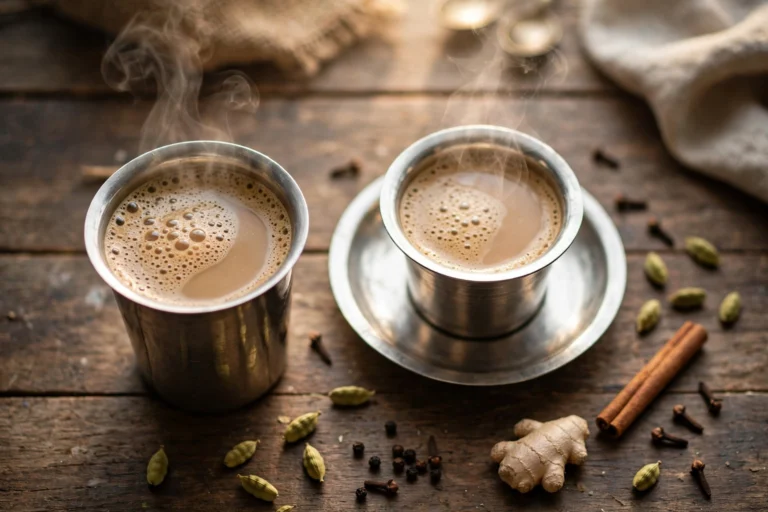
South Indian filter coffee — filter kaapi, or degree coffee — is a strong coffee concentrate called decoction, mixed with hot milk and sugar and frothed by pouring it between a steel tumbler and a wide saucer called a dabara. The decoction is made by slowly dripping hot water through finely ground coffee in a two-part stainless steel filter: the powder sits in a perforated upper chamber, water seeps through under gravity over 10–20 minutes, and the dark liquid collects below.
Two things make it different from any other home coffee. First, the powder is usually coffee blended with roasted chicory root — the classic ratio is 80% coffee to 20% chicory, which gives the decoction its body, dark colour and slight bitter-caramel edge. Second, the decoction is a concentrate, always diluted with milk in the cup, so strength is set twice — once by the brew, and again by how much milk you add. That is why recipes disagree about ratios, and why this guide settles them in one place.
What You Need to Make South Indian Filter Coffee at Home
Equipment: a two-part stainless steel South Indian filter with its pressing disc (the “umbrella”) — 250 ml is the standard family size; a steel tumbler and dabara set for serving and frothing; a kettle; a tablespoon and, for precision, a kitchen scale.
Ingredients (per 2 cups): 3 tablespoons (about 20 g) of fine filter coffee powder — an 80:20 or 85:15 coffee-chicory blend; 120 ml of water, just off the boil (about 90–95°C); about 220 ml of full-fat milk, brought to a boil; sugar to taste (2 teaspoons per cup is the traditional sweetness).
Full-fat milk matters: it gives the classic creamy body, and milk that is only warm — not scalding — will not froth when you pull the coffee. If you are buying your first filter, the filter picks below start at ₹240 on Flipkart today, and a good steel filter lasts a decade.Same price as when this guide was published (₹240, 9 Nov 2026).
The Recipe: Exact Quantities by Filter Size
Most recipes give you one size and leave you to guess the rest. This table scales the same ratio — about 20 g of powder and 120 ml of water per two cups — across the three filter sizes sold in India. The large row is scaled from the same ratio as the small and medium rows, which come from published recipes.
| Filter size | Coffee powder | Hot water | Decoction you get | Drip time | Serves |
|---|---|---|---|---|---|
| Small (100 ml, 2 cups) | 3 tbsp (about 20 g) | About 120 ml | About 80 ml | 10–15 min | 2 tumblers |
| Medium (200 ml, 4 cups) | 5–6 tbsp (about 35–40 g) | About 220 ml | About 150 ml | 10–15 min | 4 tumblers |
| Large (250–500 ml, 6 cups) | 8–9 tbsp (about 55–60 g) | About 330 ml | About 220 ml | 15–20 min | 6 tumblers |
One rule behind the table: the top chamber should be about one-third full of powder before you add water. Heap it to the brim and the water stalls; use too little and the water rushes through and the decoction comes out thin. Three tablespoons per two cups is the starting point every published recipe converges on — two tablespoons brews a light cup, six a very strong one.
How to Make South Indian Filter Coffee at Home: Step by Step
Step 1 — Clean the filter. Take the filter apart and rinse the upper chamber, the pressing disc and the lower vessel with warm water. Dried coffee from the last batch clogs the tiny holes in the upper chamber, and clogged holes are the most common reason a filter drips slowly or not at all.
Step 2 — Add the powder and level it. Spoon the powder into the upper chamber and spread it flat with the back of a spoon. For a 250 ml filter making two cups, that is 3 tablespoons (about 20 g); scale from the table above for other sizes. Some cooks sprinkle a quarter-teaspoon of sugar over the powder — it caramelises slightly as the water passes through and rounds off the bitterness. It is optional.
Step 3 — Press the disc gently. Place the pressing disc on top and press very lightly, just enough to settle the bed. This is the step most beginners get wrong: pressing hard compacts the fine powder, squeezes grounds through the holes into your decoction, and slows the drip to a crawl. Gentle is the word — every reliable recipe agrees on this.
Step 4 — Pour just-off-the-boil water. Bring water to a boil, take it off the heat, and pour slowly over the disc until the upper chamber is nearly full. Water at about 90–95°C is the target — boiling water poured straight onto a fine grind pulls out harsh, bitter notes in seconds, while water that has cooled too far under-extracts and gives a sour, thin decoction. Put the lid on.

Step 5 — Wait for the drip. Leave the filter alone for 10–20 minutes. Do not stir it, shake it or press the disc again — the slow percolation is what makes the decoction thick. A drip that has not started after five minutes usually means the disc was pressed too hard or the holes are clogged. One food writer’s slow method leaves the filter for 3–4 hours for a stronger decoction — that works, but it is a variation, not the standard; many households set the filter up the night before and use the decoction in the morning.
Step 6 — Boil the milk. While the decoction drips, heat full-fat milk in a saucepan until it comes to a rolling boil. The milk has to be scalding: hot milk plus the pouring is what makes the foam, and lukewarm milk gives you a flat cup.
Step 7 — Mix decoction, sugar and milk. Put sugar in the tumbler first, then add the decoction — about 40 ml (roughly 2–3 tablespoons) for a regular cup — and top up with about 110 ml of boiling milk. The standard starting ratio is 1 part decoction to 3 parts milk; the strength table below shows how to move it.
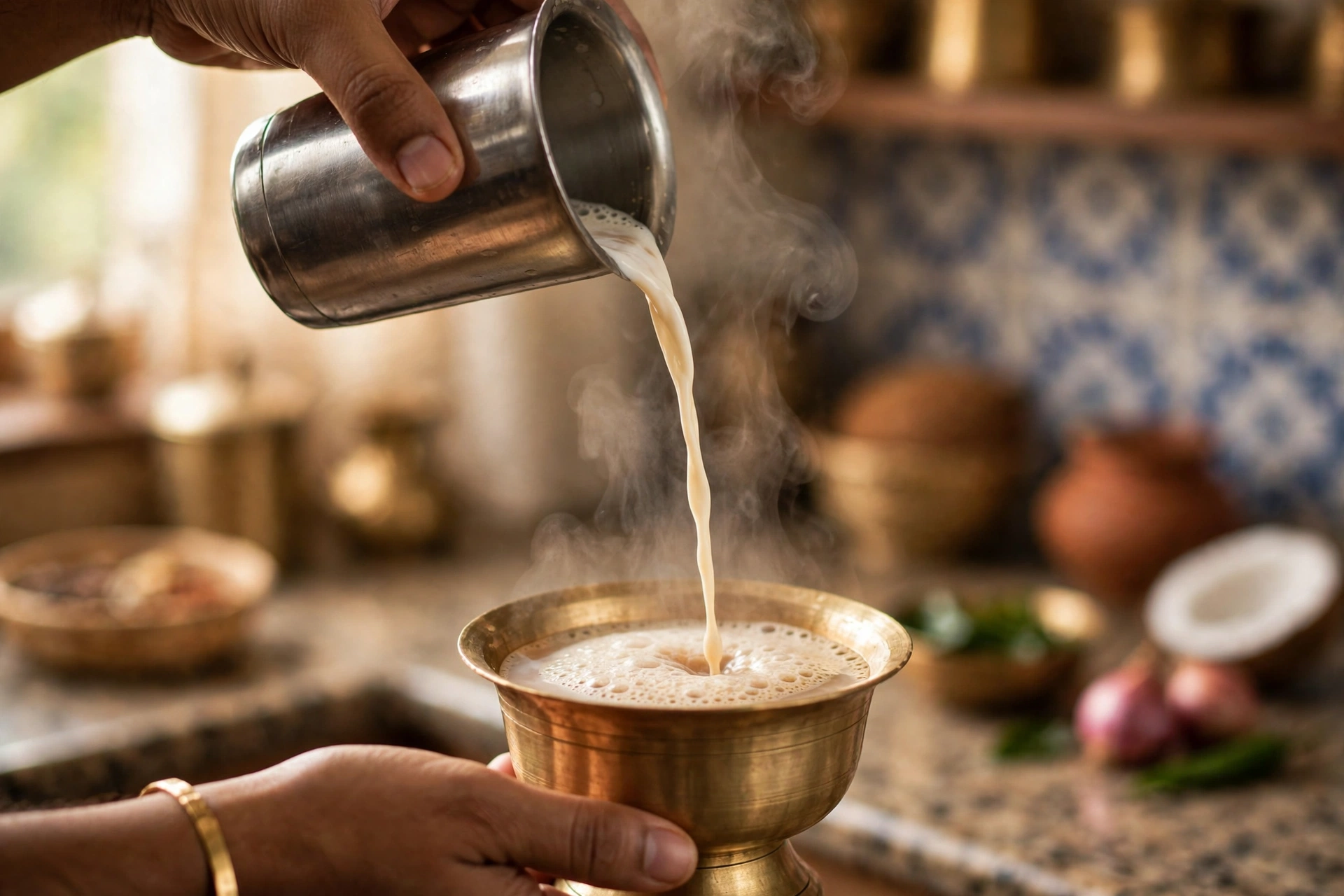
Step 8 — Pull it. Lift the tumbler by the rim (the sides are too hot to hold) and pour the coffee into the dabara from a little height, then pour it back into the tumbler, again from a height. Repeat three or four times. Each pass cools the coffee slightly, dissolves the sugar and builds a thicker layer of foam. Do not overdo it — too many passes and the coffee goes cold. Serve the tumbler sitting in the dabara, froth on top.
PRO TIP — Use the first decoction for the best cup. You can pour a second round of hot water through the same grounds for a weaker second batch, but it will never taste as good as the first — keep the second decoction for a mild afternoon cup, not for guests.
Getting the Strength Right: Decoction-to-Milk Ratios
This is where the recipes online contradict each other most: published ratios run from 1:2 all the way to 1:5. The disagreement is real but small — different recipes start from different decoction strengths, so a 1:5 from a very strong decoction and a 1:2 from a weak one can land in the same place. For the recipe in this guide, start at 1:3 and move from there. The table is for a standard 150 ml tumbler, with millilitres rounded to the nearest 10 ml.
| Strength | Ratio (decoction : milk) | Decoction | Hot milk | Who it suits |
|---|---|---|---|---|
| Strong | 1 : 2 | 50 ml | 100 ml | Dark-roast lovers, extra-chicory blends |
| Regular | 1 : 3 | 40 ml | 110 ml | The standard kaapi — start here |
| Mild | 1 : 4 | 30 ml | 120 ml | First-timers, an evening cup |
Taste the regular cup first: if it feels thin, add a tablespoon of decoction to the next cup rather than remaking the batch. A 53:47 high-chicory blend tastes stronger and more bitter at the same ratio than an 85:15 blend, so chicory-heavy powders usually want the mild end of the table.
Which Filter Coffee Maker to Buy in India
A good steel filter costs ₹200–₹500 — the cheapest brewer in Indian coffee, and one that lasts for years with no parts to replace. Pick the size by household, not by price: a 100 ml filter makes two cups and suits a solo drinker; a 250 ml filter makes four to six cups and is the right default for a family. Stainless steel is the practical buy — brass filters are the traditional Kumbakonam style and look beautiful, but they cost several times more and need regular polishing, so buy brass for the ritual, steel for everyday use. Both filters below were price-checked today on Flipkart through our tracker, and both are in stock.
SRIYAZH South Indian Coffee Filter 250 ml

Price: ₹240 on Flipkart (MRP ₹899; 4.4★ from 345 ratings; Flipkart Assured).
The best-value filter we track: a 250 ml stainless steel filter covering 2–6 cups, with the strongest warranty claim of the budget filters — a 10-year warranty link on the listing — and a Flipkart Assured badge. It has held the same price since our October check, which is rare for a budget listing. One caveat: the specification block does not name the steel grade, though the photos show a polished steel finish.
pajaka South Indian Filter 250 ml (6 Cups)

Price: ₹351 on Flipkart (MRP ₹599; 4.3★ from 484 ratings).When this guide was published (9 Nov 2026): ₹372 at Flipkart.
The most transparent listing of the budget filters: the smallest claimed discount of the four we compared in October, which also means the least inflated MRP, and the best-rated seller — Retail_Hub_India, 4.4★ with five years on Flipkart. The price has moved up from ₹344 in October to ₹372 today, so it is no longer the cheapest 250 ml filter — but if you value the seller’s track record over the deepest discount, this is the pick. Two honest notes: it is not Flipkart Assured, and the listing has flagged low stock before.
If you already own a moka pot, it can stand in for a filter in a pinch — our Moka Pot vs South Indian Filter guide compares the two methods — but a steel filter at this price is worth owning on its own. Our Best French Press Coffee Maker in India guide covers the other classic budget brewer.
Which Filter Coffee Powder to Buy
The powder is half the cup. Buy a fine-ground powder made specifically for the South Indian filter — a coarse grind gives a thin decoction, and a medium grind meant for pour-over drips too fast. The number on the pack is the coffee-to-chicory ratio: 85:15 means 85% coffee and 15% chicory, 80:20 is the classic balance, and 53:47 is a strong, chicory-heavy traditional blend. Our full comparison of seven powders is in our Best Filter Coffee Powder in India guide; the two picks below are the ones this recipe is built around, both price-checked today.
Cothas Speciality Blend 85:15

Price: ₹490 for 500 g on Amazon, checked 9 November 2026 (the Cothas store sells the same pack at ₹530; 200 g, 100 g and 50 g packs also sold).
The default recommendation: the heritage South Indian brand, and the 85:15 ratio is the most balanced in our powder guide — recognisably kaapi, with body and a caramel edge, but without the heavy bitterness of stronger blends. At ₹490 for 500 g it works out to ₹980 per kilo, and a 500 g pack makes about 50 cups. Buy the small pack first if you have never tried it — powder goes stale within weeks of opening, so a fresh small pack beats a big stale one.
Continental Malgudi 53/47 Filter Coffee (500 g)
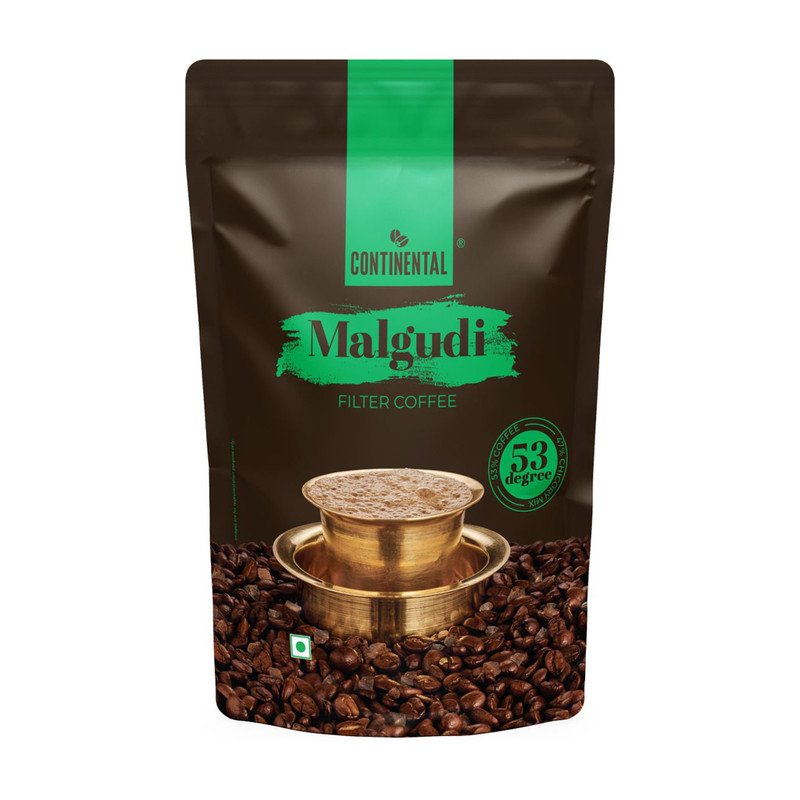
Price: ₹345 for 500 g (MRP ₹460) on Flipkart, checked 9 November 2026 (in stock; seller SuperComNet).
The strong-chicory alternative: 53% coffee and 47% chicory makes a darker, thicker, more bitter decoction that stands up to more milk — the most traditional end of the spectrum, and the cheapest per kilo of the two picks here at ₹690. Use it at the mild end of the strength table (1:4) until you know how much chicory bitterness you like. One honest caveat: the Flipkart page carries conflicting copy — a showcase caption and a highlights line say “60/40” while the title and the pack photo say 53/47. We cite 53/47 because the title and the pack agree.
What a Home Cup of Filter Coffee Costs
Filter coffee is the cheapest good coffee in India, and the maths is worth doing once. At the prices verified today, a 500 g pack of Cothas at ₹490 makes about 50 cups (10 g of powder per cup), so the powder costs about ₹9.80 a cup. Add about 120 ml of full-fat milk — roughly ₹8 at typical milk prices of ₹60–70 a litre — and a couple of teaspoons of sugar at well under a rupee, and a home cup lands at about ₹18–19.
| Per cup (150 ml tumbler) | Quantity | Cost |
|---|---|---|
| Filter coffee powder (Cothas 85:15, ₹490/500 g) | 10 g | ~₹9.80 |
| Full-fat milk | 120 ml | ~₹8.00 |
| Sugar | 2 tsp | ~₹0.50 |
| Total per cup | ~₹18–19 | |
| One month, one cup a day | 30 cups | ~₹540–570 |
Two things follow. First, the gear is a one-time cost — a ₹240 steel filter spread over a year of daily brewing adds less than a rupee a cup. Second, the powder is the real cost, and it is still small: against a conservative ₹40 café cup as the comparison, a month of home kaapi costs roughly half what the same habit costs at a café. The 500 g pack is the right size for a daily drinker; occasional drinkers should buy the 200 g pack instead and keep it sealed, because an open pack loses its aroma within weeks.
SAVINGS — One 500 g pack of powder (₹490) plus one steel filter (₹240) is ₹730 all-in for roughly 50 cups. The filter is a decade-long purchase; the powder is the only recurring cost.
Troubleshooting: When Your Filter Coffee Goes Wrong
Almost every bad cup of filter coffee comes from one of five causes, and each has a direct fix.
| Problem | Likely cause | Fix |
|---|---|---|
| Weak, thin decoction | Too little powder, or a coarse grind, or water too cool | Add a tablespoon of powder; use a fine grind made for filters; use water just off the boil |
| Bitter cup | Boiling water on a fine grind, decoction re-boiled, or too much chicory | Let the water come off the boil first; never re-boil decoction, warm it gently; try an 85:15 blend |
| Slow drip or no drip | Disc pressed too hard, or holes clogged with old coffee | Press the disc gently — never tamp; take the filter apart and rinse the holes with warm water |
| Cloudy decoction, grounds in the cup | Disc pressed too hard, forcing fines through the holes | Press gently and level the powder instead; if the holes have worn wide, replace the filter |
| Sour cup | Water too cool, or a rushed drip, or stale powder | Hotter water and the full 10–20 minute drip; buy a fresh, small pack of powder |
| Flat, no froth | Milk not hot enough, or too few pulls, or a cold tumbler | Milk must be scalding; pull 3–4 times from a height; warm the tumbler first |
If the cup is weak and bitter at the same time, the usual culprit is a coarse grind with boiling water — the water rushes through the coarse bed, over-extracting the fines and under-extracting the rest. Fix the grind first: filter coffee powder should feel like fine sand, slightly coarser than espresso powder and finer than drip grind.
No Filter? Make It Without One
If you have the powder but no filter yet, you can still make a recognisable kaapi. Stir 2–3 tablespoons of fine filter coffee powder into 120 ml of just-off-the-boil water in a vessel, cover it and leave it for 10 minutes, then strain it slowly through a fine cloth or a muslin square into another vessel — the cloth does the job of the perforated chamber. Mix the strained decoction with hot milk and sugar and pull it the same way. The cup will be a little cloudier than a filter-brewed one, because cloth lets more fines through than steel, but the flavour is close. Treat it as a stopgap: a steel filter costs less than a week’s worth of café coffee and gives a cleaner cup every morning.
Storing Decoction and the Second Decoction
Decoction keeps well, which is why many households brew it once and use it across the day. Let it cool, then store it in a sealed container in the fridge for up to two days. To use it, warm it gently — never boil it, because boiling turns it bitter — and mix it with freshly boiled milk. Do not store mixed coffee (decoction plus milk) in the fridge; mix each cup fresh. The grounds have one more cup in them: pour a second round of hot water through the same bed for a weaker second batch, roughly half the strength of the first — good for a mild cup, or for stretching a batch when guests arrive.
How Much Caffeine Is in Filter Coffee?
A standard 150 ml dabara cup of South Indian filter coffee carries roughly 90–120 mg of caffeine — more than a single espresso shot (about 63 mg) because the cup is five times bigger, even though espresso is far stronger per millilitre. One honest caveat: no lab-measured caffeine figure exists specifically for South Indian filter coffee, so 90–120 mg is an estimate — consistent with the Indian Council of Medical Research range for brewed coffee, but never measured in a lab for this exact drink. Chicory has no caffeine at all, so a heavy-chicory blend like the 53:47 delivers less caffeine per spoon than an 85:15 blend. For the full comparison, see our Caffeine in Filter Coffee vs Espresso guide.
Frequently Asked Questions
How much coffee powder do I need for 1 cup of filter coffee?
About 1½ tablespoons, or roughly 10 g, of fine filter coffee powder per cup — with about 60 ml of just-off-the-boil water, which yields about 40 ml of decoction. In practice, brew for two cups at a time (3 tablespoons, about 20 g, with 120 ml of water) and use 40 ml of decoction per cup.
What is the ratio of decoction to milk in filter coffee?
The standard ratio is 1 part decoction to 3 parts hot milk — about 40 ml of decoction to 110 ml of milk in a 150 ml tumbler. For a stronger cup use 1:2; for a milder cup use 1:4. Published recipes range from 1:2 to 1:5 because they start from different decoction strengths; for this guide’s recipe, 1:3 is the tested starting point.
How long does filter coffee take to drip?
About 10–20 minutes for a standard filter. If nothing has dripped after five minutes, the disc was pressed too hard or the holes are clogged — lift the disc, press it again gently, and check the holes are clear. One slow method leaves the filter for 3–4 hours for a stronger decoction, but that is a variation, not the standard wait.
Can I make South Indian filter coffee without a filter?
Yes. Stir 2–3 tablespoons of fine filter coffee powder into 120 ml of just-off-the-boil water, cover and leave it for 10 minutes, then strain it slowly through a fine cloth or muslin square. Mix the strained decoction with hot milk and sugar and pull it the same way. The cup is a little cloudier, but the flavour is close.
Why is my filter coffee bitter?
The most common causes are water that is still at a rolling boil when poured, decoction that was re-boiled instead of warmed gently, or a powder with too much chicory for your taste. Let the water come off the boil before pouring, warm stored decoction gently and never boil it, and try an 85:15 blend like Cothas Speciality Blend instead of a heavy-chicory 53:47.
How much caffeine is in a cup of filter coffee?
A standard 150 ml dabara cup carries roughly 90–120 mg of caffeine — more total caffeine than a single espresso shot (about 63 mg), because the cup is much bigger. The figure is an estimate, not a lab measurement: no lab-measured caffeine figure exists specifically for South Indian filter coffee, but the range matches the ICMR range for brewed coffee.
Prices checked on 9 November 2026 on Flipkart (SRIYAZH, pajaka and Continental Malgudi) and the Cothas store. Filter prices refresh automatically every hour through our tracker — the price at checkout is what counts. Looking for today’s best offers across all our picks? See Today’s Deals on Kaapi Craft.