Learning how to make masala coffee at home takes 10 minutes, one saucepan, and spices already sitting in your kitchen. The ratio that works: 20 g filter coffee powder (2 heaped tablespoons) brewed in 240 ml spiced water, mixed 1:1 with 240 ml hot milk — two strong, warming cups for about ₹18–25 each. No machine, no café queue, no ₹250 bill.
Last updated: 12 November 2026.
AT A GLANCE — 10 minutes, 2 cups, no machine needed. The ratio is 20 g coffee + 240 ml water + 240 ml milk + 4 whole spices. Two methods: a quick saucepan method, or a South Indian filter decoction version. Cost is about ₹18–25 per cup with prices verified 12 Nov 2026. A make-ahead masala powder mix keeps 3–4 weeks in an airtight jar.
What Is Masala Coffee?
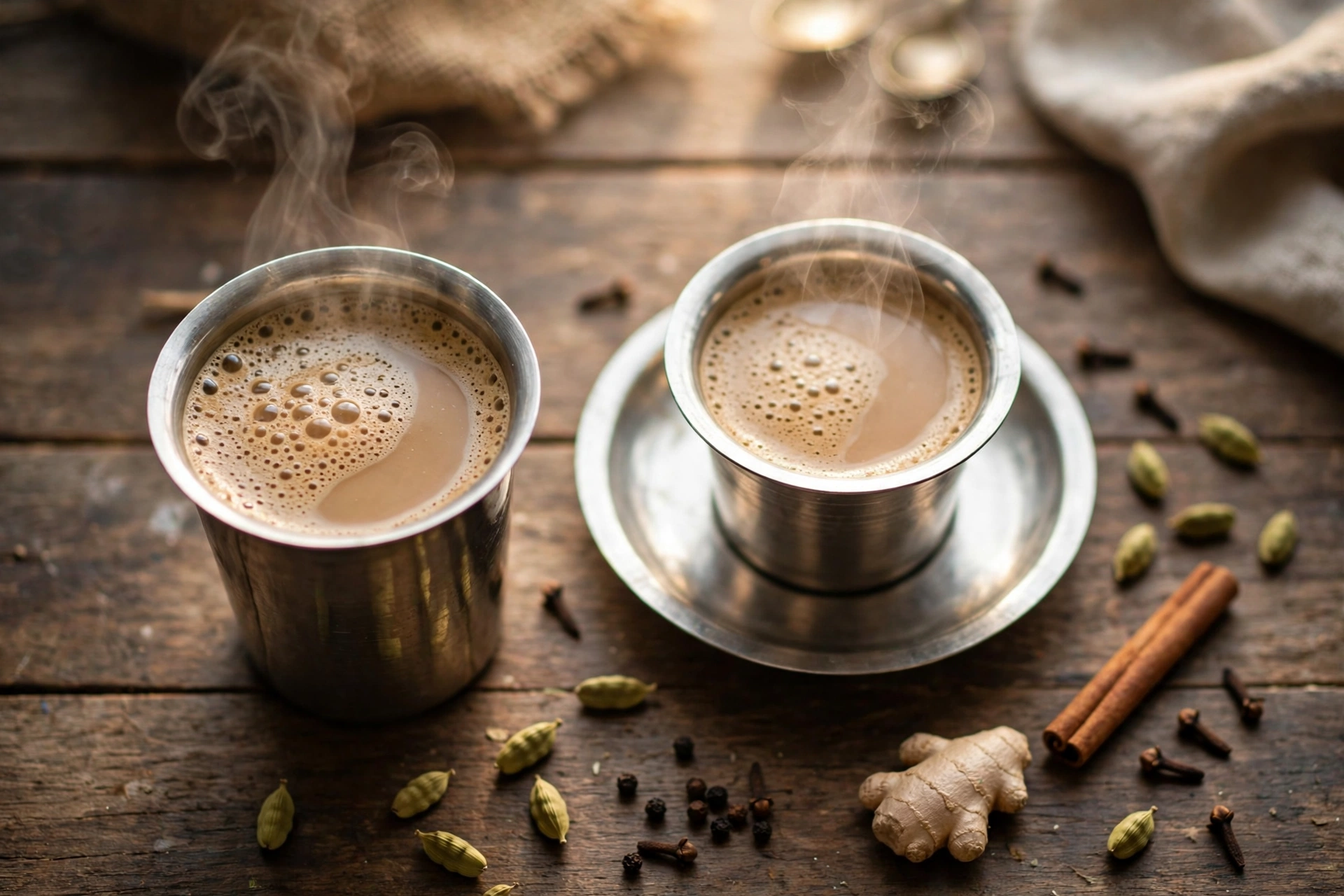
Masala coffee is exactly what it sounds like: coffee brewed with the warming spices of masala chai — cardamom, cinnamon, cloves, black pepper and ginger — instead of tea leaves. It is less famous than masala chai, but it has been made in Indian homes for years, especially in cold or rainy weather, when a plain cup feels too thin and a milky, spiced one feels right.
It is not a latte with a fancy name. A latte is espresso plus steamed milk; masala coffee is strong brewed coffee plus spice-infused milk, and the spices do real work — cardamom gives the floral top note, cinnamon adds warmth and a hint of sweetness, cloves bring depth, pepper gives a gentle kick, and ginger adds freshness. Get the balance right and the coffee still tastes like coffee. Get it wrong — too much clove or pepper — and it tastes like cough syrup.
One honest note: you will read claims online that masala coffee “boosts immunity” or “aids digestion”. This article makes no such claim — the spices are here for flavour and warmth. If you have acidity, go easy on the pepper and ginger.
Ingredients (Makes 2 Cups)
| Ingredient | Amount | Notes |
|---|---|---|
| Filter coffee powder | 20 g (2 heaped tbsp) | Any South Indian filter blend, 80:20 or 85:15. Instant coffee works too — see the swap below. |
| Water | 240 ml | For brewing the coffee and simmering the spices. |
| Milk | 240 ml (120 ml per cup) | Full-cream tastes best; toned milk works and costs less. |
| Green cardamom | 3–4 pods, lightly crushed | The signature aroma. Do not skip this one. |
| Cinnamon | 1 small stick (about 2 g) | Break it in half so it releases flavour faster. |
| Cloves | 2–3 whole | More than 3 and the cup turns medicinal. |
| Black peppercorns | 5–6, lightly crushed | The gentle kick. Skip if you dislike heat. |
| Fresh ginger | ½ tsp, grated (optional) | Adds freshness; leave out if you prefer a softer cup. |
| Sugar or jaggery | 2 tsp, to taste | Jaggery gives a deeper, caramel note. |
Everything here is at any kirana store — no saffron, no imported syrups, no special equipment beyond a saucepan and a sieve.
How to Make Masala Coffee at Home: The Quick Saucepan Method (10 Minutes)
Step 1 — Crush the spices (1 minute). Lightly crush the cardamom pods, cloves and peppercorns in a mortar and pestle, or put them in a small plastic bag and press with a rolling pin. You want them cracked open, not powdered — cracked spices release flavour slowly and strain out cleanly.
Step 2 — Simmer the spices (3–5 minutes). Pour the 240 ml water into a small saucepan, add all the spices and the grated ginger, and bring to a gentle boil. Reduce the heat and let it simmer for 3–5 minutes, until the water smells strongly of spice. This is the step most recipes rush: under 3 minutes and the spices barely register; over 5 and the clove starts to dominate.
Step 3 — Add the coffee (2–3 minutes). Stir in the 20 g filter coffee powder and keep the pan at a gentle simmer for 2–3 minutes. Do not let it come to a rolling boil — vigorously boiled coffee turns bitter, and there is no fixing that later. If you are using instant coffee instead, stir in 2 teaspoons now and skip the simmer; instant dissolves in seconds.
Step 4 — Add the milk (2 minutes). Pour in the 240 ml milk and heat over medium-low heat until it just starts to steam, about 65 °C. Do not boil the milk hard — scorched milk dulls the spice aroma and leaves a skin on top. For froth, whisk briskly for 20 seconds, or pour the finished coffee between two vessels from a height, dabara-style.
Step 5 — Sweeten and strain. Take the pan off the heat and stir in the sugar or jaggery until dissolved. If you are using jaggery, add it only now, off the heat — jaggery boiled in milk can split it. Strain through a fine sieve into two cups to catch the grounds and whole spices, and serve immediately.
Method B: The South Indian Filter Version
If you own a South Indian filter — and many Indian kitchens do — this version tastes cleaner and more distinctly like coffee, because the decoction is brewed separately from the spices instead of boiled with them.
Step 1 — Brew the decoction. Brew a strong decoction in your filter the usual way: 20 g filter coffee powder in the upper chamber, 120 ml hot water (just off the boil, about 90–95 °C) poured over it, and let it drip through. You want about 120 ml of thick decoction for two cups. Our full step-by-step for this is in How to Make South Indian Filter Coffee at Home.
Step 2 — Simmer the spices in the milk. While the decoction drips, put 360 ml milk in a saucepan with the same crushed spices (cardamom, cinnamon, cloves, pepper, ginger) and simmer gently for 3–5 minutes. Do not boil.
Step 3 — Combine. Strain the spiced milk, then mix 60 ml decoction with 180 ml hot spiced milk per cup — a 1:3 decoction-to-milk ratio, the same standard ratio our filter coffee guide uses. Sweeten to taste and serve. The result is smoother than Method A, with the spice sitting on top of a proper kaapi base instead of competing with boiled grounds.
If you do not own a filter yet, Method A is the one to start with — it needs nothing you do not already have. And if you are choosing a powder for either method, our best filter coffee powder in India guide compares the blends that hold up best to milk and spice.
Make-Ahead Masala Coffee Powder
If you make this more than once a week, grind a batch of the spice mix once and skip the crushing step every morning.
Mix together: 20 g ground cardamom (from about 30 pods, seeds only), 15 g ground cinnamon, 5 g ground cloves, 5 g ground black pepper and 10 g dry ginger powder. That is 55 g of mix — enough for about 20 cups at 1 teaspoon (about 2.5 g) per cup. Store it in a small airtight jar in a cool, dark cupboard and use it within 3–4 weeks; ground spices lose aroma steadily, while whole spices kept separately stay good for months.
To use it, add 1 teaspoon of the mix per cup to the water in Step 2 of Method A and carry on as normal. Start with 1 teaspoon — you can always add more next time, but you cannot take spice out of a finished cup.
Variations
- Sugar-free: skip the sweetener entirely. Cinnamon adds a perception of sweetness, and a full-cream milk base softens the coffee enough that many people do not miss the sugar.
- Jaggery version: replace sugar with the same amount of jaggery powder. Add it off the heat and stir until dissolved. It gives a deeper, caramel note that suits the spices better than white sugar.
- Vegan: oat milk is the best swap — it froths well and does not split. Almond milk works too. Avoid soy milk in this recipe; it can curdle with the ginger and pepper.
- Stronger: use 25 g coffee powder, or in Method B use a 1:2 decoction-to-milk ratio (80 ml decoction + 160 ml milk per cup).
- Milder and milkier: use 15 g coffee, or a 1:1.5 coffee-to-milk ratio. Children and light-coffee drinkers usually prefer this.
- Iced masala coffee: make Method A with half the milk, let it cool, then pour over ice and top up with cold milk. Do not pour hot spiced coffee directly onto ice — it waters down before the flavour sets.
Common Mistakes and How to Fix Them
| Mistake | What happens | Fix |
|---|---|---|
| Boiling the milk hard | Scorched taste, skin on top, dull spice aroma | Heat milk only until it steams (~65 °C); never a rolling boil |
| Boiling the coffee vigorously | Bitter, harsh cup | Gentle simmer only, 2–3 minutes after adding coffee |
| Too many cloves or peppercorns | Medicinal, numbing taste | Max 2–3 cloves and 5–6 peppercorns per 2 cups |
| Stale pre-ground spices | Flat, dusty aroma | Crush whole spices fresh each time, or make the powder mix above |
| Rushing the spice simmer | Spices barely register | Simmer 3–5 minutes; the water should smell strongly spiced before coffee goes in |
| Jaggery boiled in milk | Milk can split | Add jaggery off the heat and stir to dissolve |
| Too little coffee | Spices overpower the cup | Minimum 20 g filter powder (or 2 tsp instant) per 2 cups |
What Does Masala Coffee Cost Per Cup?
Prices verified 12 Nov 2026. Milk is the biggest cost, and it moved today: Amul Gold is ₹80 a litre from 12 Nov 2026, so 240 ml costs ₹19.20. Toned milk (Amul Taaza, ₹62 a litre) costs ₹14.88 — about ₹2 less per cup.
| Ingredient (2-cup batch) | Amount | Cost |
|---|---|---|
| Filter coffee powder (Cothas, ₹228/200 g) | 20 g | ₹22.80 |
| Milk (Amul Gold, ₹80/L) | 240 ml | ₹19.20 |
| Whole spices (cardamom, cinnamon, cloves, pepper, ginger) | 1 batch | ~₹7.50 |
| Sugar or jaggery | 10 g | ~₹0.80 |
| Total per batch (2 cups) | ~₹50.30 | |
| Per cup — filter-coffee version | ~₹25 | |
| Per cup — instant version (Nescafé Classic ₹455/200 g, 4 g per batch) | ~₹18 |
So a homemade masala coffee costs about ₹18–25 a cup, depending on the coffee you use. For comparison, our Bengaluru café price check (11 Nov 2026) found spiced lattes and flavoured coffees at ₹180–350 a cup — roughly ten times the homemade cost. The spices are the cheapest part of the drink; the coffee and the milk are where the money goes, which is also why the instant version is the budget pick.
What You Need
Nothing here requires a machine. The essentials are a small saucepan, a fine sieve, and something to crush spices with — a mortar and pestle, or a rolling pin and a plastic bag. A South Indian filter earns its place if you prefer Method B, and a whisk (or the dabara pour) gives you a frothy top. If you are still deciding on blends, start with the powder guide linked above, and check today’s coffee deals before stocking up — buying the 500 g pack on a deal day is usually the cheapest way to keep this drink in your routine.
Frequently Asked Questions
What is masala coffee?
Masala coffee is coffee brewed with warming Indian spices — cardamom, cinnamon, cloves, black pepper and ginger — instead of tea leaves. It is the coffee cousin of masala chai: strong coffee, hot milk, whole spices simmered in, and sugar or jaggery to taste. It is best known in South Indian homes, where it is often made with filter-coffee decoction.
Can I use instant coffee for masala coffee?
Yes, and it is the fastest version. Use 2 teaspoons of instant coffee (about 4 g) for 2 cups, stirred into the spiced water in Step 3 — it dissolves in seconds, so skip the 2–3 minute simmer. The cup is slightly less deep than the filter-powder version, but the spice character is the same, and it costs about ₹7 less per cup.
Can we add jaggery in coffee instead of sugar?
Yes — jaggery works well in masala coffee and its caramel note suits the spices better than white sugar. Use the same quantity (about 1 teaspoon per cup). The one rule: add it off the heat and stir until dissolved. Jaggery boiled in milk can make the milk split.
What is the difference between masala coffee and masala chai?
The base. Masala chai is brewed with tea leaves; masala coffee is brewed with coffee. The spice blend is nearly identical — cardamom, cinnamon, cloves, ginger — and both are usually made with hot milk and a sweetener. If you like masala chai, you will like masala coffee — the coffee version is stronger and slightly more bitter.
How many calories are in masala coffee?
Roughly 90–120 kcal per cup with full-cream milk and 1 teaspoon of sugar — most of it from the milk. With toned milk and no sugar it drops to about 60–70 kcal, and a black version (no milk, no sugar) is roughly 10–15 kcal. These are estimates from the ingredient quantities in this recipe, not lab measurements.
Can I make masala coffee without milk?
Yes. Brew the spiced water and coffee exactly as in Method A, skip the milk, and strain into a cup — a black masala coffee. The spice hit is stronger without milk softening it, so cut the pepper to 3–4 peppercorns and the cloves to 2. It also works iced: cool the spiced brew and pour over ice.
Prices checked 12 Nov 2026 and may change — milk and coffee prices move often, so the per-cup cost is a worked-out estimate from today’s prices, not a fixed price. The recipe itself needs nothing more than a saucepan, a sieve and spices from your kitchen shelf.