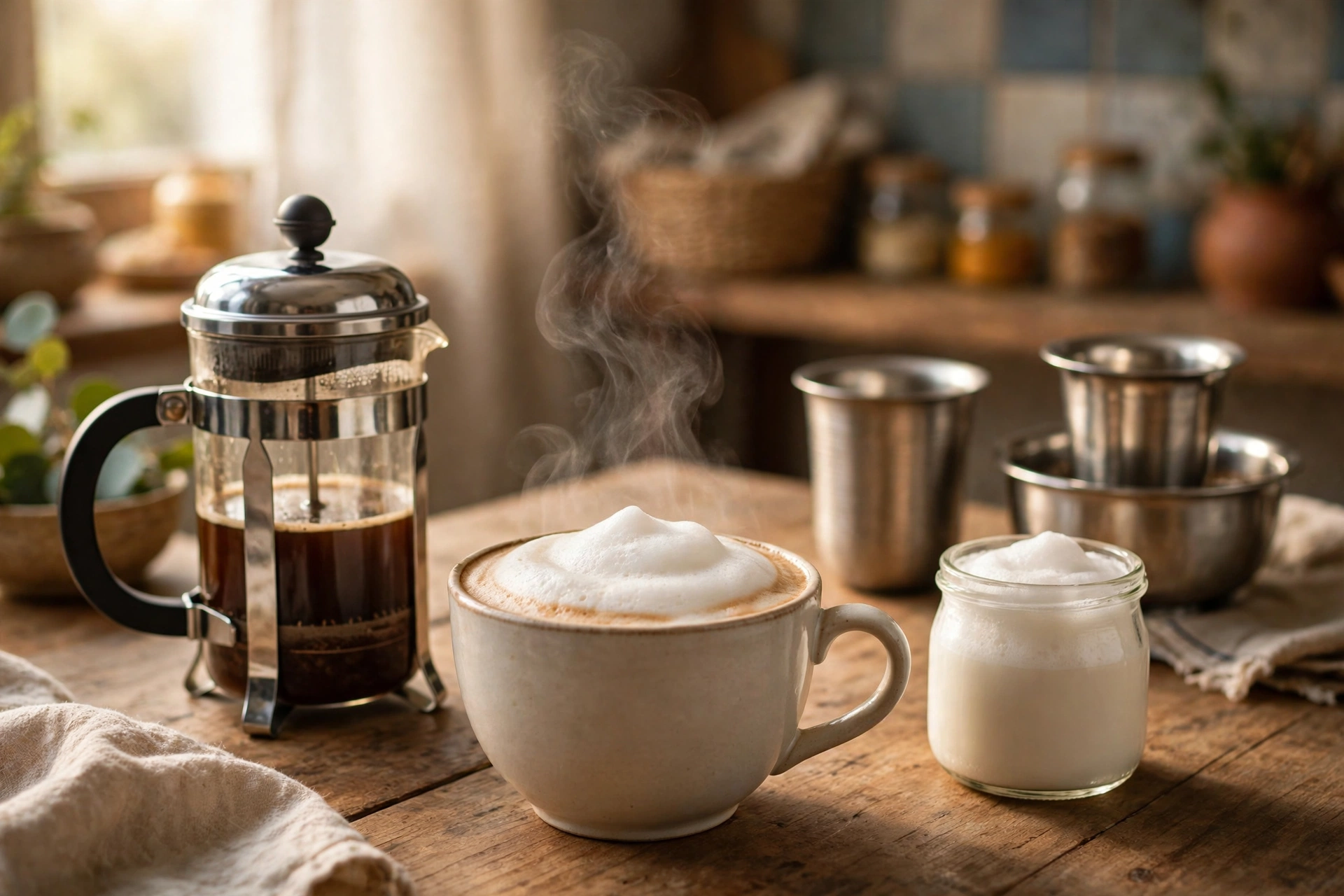
Learning how to froth milk without a frother takes about a minute and nothing you do not already own. Warm 120 ml of milk to 60–65 °C, shake it hard in a lidded jar for 30–60 seconds, and you have thick foam for a cappuccino — no machine, no gadget, no ₹500 purchase. The five methods below all work; the difference is the foam each one gives you, and which drink it suits.
Last updated: 19 November 2026.
AT A GLANCE — 5 methods, 1–4 minutes each, ₹0 extra cost. Heat milk to 60–65 °C and never past 70 °C. Full-cream Amul Gold (₹80/L) gives the richest foam; toned Amul Taaza (₹62/L) is the everyday compromise. Best foam without buying anything: the French press. Fastest: the jar shake. For iced coffee, shake cold milk and skip the heat entirely.
Which Milk Froths Best in India?
Foam is air trapped by milk proteins, so the milk you start with decides the foam you get. Fat adds richness but weakens the bubbles — skimmed milk holds foam longest but tastes thinnest, full-cream tastes richest and fades a little faster. There is no single winner, only a trade-off:
| Milk (India) | Fat | Price, 19 Nov 2026 | Foam you get | Best for |
|---|---|---|---|---|
| Amul Gold (full cream) | 6% | ₹80/L | Rich, thick, good volume | Cappuccino, latte, masala coffee |
| Amul Taaza (toned) | 3% | ₹62/L | Good foam, slightly lighter | Everyday frothing |
| Skimmed milk (e.g. Amul Slim & Trim) | ~0.5% | — | Light, airy, longest-lasting | Cold foam and iced coffee |
| Oat milk (barista blend) | — | — | Froths well, holds its shape | Vegan lattes |
| Almond milk | — | — | Thin foam that fades fast | Only if you already drink it |
Prices are the post-12-November GCMMF rates and vary by city — Amul Gold was ₹76 a litre before 12 Nov 2026 and is ₹80 now; Amul Taaza moved from ₹60 to ₹62. The milk for one cup is 120 ml, so a frothed cup costs ₹9.60 in milk with Gold and ₹7.44 with Taaza. On plant milks: a barista-blend oat milk froths well in a jar or a French press, almond milk makes a thin foam that fades within a minute, and soy milk can split in hot, acidic coffee — so if you drink plant milk, oat is the swap to reach for.
How to Froth Milk Without a Frother: 5 Methods Compared
Every method follows the same idea: get the milk to 60–65 °C, then work air into it until foam forms. Pick your method from the table, then read its steps.
| Method | Time | Foam style | Best for |
|---|---|---|---|
| 1. Jar shake | ~2 min | Light, airy, coarse bubbles | Quick weekday cappuccino |
| 2. French press pump | ~3 min | Dense, fine — closest to café foam | Latte and cappuccino |
| 3. Hand whisk | ~4 min | Medium, a little uneven | When you own nothing else |
| 4. Immersion blender | ~2 min | Thick, lots of volume | Big mugs, two cups at once |
| 5. Dabara pull | ~2 min | Loose, rustic foam | Filter coffee and masala coffee |
Method 1: Shake It in a Jar (Fastest, Nothing to Buy)
You need: 120 ml cold milk, a jar of at least 300 ml with a tight lid, and a microwave or a small pan.
Step 1 — Fill the jar one-third full. The milk roughly doubles in volume, and a jar filled past half leaves no room for the foam to grow.
Step 2 — Shake hard for 30–60 seconds. Screw the lid on tight and shake vigorously until the milk looks frothy and has visibly doubled. Cold milk whips up more easily than warm milk, which is why you shake first and heat second.
Step 3 — Heat with the lid OFF for 30 seconds. Take the lid off and microwave for about 30 seconds, or pour the milk into a pan and warm it gently to 60–65 °C. Heating sets the foam so it holds on the drink instead of collapsing.
Step 4 — Pour and spoon. Pour the liquid milk into your coffee first, then spoon the foam over the top. The foam is light and airy with fairly coarse bubbles — perfect for a cappuccino, less suited to latte art.
Safety first: never shake hot milk in a sealed jar. The pressure can push the lid off and scald you. Shake cold, heat after — always in that order.
Method 2: Pump It in a French Press (Best Foam)
You need: a French press and 120–180 ml of milk. If you already brew in a French press, you own one of the best manual frothers available — its mesh screen breaks air into small bubbles for a denser, silkier foam than shaking.
Step 1 — Heat the milk first. Warm it to 60–65 °C in the microwave (about 45 seconds per 120 ml) or in a pan on medium heat. Unlike the jar method, the press works on warm milk.
Step 2 — Fill the press no more than halfway so the milk has room to double.
Step 3 — Pump for 30–60 seconds. Put the lid on and move the plunger up and down rapidly, 20–30 strokes, keeping the mesh just under the surface. The milk will double in volume.
Step 4 — Rest 10 seconds, then pour. Let the foam settle briefly, hold the plunger down, pour the liquid milk into your coffee first, then spoon or pour the foam over the top.
One condition: the press must be clean. Coffee residue kills foam, so rinse it with hot water before you start. Our best French press in India guide compares the presses that do this job well — the same press brews your coffee and froths your milk.
Method 3: Whisk It by Hand (The Classic Arm Workout)
You need: a small saucepan, a balloon whisk (a fork works in a pinch), and a wide bowl or jug.
Step 1 — Heat the milk to 60–65 °C in the pan until it steams. Do not let it boil — past 70 °C the foam collapses almost as fast as you make it.
Step 2 — Whisk fast for about a minute. Pour the warm milk into the bowl and whisk vigorously back and forth, keeping the whisk near the surface so it pulls air in, until the milk roughly doubles in volume.
Step 3 — Pour. Pour the frothed milk into your coffee in one go — this method makes a single, mixed foam rather than a separate cap to spoon on top.
Whisking takes the most effort and gives the least even foam, but it needs nothing you do not already own, and full-cream milk covers for the uneven bubbles.
Method 4: Use an Immersion Blender (Most Volume, Least Effort)
You need: a stick blender (or hand mixer) and a tall, narrow cup.
Step 1 — Heat the milk to 60–65 °C in a pan or the microwave.
Step 2 — Blend for 20–30 seconds. Pour the warm milk into the tall cup, keeping the blender head covered with generous empty space above it. Start low, then raise the head slowly towards the surface until you hear a light fizzing sound — that is air being pulled in. Hold it there a few seconds to build foam, then lower it again to keep the texture even.
Step 3 — Stop before it gets stiff. Over-blending makes a dry, stiff foam that separates into a cap and watery milk within a minute. Twenty to thirty seconds is enough; tap the cup once on the counter to settle any big bubbles.
Watch out: keep the blender head submerged or the milk sprays everywhere. With a countertop blender instead, never fill it past half with hot liquid and hold the lid down with a folded towel.
Method 5: The Dabara Pull (The South Indian Way)
You need: two vessels — a tumbler and a dabara, or any two bowls or jugs — and 120 ml of milk.
Step 1 — Heat the milk to 60–65 °C in a pan.
Step 2 — Pour from a height, 4–5 times. Pour the hot milk from one vessel into the other from about 30 cm up, and repeat. Each pour folds air into the milk and builds a loose, rustic foam — the same motion that makes South Indian filter coffee frothy.
Step 3 — Serve straight away. This foam is the loosest of the five and fades fastest, so pour it onto the coffee immediately.
The dabara pull will never give you latte-art foam, and that is not its job — it is the traditional way to finish a filter coffee or a masala coffee, and the foam it makes suits those drinks exactly. Our South Indian filter coffee guide shows the full pour, and the same motion tops our masala coffee beautifully.
Cold Foam Without Heat (For Iced Coffee)
Cold foam skips the heating step entirely. Pour 120 ml of cold milk into a jar, fill it one-third full, seal the lid and shake hard for about 30 seconds until it thickens, then spoon it over iced coffee. Cold-milk foam is stable and lasts — skimmed or toned milk holds it longest, though full-cream milk still works. Use it for iced coffee and cold brew, where warm foam would melt the ice.
The Indian Beaten-Coffee Foam (No Milk Frothing at All)
One more foam Indian kitchens invented needs no milk frothing at all — the hand-beaten instant coffee foam of the classic Indian cappuccino. Put 1 tablespoon of instant coffee, 1 teaspoon of sugar and 1 teaspoon of water in a cup, and beat the mixture fast with a spoon or fork until it turns thick, pale and creamy. Spoon the foam over hot milk and stir. Be honest about the effort: beating by spoon takes several minutes of fast stirring, so this is a slow-weekend method rather than a weekday one — but the foam is real, it costs nothing, and it needs no equipment at all.
Which Method for Which Drink?
| Drink | Best method | Why |
|---|---|---|
| Cappuccino | French press or jar | Thick cap of foam on top; the airy jar foam is made for this |
| Latte | French press | Finest, silkiest foam pours smoothest into the coffee |
| Masala coffee | Dabara pull or whisk | Rustic foam suits a spiced cup |
| Filter coffee | Dabara pull | The traditional pour; the foam is a bonus |
| Iced / cold coffee | Cold jar shake | No heat, so the ice survives |
| Big family batch | Immersion blender | Volume fast — the only method that scales past two cups |
Common Mistakes and How to Fix Them
| Mistake | What happens | Fix |
|---|---|---|
| Milk heated past 70 °C | Scorched taste; foam collapses almost instantly | Heat only until it steams, 60–65 °C; if it bubbles at the edges, it is too hot |
| Shaking hot milk in a sealed jar | Lid pops off; scalding risk | Shake cold, heat after — always in that order |
| Jar filled too full | No room for the foam to grow | Fill one-third full, never above half |
| Toned-milk foam collapsing fast | Thin foam that fades within a minute | Expected with lower fat — use full-cream milk for a sturdier cap, or spoon the foam on last |
| Coffee residue in the French press | Foam dies as fast as you pump it | Rinse the press with hot water before you start |
| Whisking deep in the milk, slowly | Warm milk, no air, no foam | Keep the whisk near the surface and move fast, back and forth |
| Blending too long | Stiff, dry foam that separates | Stop at 20–30 seconds; tap the cup once to settle big bubbles |
Do You Need to Buy a Frother?
Probably not. Every method above costs ₹0 and uses something already in your kitchen, and the French press method matches a basic handheld frother closely enough that most people will never notice the difference. A handheld frother is worth it only if you froth milk every day and want the same result in under a minute with no arm work — a basic one typically sells for about ₹450–600 in India. If that is you, check our milk frother deals roundup and today’s coffee deals before buying, since the price moves often. If you froth twice a week, skip the purchase — the jar and the French press have you covered.
Frequently Asked Questions
Can you froth milk without a frother?
Yes. Shake cold milk in a lidded jar for 30–60 seconds and heat it with the lid off, pump warm milk in a French press for 30–60 seconds, whisk warm milk briskly for about a minute, or pour hot milk between two vessels from a height — all make real foam with no frother and no extra purchase.
How do you froth milk without a frother or whisk?
Use the jar method: pour cold milk one-third full into a jar with a tight lid, shake hard for 30–60 seconds, remove the lid and microwave for 30 seconds. If you have no jar either, use the dabara pull — pour hot milk back and forth between two vessels from a height 4–5 times.
How do you froth milk in a French press?
Heat 120–180 ml of milk to 60–65 °C, pour it into a clean French press filled no more than halfway, and pump the plunger up and down rapidly for 30–60 seconds, keeping the mesh just under the surface. Rest 10 seconds, then pour the milk into your coffee and spoon the foam over the top.
Can you froth cold milk without a frother?
Yes — shake 120 ml of cold milk in a sealed jar for about 30 seconds until it thickens, then spoon it over iced coffee as cold foam. Cold-milk foam is stable and lasts; skimmed or toned milk holds it longest. Heat the milk only if you want a warm drink, not to make thicker foam.
Which milk froths best — full cream or toned?
It depends what you value. Full-cream milk (Amul Gold, 6% fat, ₹80/L) gives the richest-tasting foam with good volume; toned milk (Amul Taaza, 3% fat, ₹62/L) gives slightly lighter foam that most homes find perfectly good for everyday cups; skimmed milk gives the lightest, longest-lasting foam but the thinnest taste. For a cappuccino, pick full cream; for everyday frothing, toned milk is the practical middle.
How do you froth oat milk without a frother?
Use a barista-blend oat milk — it is formulated to froth — and treat it like dairy: shake it cold in a jar for 30–60 seconds, or pump it warm in a French press. Regular oat milk froths poorly, and almond milk makes a thin foam that fades within a minute, so the barista blend matters more than the method.
Prices checked 19 Nov 2026 and may change — Amul Gold ₹80/L and Amul Taaza ₹62/L are the post-12-November rates and vary by city. The methods need nothing more than a jar, a whisk or a French press you already own.