Learning how to make mocha coffee at home takes about 10 minutes and one simple ratio: 60 ml of strong coffee, 1 tablespoon of chocolate, and 180 ml of hot milk. That is the whole drink — a latte with chocolate stirred in — and it costs about ₹34 a cup at home against ₹270–₹335 for the same drink at a café. No espresso machine is needed: the moka-pot and instant-coffee versions below taste just as good, and the only rule that matters is to dissolve the cocoa into a smooth paste before the milk goes in.
Last updated: 26 November 2026.
AT A GLANCE — One mug in about 10 minutes: 60 ml strong coffee + 1 tbsp chocolate + 180 ml milk heated to 60–65 °C. Cost: about ₹34 a cup with instant coffee, about ₹42 with a moka pot — against ₹270–₹335 for a café mocha. Mix the cocoa into a paste with hot water or espresso first; cocoa dumped straight into milk turns grainy. No espresso machine needed.
What Is a Mocha Coffee?
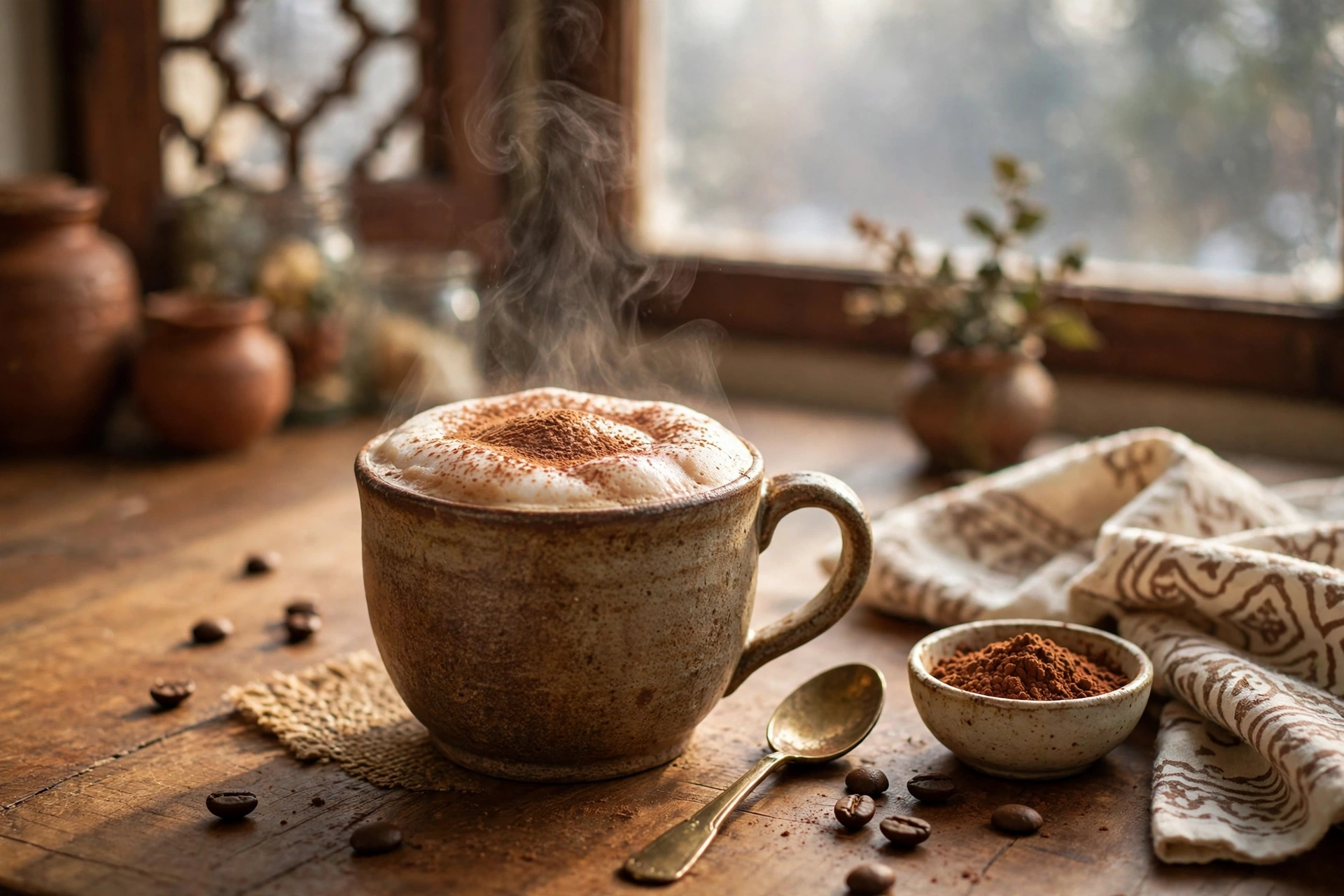
A mocha — a caffè mocha, or mocha latte — is an espresso drink made with steamed milk and chocolate. In plain terms, it is a latte with chocolate in it: one or two shots of espresso, chocolate (cocoa powder or chocolate sauce), steamed milk, and often whipped cream on top. The name comes from the port of Mocha in Yemen, once famous for its coffee.
The difference from a latte is exactly one ingredient:
| Drink | Coffee | Milk | Chocolate | Foam | Taste |
|---|---|---|---|---|---|
| Mocha | 1–2 shots | Steamed, 150–240 ml | Yes — cocoa or sauce | Thin layer | Rich, sweet, chocolatey |
| Latte | 1–2 shots | Steamed, 150–240 ml | No | Thin layer, about 1 cm | Smooth, mild, creamy |
| Cappuccino | 1–2 shots | Equal thirds with foam | No | Thick, about 2 cm | Bold, airy, coffee-forward |
| White mocha | 1–2 shots | Steamed, 150–240 ml | Yes — white chocolate | Thin layer | Sweeter, creamier, milder |
A mocha and a latte carry the same caffeine — a double shot holds around 126 mg — but the mocha is the sweeter, heavier drink, roughly 250–400 kcal for a 12 oz café cup against 100–200 kcal for a latte.
Ingredients for One Mug of Mocha Coffee
These amounts make one mug of about 300 ml. The ratio is the thing to remember: 60 ml strong coffee : 1 tablespoon chocolate : 180 ml milk. Everything else is a variation on that.
| Ingredient | Amount (1 mug) | Notes |
|---|---|---|
| Strong coffee | 60 ml (a double shot) | Espresso, moka pot, or 2 tsp instant coffee in 60 ml hot water |
| Unsweetened cocoa powder | 1 tbsp (about 7 g) | Any natural cocoa; Dutch-processed tastes milder |
| Sugar | 1–2 tsp (8–16 g), to taste | Skip if using chocolate sauce or sweetened cocoa |
| Milk | 180 ml | Full-cream (Amul Gold) is creamiest; toned milk works for everyday cups |
| Hot water | 1 tbsp | Only for the cocoa paste — skip if using chocolate sauce |
| Vanilla extract (optional) | ¼ tsp | Rounds off the chocolate; a pinch of salt does the same job |
| Whipped cream + cocoa dust (optional) | To finish | The café look; skip it on a weekday and nothing is lost |
On the chocolate, you have three honest choices. Cocoa powder gives the cleanest chocolate flavour and lets you control the sweetness — it is the version this recipe uses. A square or two of dark chocolate (about 20 g) melted into the hot coffee tastes richer and silkier. Chocolate sauce is the easiest and sweetest, and tastes most like a chain café mocha.
How to Make Mocha Coffee at Home: The Method
This is the espresso version. The no-machine versions follow in the next section, and every step after the coffee is identical.
Step 1 — Warm the mug. Fill your mug with hot water while you gather everything, then empty it. A warm mug keeps the drink hot while you work, and it helps the chocolate melt.
Step 2 — Make the cocoa paste. Put the cocoa powder and sugar in the warm mug, add 1 tablespoon of hot water, and stir until it turns into a smooth, glossy paste with no dry lumps. This is the step that decides whether your mocha is silky or grainy: cocoa dumped straight into milk seizes into specks, and no amount of stirring afterwards fixes it.
Step 3 — Pull the coffee onto the paste. Pull a double shot of espresso (18–20 g of ground coffee, 36–40 g of liquid, in 25–30 seconds) directly onto the cocoa paste and stir right away. Taste it now — this is your chance to add a little more chocolate before the milk softens everything.
Step 4 — Heat the milk to 60–65 °C. Warm 180 ml of milk in a small pan or the microwave until it steams. Do not let it boil: past 70 °C the milk scorches and the foam collapses. If it bubbles at the edges, it is too hot.
Step 5 — Froth lightly and pour. Froth the milk until it is silky with a thin foam cap — a mocha needs far less foam than a cappuccino. Pour it into the coffee in a steady stream, holding back most of the foam with a spoon.
Step 6 — Finish and serve. Dust with a pinch of cocoa powder, or add whipped cream for the full café treatment. Drink it straight away — a mocha cools faster than a black coffee because of all that milk.
No Espresso Machine? Three Ways to Make the Coffee Base
You can make a good mocha with regular coffee as long as you brew it strong. Coffee at normal drip strength gets lost behind a cup of milk and chocolate, so aim for roughly double strength and use about 60 ml in place of the two espresso shots. Then follow the same steps: dissolve the chocolate in the hot coffee, heat and froth the milk, and combine.
| Brewer | How to get a strong base | Result |
|---|---|---|
| Moka pot | Brew as usual; use 60 ml from a 3-cup or 6-cup pot | Closest to espresso — bold and thick; the best no-machine mocha |
| Instant coffee | 2 tsp dissolved in 60 ml hot water | Quickest, least nuanced — the version most Indian kitchens will actually make |
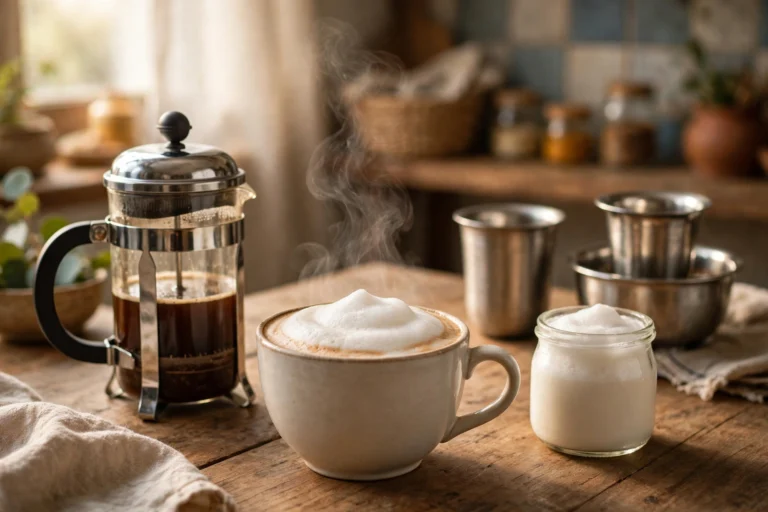
| French press or South Indian filter | Use double your usual coffee for the same water; for decoction, use the first, strongest draw | Good, slightly lighter body; the filter version tastes closest to a masala-coffee base |
The moka pot is the pick if you own one — our best moka pot in India guide compares the pots that do this job well. The instant-coffee version is the honest everyday answer: 2 teaspoons of Nescafé-style instant in 60 ml of hot water, stirred into the cocoa paste, and the drink is 90% of the espresso version in a third of the time. The French-press and filter-decoction versions work too, but keep the coffee strong — a weak base is the single most common reason a homemade mocha tastes like chocolate milk.
How to Froth Milk for a Mocha Without a Steamer
A mocha needs only a light, velvety foam cap, not the thick foam of a cappuccino. Heat the milk to 60–65 °C first, then shake it in a lidded jar for 30–60 seconds, pump it in a French press for the same time, or whisk it briskly in a pan for about a minute. Our guide to frothing milk without a frother compares all five methods — the French press gives the finest foam, the jar is the fastest. Never shake hot milk in a sealed jar: shake it cold and heat it after, or the pressure can pop the lid off.
Variations to Try
Iced mocha: brew the coffee, stir the chocolate into the hot coffee so it dissolves fully, then pour it over a tall glass of ice and add cold milk. Never put raw cocoa powder into cold milk — it will not dissolve. Blend the iced mocha with a handful of ice and you have a mocha frappe.
White mocha: swap the cocoa for 20 g of chopped white chocolate, melted into the hot coffee the same way. Sweeter, creamier, milder — the version for someone who finds dark chocolate too bitter.
Sugar-free: skip the sugar and use unsweetened cocoa with a pinch of salt; the salt lifts the chocolate flavour without sweetness.
Jaggery mocha: replace the sugar with the same quantity of jaggery — its caramel note suits chocolate well. Add it off the heat and stir until dissolved; jaggery boiled in milk can make the milk split. (Our masala coffee uses the same jaggery rule for the same reason.)
Vegan: use a barista-blend oat milk — it froths well and holds its shape. Regular oat milk froths poorly, and almond milk makes a thin foam that fades within a minute, so the barista blend matters more than the method.
Stronger or milder: for a stronger cup, use a triple shot or cut the milk to 150 ml; for a milder cup, use a single shot and 200 ml of milk. Change the coffee, not the chocolate — more cocoa just makes it sweeter, not stronger.
Spiced mocha: add a pinch of cinnamon or a drop of vanilla to the cocoa paste. Cinnamon is the café classic; a tiny pinch of chilli powder is the Mexican-style version, and it works better than it sounds.
Common Mistakes and How to Fix Them
| Mistake | What happens | Fix |
|---|---|---|
| Cocoa stirred straight into milk | Grainy specks that never dissolve | Always make a paste first: cocoa + sugar + a splash of hot water or espresso, stirred smooth before the milk goes in |
| Weak coffee base | Tastes like chocolate milk, not mocha | Double the coffee: 2 shots, 60 ml of moka-pot coffee, or 2 tsp instant in 60 ml water — never a normal-strength cup |
| Milk heated past 70 °C | Scorched taste; foam collapses almost instantly | Heat only until it steams, 60–65 °C; if it bubbles at the edges, it is too hot |
| Too much chocolate sauce | Sickly sweet; the coffee disappears entirely | Start with 1 tablespoon and taste before the milk goes in — you can always add more, you cannot take it out |
| Chocolate melted on high heat | Seizes and turns grainy | Melt chocolate on low heat with the coffee; never boil it |
| Stiff cappuccino foam on top | Drink feels heavy and the chocolate sits underneath | A mocha wants a thin foam cap — stop frothing while the milk is still silky, not stiff |
| Skipping the warm mug | Drink cools before you finish making it | Fill the mug with hot water while you gather ingredients; empty it before the cocoa goes in |
Make-Ahead Chocolate Syrup (2 Weeks in the Fridge)
If you make mochas often, a jar of chocolate syrup in the fridge turns the recipe into a two-minute job. Combine 100 g of cocoa powder, 150 g of sugar, 240 ml of water and a pinch of salt in a small pan. Heat gently, stirring, until the sugar dissolves and the mixture just simmers — about 3–4 minutes. Take it off the heat, stir in 1 teaspoon of vanilla extract, and let it cool. Pour into a clean jar and keep it in the fridge for up to 2 weeks. Use 2 tablespoons per mug in place of the cocoa powder and sugar in Step 2 — no paste needed, since the syrup is already smooth. The same syrup goes on ice cream and into cold milk, so it rarely lasts the full two weeks.
What a Mocha Costs: Home vs Café
A café mocha in India runs ₹270–₹335 — Starbucks lists its Caffè Mocha at ₹270 in Mumbai and ₹330 in Bengaluru, with other outlets in between. The homemade version uses ingredients already in the kitchen, and the maths is short:
| Ingredient (1 mug) | Amount | Price used | Cost |
|---|---|---|---|
| Instant coffee (Nescafé Classic 200 g, ₹450) | 4 g (2 tsp) | ₹2.25/g | ₹9.00 |
| Cocoa powder (Hershey’s 225 g, ₹325) | 7 g (1 tbsp) | ₹1.44/g | ₹10.08 |
| Sugar | 8 g (2 tsp) | ~₹45/kg | ₹0.40 |
| Milk (Amul Gold, ₹80/L) | 180 ml | ₹80/L | ₹14.40 |
| Total — instant-coffee mocha | ~₹34 | ||
| Total — moka-pot mocha | 15 g filter powder instead of instant | ₹1.14/g | ~₹42 |
So one homemade mocha costs about ₹34 — roughly a tenth of the café price — and even the moka-pot version, with real ground coffee, lands at about ₹42. The cocoa is the priciest ingredient per cup, not the coffee: a 225 g pack makes about 30 mochas. Check today’s coffee deals before restocking cocoa or coffee — the per-cup maths above uses prices checked 24–26 November 2026.
Frequently Asked Questions
What is mocha coffee?
A mocha is an espresso drink made with steamed milk and chocolate — a latte with chocolate in it. A café mocha starts with one or two shots of espresso, adds chocolate (cocoa powder or chocolate sauce), fills the cup with steamed milk, and often finishes with whipped cream.
Can I make a mocha without an espresso machine?
Yes. Use very strong coffee instead — a moka pot, AeroPress, or a pour-over brewed at double strength — then heat and froth milk as normal and stir the chocolate into the hot coffee first. Or use 2 teaspoons of instant coffee dissolved in 60 ml of hot water. It will not have true espresso crema, but the flavour balance is close.
How do you make a mocha without special equipment?
You need a way to make strong coffee, a way to heat milk, and something to froth it with — and most kitchens already have all three. Brew strong coffee in a moka pot or with instant coffee, heat the milk in a pan, dissolve cocoa and sugar into a paste with hot water, combine, and froth the milk by shaking it in a jar or whisking it briskly. A mug, a pan and a jar are enough.
What is the difference between a mocha and a latte?
Chocolate. A latte is espresso and steamed milk; a mocha is espresso, steamed milk, and chocolate. Everything else — the milk amount, the thin foam, the cup size — is the same. A mocha tastes richer and sweeter, and carries about 100–150 kcal more per 12 oz cup.
Can I use cocoa powder in an iced mocha?
Yes, if you make a hot paste with espresso first. Stir the cocoa and sugar into the hot coffee until smooth, then pour it over ice and add cold milk. Raw cocoa in cold milk will not dissolve — it just floats in specks.
How do I get a frothy top without a steamer?
Heat the milk to 60–65 °C, then shake it hard in a sealed jar for 30–60 seconds, pump it in a French press for the same time, or whisk it briskly in a pan for about a minute. A mocha only needs a thin, silky foam cap, so any of these is enough.
How much caffeine is in a mocha?
About 126 mg for a double-shot mocha, since each shot of espresso contains about 63 mg of caffeine on average. A single-shot or instant-coffee mocha has roughly half that. The chocolate adds only a trace of caffeine.
How do you make a mocha frappe at home?
Make an iced mocha first — hot coffee, chocolate dissolved in it, poured over ice with cold milk — then blend it with a handful of ice until thick and slushy. Top with whipped cream and a dusting of cocoa.
How many calories are in a mocha?
Roughly 250–400 kcal for a 12 oz café-style mocha with whole milk, sugar and whipped cream. A homemade version with toned milk, no sugar and no cream drops well below that. These are estimates from the ingredient quantities in this recipe, not lab measurements.
Prices checked 24–26 November 2026 and may change — the per-cup cost is a worked-out estimate from those prices, not a fixed price. Café mocha prices (₹270–₹335) are from Starbucks India store listings in November 2026 and vary by city and size. The recipe itself needs nothing more than a mug, a pan and cocoa powder from your kitchen shelf.
Sources
- Coffeeness — How to Make a Mocha
- Bold Brew Co — How To Make The Perfect Homemade Mocha Coffee
- Home Espresso HQ — How to Make a Mocha at Home
- Kicker Coffee — Mocha Recipe
- Crazy Coffee Crave — How to Make a Cafe Mocha at Home
- The Spruce Eats — Mocha Coffee Recipe
- Best Coffee Guide — What Is a Mocha Coffee?
- Breville — Mocha vs Latte
- Cooks & Coffee — Mocha vs Latte
- Third Wave Coffee — How To Brew The Perfect Mocha Coffee
- pricehistory.app — Nescafé Classic Instant Coffee 200 g price
- pricehistory.app — Hershey’s Cocoa Powder 225 g price
- NDTV — Amul Milk Prices To Go Up By Rs 2–4 Per Litre
- magicpin — Starbucks Coffee Price in India